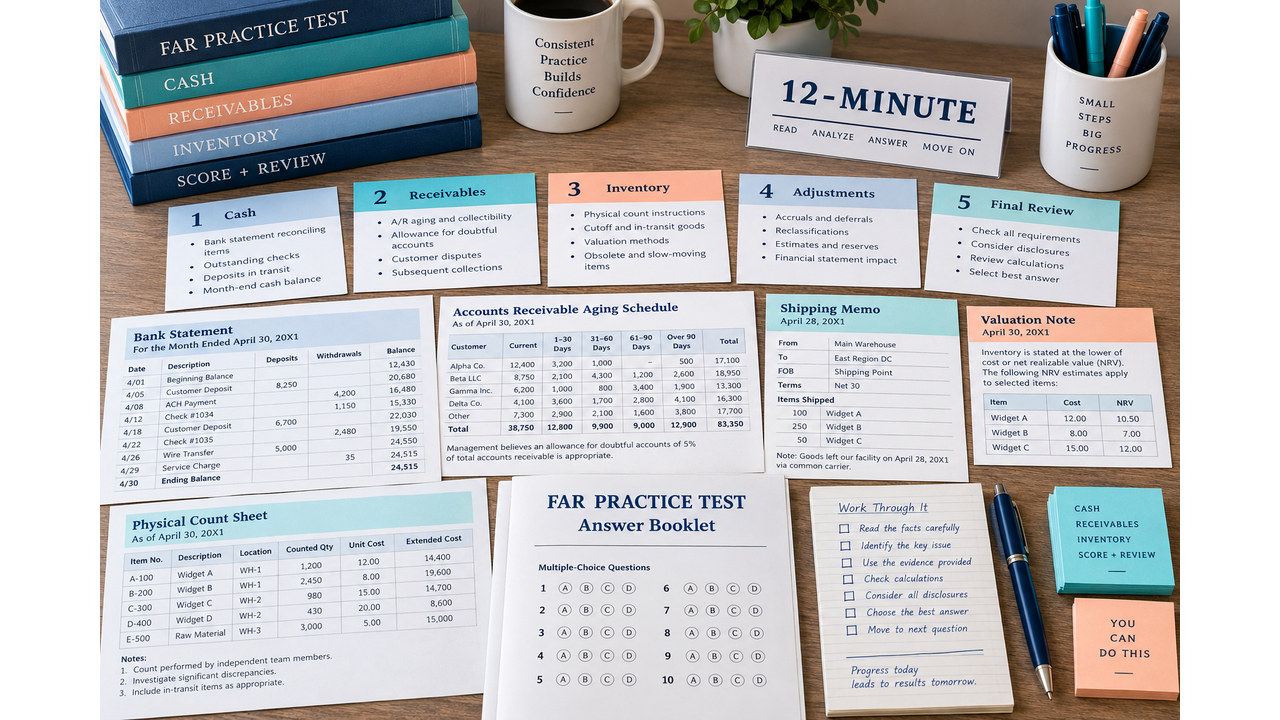

Direct answer: First, use this cash receivables inventory practice test as a 12-minute drill: read the evidence, calculate or classify one decision, commit to an answer, and mark the first field that felt uncertain. Next, check the rationales and use the five-point result to choose the next review block.
Editorial boundary: In addition, this is original study material, not live provider material or a score prediction. The values, answer choices, rationales, visuals, score bands, and retry are written for practice.
These cases use simplified assumptions so one reasoning decision stays visible. Meanwhile, the current AICPA Blueprint sets the exam boundary, while the FASB Codification remains the place to reopen when a real fact pattern changes a reporting date, shipping term, allowance model, cost-flow assumption, or measurement rule. For broader routing, visit the FAR review hub.
How to use the cash receivables inventory practice test
Set a 12-minute timer on paper or in your normal study environment. Do not look up a rule during the first pass. For each case, write the evidence lane, the answer, and one sentence explaining why the nearest distractor loses.
Before starting, keep a blank line for the date or term, the controlling record, and the calculation. That small setup prevents the five cases from blending together when the topic shifts from cash timing to inventory ownership.
- Read: underline the date, owner, shipping term, balance, or measurement input that controls the case.
- Calculate: show the short arithmetic instead of trusting a familiar amount.
- Classify: decide whether the issue is timing, opening balance, ownership, valuation direction, or quantity.
- Score: give yourself one point only when the answer and controlling reason are both correct.
- Review: record the first broken field, not only the final percentage.
As a result, the drill measures reasoning under a small time limit, not speed alone. If a calculation is correct but the evidence lane is wrong, keep the item in review.
Meanwhile, write the reason in your own words before checking the answer. That habit makes the later error review faster and keeps the exercise useful when the numbers change.

Original FAR cash receivables inventory practice test
Study boundary: these five cases are original practice material. Attempt all five before opening an answer. Then write the nearest distractor and the field it changes.

Case A — Reconcile cash timing and book activity
Question: The December 31 bank statement shows $72,400. A deposit of $3,600 is in transit, and checks totaling $1,950 are outstanding. Book cash is $73,810 before recording a $45 service charge and $285 of bank interest. What adjusted cash balance should both sides show?
Answer A and rationale
Answer: $74,050. The bank side is $72,400 + $3,600 − $1,950 = $74,050. The book side is $73,810 − $45 + $285 = $74,050. The nearest distractor puts the deposit in transit on the books or subtracts outstanding checks from the books. The broken field is timing, so the review verb is reconcile.
Case B — Move an allowance to its required target
Question: Gross accounts receivable are $168,000. The allowance has a $2,400 credit balance, and the aging analysis requires an $8,900 credit ending balance. What bad-debt expense and net receivables should the learner report?
Answer B and rationale
Answer: $6,500 expense and $159,100 net receivables. The expense is the movement from the existing credit to the target: $8,900 − $2,400 = $6,500. Net receivables are $168,000 − $8,900 = $159,100. The nearest distractor records $8,900 of expense and ignores the opening credit. The broken field is the opening balance, so the review verb is target.
Case C — Apply a shipping term to ownership
Question: Goods costing $9,600 were shipped to the buyer on December 30 under FOB shipping point and arrived January 2. Under the stated simplified facts, should the buyer include the goods in December 31 inventory?
Answer C and rationale
Answer: Yes, include $9,600. The stated shipping term transfers the relevant ownership risk at shipment, so the buyer includes the goods at year-end even though physical receipt occurs later. The nearest distractor treats arrival date as the only ownership test. The broken field is ownership, so the review verb is cut off.
Case D — Compare cost with NRV
Question: Under the simplified measurement rule supplied for this drill, an inventory group has recorded cost of $64,500 and NRV of $61,800 at year-end. No other complication is supplied. What write-down and ending amount follow?
Answer D and rationale
Answer: $2,700 write-down and $61,800 ending inventory. The stated comparison is $64,500 − $61,800 = $2,700. The nearest distractor keeps cost unchanged merely because no physical count changed. The broken field is measurement direction. In practice, reopen current guidance when the inventory category or measurement rule changes.
Case E — Explain a physical-count variance
Question: The perpetual inventory record supports $52,680 at cost, while the verified physical count supports $52,130. The prompt states no ownership or valuation issue. What amount should the learner investigate?
Answer E and rationale
Answer: Investigate a $550 quantity variance. The difference is $52,680 − $52,130 = $550. Under the stated facts, investigate count accuracy, cutoff, and shortage treatment. Do not convert a quantity difference into a valuation conclusion. The broken field is quantity, so the review verb is verify.
Score the cash receivables inventory practice test
Give one point for each case only when both the answer and the controlling reason are correct. A 0–2 result means rebuild the evidence lane with one case at a time. A 3–4 result means target the first broken field and retry a changed fact. A 5 means maintain the sequence and change one fact to confirm that the reasoning transfers.
Important: this five-point result is a local study signal, not an official CPA score or a pass prediction. It becomes useful only when it tells you what to review next.
Review practice-test errors by field
Next, record the case, answer chosen, evidence lane, controlling rule, nearest distractor, first broken field, and next ten-minute review block. A Case A miss points to bank-versus-book timing. B points to the opening allowance. C points to ownership and cutoff. D points to measurement direction. E points to quantity.
Similarly, if the letter is correct but the reason is missing, keep the case open. The answer is not secure until you can name the record or term that controls it and explain why the nearest distractor loses.
Retry one fact after the practice test
Finally, change only Case A’s service charge from $45 to $120. Keep the bank statement, deposit in transit, outstanding checks, interest, and book cash unchanged.
The adjusted bank balance remains $74,050. The adjusted book balance becomes $73,810 − $120 + $285 = $73,975, so the records differ by $75 until the book-side adjustment is recorded correctly or another fact is found. Therefore, the retry checks whether you preserve the timing lane when one book-side fact changes.
What to write when the timer ends
If the timer ends before every case is complete, stop calculating and write the evidence lane for the unfinished item. For example, a note such as “ownership—shipping term—include at shipment” is more useful than a guess with no reason. After that, reveal the rationale and compare the missing field with your note.
In contrast, if you finish early, use the remaining minute to challenge the nearest distractor. Ask which single fact would make that option correct. This last check catches sign errors, opening-balance errors, and ownership assumptions before they become habits.
Cash receivables inventory practice test FAQ
Should I use a timer?
Yes. Use the 12-minute limit to expose where the reasoning slows down, but do not treat speed as the only measure. After that, review the controlling evidence and the distractor.
What if my arithmetic is right but my score is low?
Check classification first. A correct number on the wrong evidence lane can still lead to a wrong answer when the date, owner, or measurement rule changes.
Can I reuse the five-point result as an exam prediction?
No. It is a local practice signal built from five original cases. Use it to select a review block, not to predict a live result.
Sources and refresh note for the practice test
Use the AICPA CPA Exam Blueprints for current scope and item-type boundaries, the FASB Accounting Standards Codification for current accounting guidance, and the NASBA exam FAQ for current exam-administration questions. These references were checked September 23, 2026. Recheck them before reusing a practice item after a Blueprint or accounting-guidance change.
Next action: Take the five cases once without notes, record the first broken field, then retry Case A after changing only the service charge. Keep the sequence visible: read, calculate, classify, score, review.
Sources and update log
- AICPA CPA Exam Blueprints
- AICPA CPA Exam sample tests
- FASB Accounting Standards Codification
- NASBA CPA Exam FAQ
Refresh trigger: Recheck the live Blueprint or Codification when scope, reporting date, shipping term, allowance method, or measurement rule changes.