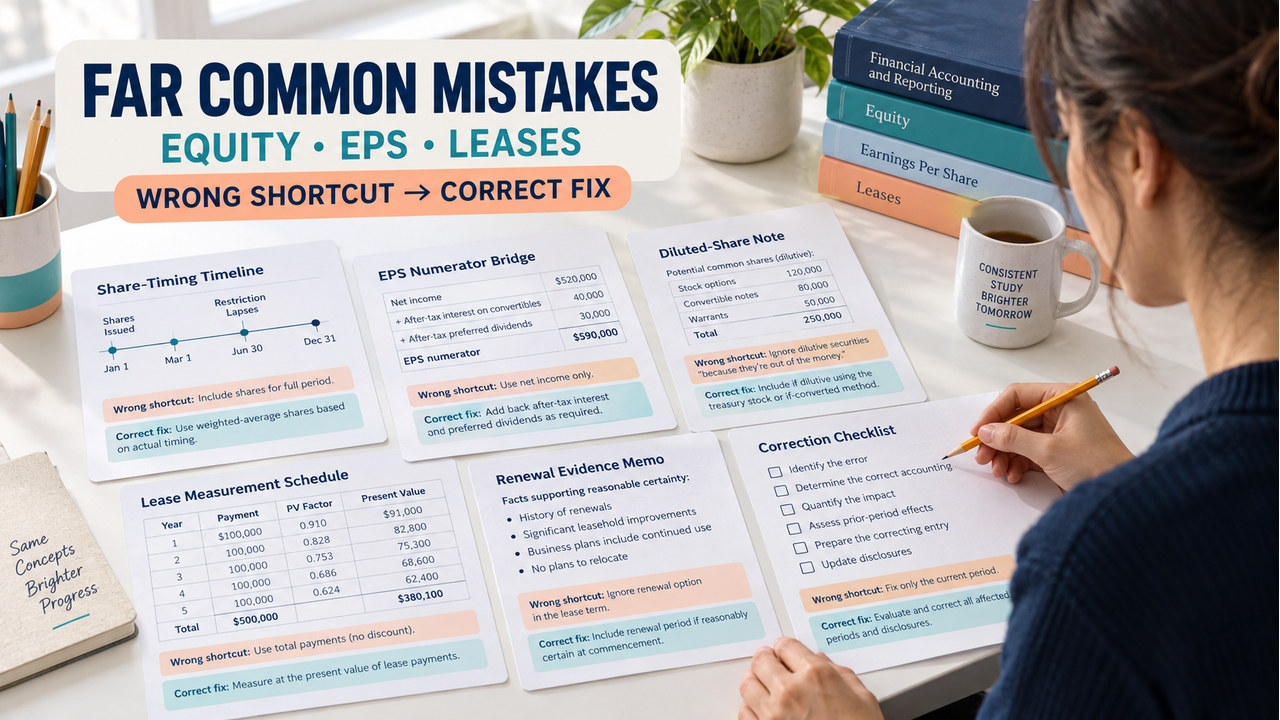

Direct answer: The fastest way to fix FAR equity EPS lease mistakes is to name the wrong shortcut, identify the controlling record, return the requested unit, and write one correction sentence. The six original cases below are study material, not official, recalled, leaked, or score-predictive questions. Attempt each option before opening its explanation.
Scope note: The CPA Exam Prep editorial team checked the scope boundary against the current AICPA Blueprint and saved an equity, EPS, and lease research checkpoint on September 30, 2026. Amounts, documents, options, rationales, visual labels, and study actions are independently authored. A real reporting conclusion still requires current research and complete facts.
For exam scope, reopen the AICPA CPA Exam Blueprint. For technical accounting, use the current FASB Accounting Standards Codification, including Topic 260 for EPS and Topic 842 for leases. The NASBA CPA Exam FAQ covers administration separately.
What FAR equity EPS lease mistakes have in common
Most errors are not caused by one difficult formula. Instead, they begin when a learner uses a nearby number without naming its role. A transaction date is treated as a year-end balance, net income is treated as the EPS numerator, every potential share is added without a dilution check, total lease cash is used instead of present value, or a renewal option is treated as automatic. Each shortcut replaces an evidence field with a guess.
Use five fields before recalculating: source, date, lane, unit, and proof. First, circle the exhibit that controls. Next, mark the reporting date or elapsed period. Then, name the lane—share timing, EPS numerator, diluted shares, lease measurement, or lease term. After that, write the requested output in words. Finally, explain why the nearest distractor fails.
Which record controls?
Which period applies?
Which accounting field?
What must you return?
Why does it follow?
Build a FAR equity EPS lease mistake map
Before looking at an answer, write one line for the shortcut you might be taking. For example, “I used the ending share balance,” “I used net income,” “I added all potential shares,” “I used total lease cash,” “I assumed renewal,” or “I returned a number when the prompt asked for a repair.” Next, place the controlling record beside that line. This small contrast makes the correction visible.
The map should also preserve the useful fact. Do not erase the first attempt. Mark the date, numerator, denominator, present value, renewal evidence, or requested unit that broke first. Then retry one fact only. A changed fact tells you whether the rule was understood or merely memorized.

Six FAR equity EPS lease mistakes to correct
Each case below states the tested skill, assumptions, and difficulty before the question. Every explanation names the wrong shortcut and ends with a next action.
1. Losing transaction dates in weighted-average shares
Tested skill: weight common shares by time. Assumptions: ignore stock splits and preferred dividends, and use a simplified annual calculation. Difficulty: foundational. The share register shows 100,000 common shares on January 1, an issuance of 20,000 on April 1, and a repurchase of 10,000 on October 1.
Question: Which weighted-average share count should the simplified answer use?
- A. 100,000
- B. 105,000
- C. 112,500
- D. 120,000
Reveal the answer and reasoning
Answer: C. The register shows 100,000 shares for three months, 120,000 for six months, and 110,000 for three months. Therefore, 25,000 + 60,000 + 27,500 = 112,500. Option A uses the opening balance, while D ignores the repurchase. Common mistake: treating the ending balance as if it existed all year. Next action: draw the transaction date line before calculating any EPS amount.
2. Using net income as the basic EPS numerator
Tested skill: separate income available to common shareholders from reported net income. Assumptions: preferred dividends are cumulative for this simplified exercise, and no other adjustments apply. Difficulty: calculation setup. Net income is $480,000, preferred dividends are $30,000, and weighted-average common shares are 225,000.
Question: Which basic EPS amount is closest?
- A. $1.87
- B. $2.00
- C. $2.13
- D. $2.27
Reveal the answer and reasoning
Answer: B. Income available to common shareholders is $480,000 − $30,000 = $450,000. Accordingly, $450,000 ÷ 225,000 = $2.00. Option C divides net income by shares and leaves the preferred dividend adjustment out. Common mistake: copying the first income number into the numerator. Next action: write a numerator bridge with net income, preferred dividends, and income available to common.
3. Adding every potential share to diluted EPS
Tested skill: control the diluted denominator. Assumptions: the stated instrument is dilutive and creates no numerator adjustment. Difficulty: denominator control. Basic income available to common shareholders is $450,000, basic weighted-average shares are 225,000, and the tested instrument adds 25,000 incremental shares.
Question: Which diluted EPS amount is closest?
- A. $1.80
- B. $2.00
- C. $2.22
- D. $2.50
Reveal the answer and reasoning
Answer: A. The diluted denominator is 225,000 + 25,000 = 250,000 shares. Thus, $450,000 ÷ 250,000 = $1.80. Option B retains the basic denominator. Common mistake: adding every potential share without separating basic shares, incremental shares, and the stated dilutive assumption. Next action: write those three denominator fields on separate lines.
4. Using total lease cash instead of present value
Tested skill: identify initial lease measurement. Assumptions: four annual payments of $100,000 occur at each year-end, the stated present value is the only adjustment, and the prompt asks for the liability at commencement. Difficulty: measurement. The schedule gives a present value of $354,600 and undiscounted payments of $400,000.
Question: Which amount best describes the initial lease liability?
- A. $100,000
- B. $300,000
- C. $354,600
- D. $400,000
Reveal the answer and reasoning
Answer: C. The initial liability is based on the present value, not the first payment or the undiscounted total. In contrast, option D adds the four cash payments without discounting. Common mistake: treating lease cash as the same as the commencement measurement. Next action: place present value, payment timing, and total cash in separate fields on the schedule.
5. Treating a renewal option as automatic or irrelevant
Tested skill: connect lease-term evidence to measurement. Assumptions: the option is evaluated at commencement and the specialized improvements cannot be moved economically. Difficulty: judgment. The lease has a five-year base term and a two-year renewal option. Management appears reasonably certain to renew because the replacement site would cost much more and the improvements are specialized.
Question: What is the best corrective action?
- A. Ignore the renewal because no cash has been paid yet
- B. Include the option period automatically without reviewing evidence
- C. Write the reasonable-certainty evidence and test one changed fact
- D. Replace the lease question with another EPS calculation
Reveal the answer and reasoning
Answer: C. The lease-term conclusion should be tied to evidence, and removing the specialized improvements is a meaningful retry. Option B skips the judgment step, while A and D do not answer the lease-term problem. Common mistake: treating an option as a fixed answer instead of an evidence-based conclusion. Next action: keep the renewal memo beside the term schedule and write the fact that would change the conclusion.
6. Returning a number when the prompt asks for a correction
Tested skill: identify the requested unit and first broken field. Assumptions: the prompt asks for a next review action, not a new accounting number. Difficulty: transfer. The learner selected the correct EPS numerator but used the undiscounted lease total and skipped the renewal evidence note.
Question: Which next action is most useful?
- A. Repeat all six cases without notes
- B. Memorize the final answers again
- C. Build a present-value schedule, then test the renewal conclusion with one changed fact
- D. Increase question volume before repairing the broken field
Reveal the answer and reasoning
Answer: C. The first broken lane is lease measurement and term evidence, not the EPS numerator. Consequently, a narrow schedule plus a changed-fact retry is more useful than more volume. Common mistake: answering with a familiar number when the task asks what to do next. Next action: write the requested unit above the answer area before selecting a formula.
Use a correction matrix for FAR equity EPS lease mistakes
After the first attempt, write the correction sentence before rereading the whole chapter. The sentence should name the wrong shortcut, the controlling evidence, and the next action. The table is a compact study scaffold; it is not a replacement for current Codification research when facts change.
| Mistake lane | Controlling evidence | Correction sentence |
|---|---|---|
| Date weighting | Share register and transaction dates | Weight each balance for its period; do not use the ending balance all year. |
| EPS numerator | Net income and preferred dividends | Build income available to common before dividing by shares. |
| Diluted shares | Incremental potential shares and stated assumption | Separate basic shares from the tested dilutive increment. |
| Lease PV | Payment timing and present value | Use commencement present value, not total undiscounted cash. |
| Renewal evidence | Specialized improvements and replacement-site facts | Write the evidence and test one changed fact. |
| Requested unit | Prompt verb: calculate, classify, explain, or retry | Return the requested action before adding another formula. |
For a current conclusion, reopen the authoritative source. Use the AICPA Blueprint for scope and the Codification for technical accounting. These original cases show a correction method; they do not establish a universal answer for a different fact pattern.
Route a FAR equity EPS lease mistake result to a next drill
Record the result only after writing a correction sentence for every case. Count a point only when the answer, evidence, period, requested unit, and rejected shortcut are visible. If the option is right for the wrong reason, route it to repair.

For 0–2, rebuild the mistake map and repeat the two weakest lanes. Next, for 3–4, target the first broken field with two changed facts. Finally, for 5–6, transfer one case to a new fact pattern and explain why the original shortcut still fails. This is a local study signal, not an official score or pass prediction.
Log the first break in the FAR equity EPS lease mistakes
Classify the earliest broken field, not the last arithmetic error. A source break means you used the wrong record. Date errors occur when you skip an issuance, repurchase, payment timing, or reporting period. The numerator break means you failed to remove preferred dividends. Next, a denominator break means you added or omitted the tested incremental shares. Measurement errors appear when you use cash instead of present value. Lease-term errors arise when you assume renewal without evidence. Finally, a unit break means you returned a number when the task asked for a correction.
Write the break as “I used ___, but the case asked for ___.” Then change one fact only: move the issuance to July 1, change preferred dividends to $20,000, remove the potential shares, change lease payments to the beginning of each year, remove specialized improvements, or ask for a next action instead of an amount. A controlled change tests transfer.
Retry one FAR equity EPS lease mistake with one changed fact
Use the renewal case as the judgment retry. Keep the five-year base term, but remove the specialized improvements and ask whether the evidence still supports the two-year option. Do not reuse the old conclusion automatically. Separate the evidence field from the measurement field and explain why the changed fact moves—or does not move—the result.
Next, choose the lane with the weakest correction sentence. When $2.00 was correct but the preferred-dividend bridge was missing, do a numerator drill. If 112,500 was correct but the dates were unlabeled, redo the share timeline. For a $354,600 answer without a payment schedule, rebuild the lease measurement exhibit.
Refresh FAR equity EPS lease mistakes before reuse
Before reusing this FAR equity EPS lease mistakes guide, reopen the AICPA CPA Exam Blueprints for scope and the FASB Codification for the technical boundary. Use Topic 260 for EPS research and Topic 842 for lease research. These links set boundaries; they do not change the original cases.
Finally, recheck every number, date, assumption, image label, and answer reveal. Keep the article clearly labeled as original study material. If a real prompt supplies a different standard, jurisdiction, reporting date, or contractual term, stop the shortcut and research the current source.
FAR equity EPS lease mistakes FAQ
Are these official CPA Exam questions?
No. They are original simplified study cases designed to expose common evidence and unit errors.
Which mistake should I fix first?
Fix the earliest broken field: source, date, lane, unit, or proof. Do not begin with the last arithmetic line automatically.
How should I use a low local result?
Use the first weak mistake lane to choose a narrow rebuild or target drill.
Why separate lease cash from lease present value?
The requested measurement at commencement is not the same as the undiscounted total of future cash payments.