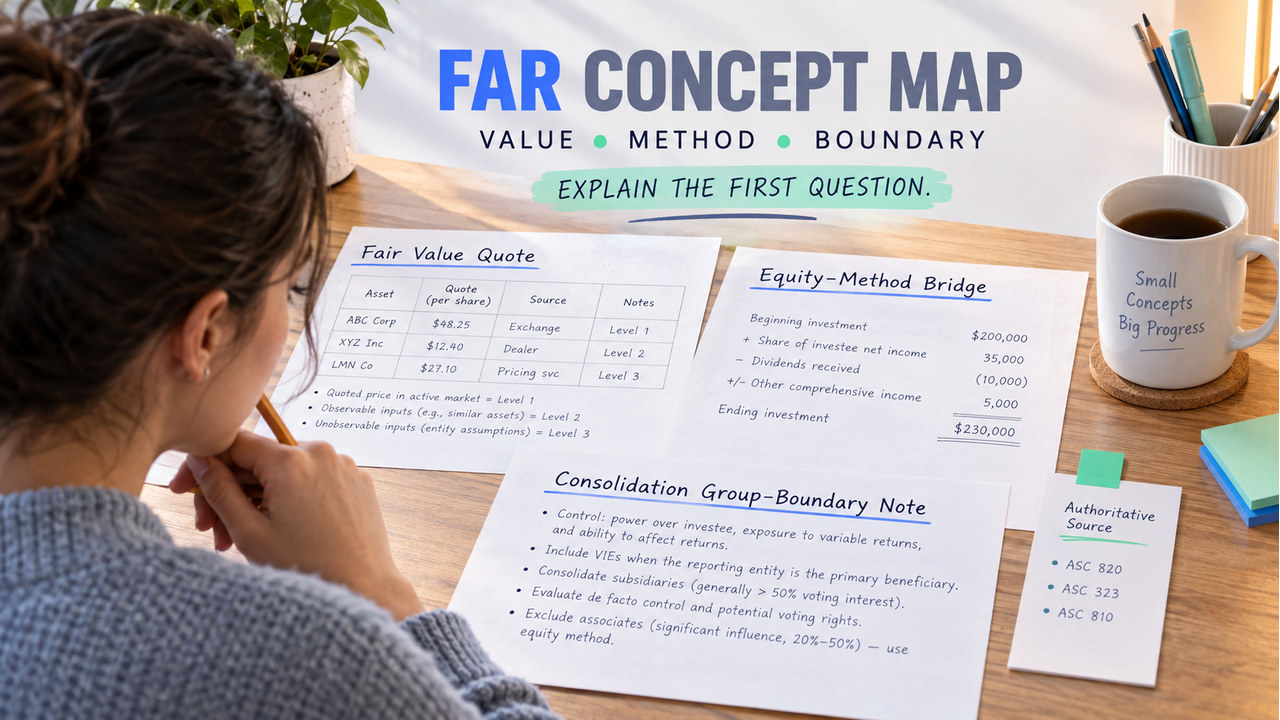

Direct answer: FAR financial instruments explained starts with three different questions. Fair value asks which measurement-date evidence controls. The equity method asks how the investment balance moves. Consolidation asks what remains inside the reporting group. Name the lane first, then calculate or research only what that lane requires.
Scope note: This original concept guide is for US CPA candidates and uses the current AICPA Blueprint as its October 2, 2026 scope checkpoint. The amounts, explanations, practice cases, and visual map are independently authored. A live accounting conclusion still requires complete facts and current research.
For scope, reopen the AICPA CPA Exam Blueprint. Additionally, use the current FASB Accounting Standards Codification and the routes for Topic 321, Topic 323, Topic 810, and Topic 820 when a fact changes. The NASBA CPA Exam FAQ covers administration, while the FAR review hub can hold the wider study sequence.
FAR financial instruments explained
These topics feel connected because one fact pattern can mention an instrument, an investment, and a group transaction. The accounting question still changes by lane. A fair-value question centers on evidence at a measurement date. An equity-method question centers on the investor’s carrying-amount bridge. A consolidation question centers on the reporting boundary and internal effects.
Use this order when the prompt mixes concepts: identify the instrument or relationship, mark the reporting date, name the relevant lane, and write the first question that lane answers. That sequence prevents an ownership percentage from replacing a rights analysis or a forecast from replacing a supported quote.
This is an original explainer with simplified practice facts. It is not an official, recalled, leaked, or exam-memory question bank. Treat every number as a learning device, not as a complete technical conclusion.
Start with the first question
Fair value: What evidence is available at the measurement date, and what input is most directly observable? Equity method: What was the opening balance, what share of income belongs to the investor, and what distributions or other stated movements change the balance? Consolidation: What is inside the group, and which internal effects remain in the combined statements?
The FAR financial instruments explained map keeps those first questions visible when a prompt mixes several accounting facts. It also gives each number a home before any calculation begins.
- Identify: circle the instrument, investment, or group fact.
- Route: write FAIR VALUE, EQUITY METHOD, or CONSOLIDATION beside it.
- Compute: use only the numbers owned by that route.
- Research: reopen the applicable source when the facts exceed the simplified example.
Fair value: identify the measurement input
Fair-value questions often hide the key issue inside a list of plausible data. A supported quote for an identical instrument at the measurement date can be more important than a detailed internal forecast. The first workpaper should therefore record the date, the instrument, the evidence source, and the reason the selected input fits the stated facts.
A useful study sentence is: “The measurement line follows the strongest stated evidence for this date; the other data becomes a research question or a distractor.” That sentence does not decide every live accounting issue, but it stops the common habit of choosing the most elaborate number.
- Write the date beside the quote or other input.
- Separate observable evidence from an internally generated estimate.
- Record what fact would make you reopen the current Codification.
Equity method: roll forward the investment
An equity-method study bridge makes the movement visible. Begin with the opening investment balance. Add the investor’s share of the investee’s income when the simplified case calls for it. Subtract a stated cash distribution in this learning example. Then list any other movement separately instead of hiding it inside a net amount.
For example, an opening balance of $300,000, a $36,000 share of income, and a $9,000 distribution produce a simplified ending balance of $327,000. The point is not memorizing one formula. The point is writing the sign before the amount so the distribution does not accidentally increase the balance.
- Opening: copy the beginning carrying amount.
- Income: show the investor share as a separate movement.
- Distribution: show the cash movement with its sign.
- Recheck: change one amount and confirm only the expected line moves.
Consolidation: draw the boundary first
Consolidation questions become clearer when the group boundary is drawn before the adjustment. Ask which amount remains inside the reporting group at period end. Internal profit may require attention only to the portion tied to inventory or another item that remains inside the group. The outside portion is not treated as though it still sits inside the combined statements.
In a simplified example, internal profit is $20,000 and 25% of the transferred inventory remains inside the group. The amount to address is $5,000. A different percentage or a different fact pattern would require a new analysis. The study habit is stable: draw the boundary, mark the remaining percentage, and then apply the amount.
- Sketch the parent, subsidiary, or reporting group described.
- Mark the portion still inside at the reporting date.
- Separate internal effects from amounts already outside the group.
Connect the three lanes in one worked example
Use one compact fact set to see how the lanes stay separate. The case supplies a supported $108 quote for an identical instrument at the measurement date. It also gives an opening investment of $300,000, a $36,000 income share, and a $9,000 distribution. Finally, it states $20,000 of internal profit with 25% of the transferred item still inside the group.
First, route the $108 quote to fair value and record why the date and evidence matter. Next, route the three investment amounts to the equity-method bridge: $300,000 + $36,000 − $9,000 = $327,000. Finally, route the internal profit and remaining percentage to the consolidation boundary: $20,000 × 25% = $5,000. The numbers coexist, but they do not share one formula.

That separation is the transferable skill. If the quote changes, revisit the measurement line. When the distribution changes, revisit the bridge. If the remaining percentage changes, revisit the group effect. A changed fact should point to a changed line, not trigger a complete reread.
Test the three-lane worked example
Before opening the explanation, label each fact as fair value, equity method, or consolidation, then write the first calculation or boundary question.
Reveal the answer
Answer: The quoted price belongs to the fair-value lane, the $300,000 + $36,000 – $9,000 bridge belongs to the equity-method lane, and 25% of $20,000 belongs inside the consolidation boundary.
Compare your process with the reasoning shown above.
Original practice: fair-value evidence
Tested skill: selecting the first measurement input. Difficulty: foundation. Assumption: an identical instrument has a supported $108 quote at the stated measurement date, while an internal forecast is also provided. Question: Which input should control the first simplified measurement line?
- A. The forecast because it contains more assumptions
- B. The prior carrying amount because it is already recorded
- C. The supported measurement-date quote
- D. The average of the quote and forecast
Reveal the explanation after your attempt
Best answer: C. The supported quote is the stated measurement-date evidence in this simplified case. The forecast may be a distractor because it looks detailed. Why the others fail: a prior balance does not answer the current measurement question, and averaging inputs invents a method not supplied by the facts. Next action: rewrite the fact with a different date and identify the research question that would reopen the source.
Original practice: equity-method bridge
Tested skill: carrying-amount movement. Difficulty: foundation. Assumption: opening investment is $300,000, the investor’s share of income is $36,000, and a $9,000 cash distribution is the only stated distribution. Question: Which simplified ending balance fits?
- A. $327,000
- B. $345,000
- C. $273,000
- D. $309,000
Reveal the explanation after your attempt
Best answer: A, $327,000. Use $300,000 + $36,000 − $9,000. Why the others fail: $345,000 adds the distribution, $273,000 subtracts the income share, and $309,000 omits one movement. Next action: change the distribution to $12,000 and recompute only the ending balance.
Original practice: consolidation boundary
Tested skill: identifying the amount tied to the group boundary. Difficulty: intermediate. Assumption: internal profit is $20,000 and 25% of the transferred inventory remains inside the group at period end. Question: What simplified amount remains to address?
- A. $5,000
- B. $15,000
- C. $20,000
- D. $80,000
Reveal the explanation after your attempt
Best answer: A, $5,000. Multiply $20,000 by the 25% that remains inside the group. Why the others fail: $15,000 uses the outside percentage, $20,000 ignores the boundary, and $80,000 reverses the relationship. Next action: change the remaining percentage and state which group amount changes.
Use a research route when facts change
A study example becomes unsafe when a learner treats its shortcut as a universal conclusion. Reopen the current source when the instrument is different, the measurement date changes, the rights arrangement is incomplete, the reporting group changes, or another standard may control. The FASB Codification is the technical starting point for that research; the AICPA page sets the exam-scope boundary.
Keep the research note concrete. Write the changed fact, the accounting question it creates, and the source route you will check. Avoid writing “review investments” as the next action. A better note is “recheck the measurement input for this date” or “confirm which internal amount remains inside the group.”
Run the concept-explanation checklist
Before moving to a new question, complete four lines. INPUT confirms the decisive fact and date. METHOD confirms the lane and sign or measurement step. BOUNDARY confirms what remains inside or outside. RESEARCH records the fact that would require a current source.

- Input: circle the quote, balance, movement, or percentage.
- Method: label fair value, equity method, or consolidation.
- Boundary: mark the reporting group or measurement date.
- Research: write the next question before guessing.
Avoid cross-lane mix-ups
The fastest review is often a separation exercise. Avoid using an ownership percentage as the entire answer to a relationship question. A forecast also should not replace a supported quote merely because it has more detail. Never add a distribution to an equity-method balance. Do not carry all internal profit forward when only a stated portion remains inside the group.
When a prompt contains all three lanes, draw three short headers on scratch paper. Under each header, place only the facts that belong there. Then explain why each fact is excluded from the other two lanes. This forces the concept map to do work instead of becoming another definition list.
Keep the explanation current
As a final check, reopen the AICPA CPA Exam Blueprint and the FASB Codification before reuse. Topics 321, 323, 810, and 820 are research routes, not substitutes for complete facts. This original guide does not assign official weights, predict an exam result, or replace current technical research.
Finally, check every amount, label, link, and source note. If a live fact changes the instrument, date, method, rights, or group boundary, pause the shortcut and reopen the current source.
FAR financial instruments explained FAQ
What should I identify first?
Identify the lane: fair value, equity method, or consolidation.
Why keep the lanes separate?
Each lane answers a different first question and uses a different workpaper movement.
Are the examples official questions?
No. They are original simplified practice cases with stated boundaries.
When should I research further?
Research when the instrument, date, rights, group boundary, or applicable route changes.