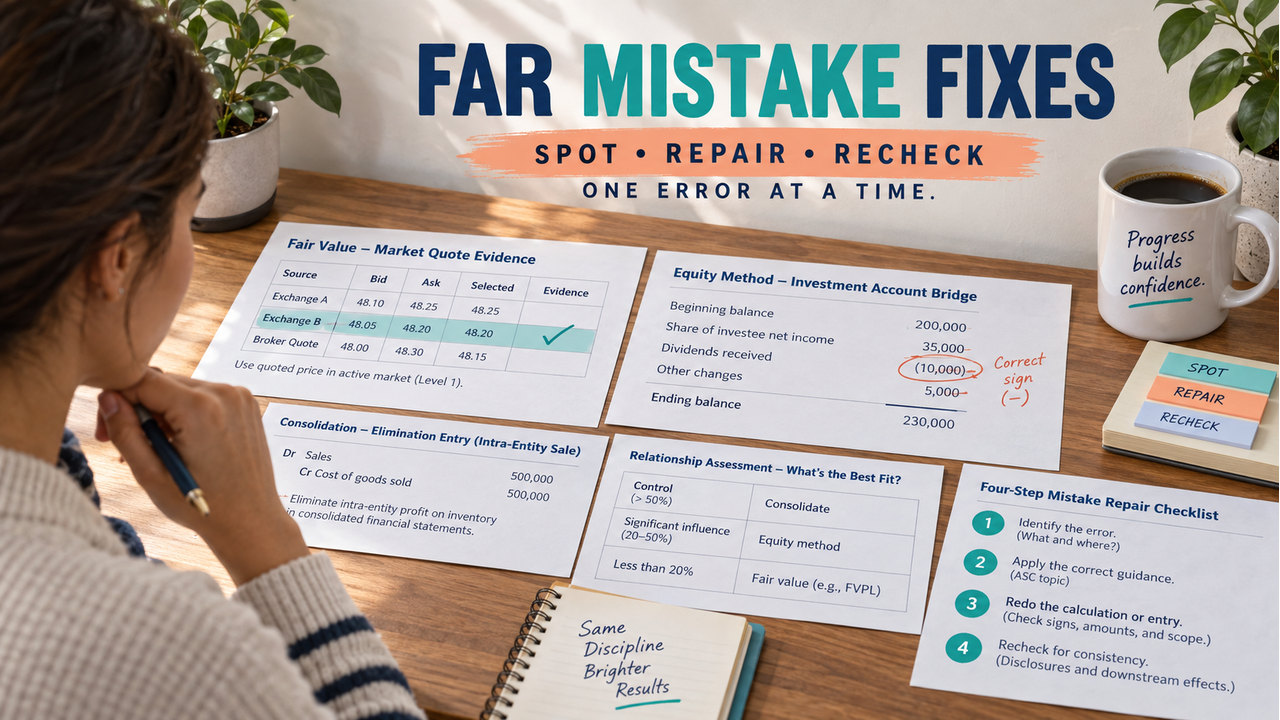

Direct answer: The most useful way to fix FAR financial instruments mistakes is to classify the broken field before rereading the whole topic. Check the evidence, sign, boundary, or relationship fact; write the minimum repair; then recheck one changed fact. That sequence turns a wrong answer into a specific study action.
Scope note: This original mistake-and-repair guide is for US CPA candidates and uses the current AICPA Blueprint as its October 2, 2026 scope checkpoint. The examples, amounts, correction cards, and checklist are independently authored. A live accounting conclusion still requires complete facts and current research.
For scope, reopen the AICPA CPA Exam Blueprint. Additionally, use the current FASB Accounting Standards Codification and the routes for Topic 321, Topic 323, Topic 810, and Topic 820 when a fact changes. The NASBA CPA Exam FAQ covers administration, while the FAR review hub can hold the wider study sequence.
FAR financial instruments mistakes
Most mistakes in this cluster come from moving a true fact into the wrong workpaper. A quoted price becomes a forecast. A distribution gets added instead of subtracted. An internal profit is treated as external. Or an ownership percentage is used as a conclusion before the stated rights are read.
First, name the lane. FAIR VALUE needs evidence and a measurement date. EQUITY METHOD needs an opening balance, the investor’s share of income, distributions, and other stated movements. CONSOLIDATION needs the group boundary and internal effects. A relationship question needs rights and missing facts, not a shortcut. Then, repair only the broken field.
This is an original correction guide, not an official, recalled, leaked, or exam-memory question bank. Use the worked examples after attempting each mini-case. Meanwhile, keep your error note narrow enough that the next replay can show whether the repair worked.
Spot the four failure fields
Use four labels when reviewing a miss: EVIDENCE, SIGN, BOUNDARY, and RELATIONSHIP. EVIDENCE asks whether the input is observable and belongs to the stated date. SIGN asks whether a movement increases or decreases the line. BOUNDARY asks what remains inside the reporting group. RELATIONSHIP asks which stated rights control the route.
- Evidence miss: a supplied quote loses to an unsupported forecast.
- Sign miss: a distribution or elimination is added in the wrong direction.
- Boundary miss: the full internal profit is carried forward even though part was sold outside the group.
- Relationship miss: ownership percentage replaces analysis of stated rights.
Map the failure before fixing it
Write the wrong line, the reason it looked plausible, and the smallest repair. Circle the evidence source and date for a measurement miss. Mark the movement sign for a bridge miss. Next, mark the portion still inside the group for a consolidation miss. Finally, write the missing right or arrangement for a relationship miss.

- Why it fails: state the wrong input, sign, boundary, or shortcut.
- Minimum repair: rewrite one line rather than restarting the entire chapter.
- Recheck: change one fact and repeat the same skill.
Mistake 1 — Using a forecast over a supported quote
Tested skill: fair-value evidence. Difficulty: foundation. Assumption: the case supplies a supported measurement-date quote for an identical instrument and also includes an internal forecast. Question: Which input should control the first simplified measurement line?
- A. The internal forecast because it contains more detail
- B. The prior carrying amount because it is already recorded
- C. The supported quote for the identical instrument
- D. The average of the quote and forecast
Reveal the correction after your attempt
Best answer: C. The supported quote is the stated measurement-date evidence. The forecast may be a distractor because it feels analytical, but extra detail does not override the supplied evidence. Repair: circle the input and date before writing any calculation. Recheck: remove the quote and write the new research question instead of silently substituting a forecast.
Mistake 2 — Flipping the equity-method sign
Tested skill: carrying-amount bridge. Difficulty: foundation. Assumption: opening investment is $300,000, the investor’s share of income is $36,000, and a $9,000 cash distribution is the only stated distribution. Question: Which ending balance fits?
- A. $327,000
- B. $345,000
- C. $273,000
- D. $309,000
Reveal the correction after your attempt
Best answer: A, $327,000. Use $300,000 + $36,000 − $9,000. The distribution reduces the investment balance in this simplified bridge. Repair: write plus for the income share and minus for the distribution before inserting amounts. Recheck: change the distribution to $12,000 and recompute only the ending balance.
Mistake 3 — Ignoring the group boundary
Tested skill: remaining internal profit. Difficulty: intermediate. Assumption: internal profit is $20,000 and 25% of the transferred inventory remains inside the group at period end. Question: What simplified amount remains to address?
- A. $5,000
- B. $15,000
- C. $20,000
- D. $80,000
Reveal the correction after your attempt
Best answer: A, $5,000. Multiply $20,000 by the 25% still inside the group. The common error carries the full profit forward and ignores the outside portion. Repair: draw a boundary around the group and label the remaining percentage. Recheck: change the remaining percentage while keeping internal profit constant.
Mistake 4 — Using ownership as the conclusion
Tested skill: relationship analysis. Difficulty: intermediate. Assumption: the case states 40% voting ownership and a right to appoint two of five governing-body members, with no other directing right. Question: What should the first sentence of the analysis do?
- A. Select a method from 40% alone
- B. Select fair value automatically because ownership is below 50%
- C. Map the stated rights and the applicable route before concluding
- D. Skip the analysis because the investee is separate
Reveal the correction after your attempt
Best answer: C. The ownership percentage is one fact, not the entire conclusion. The appointment right and any missing arrangement must be routed to the applicable research question. Repair: list the stated rights and the missing fact separately. Recheck: change one right and explain whether the research route changes.
Run the corrective checklist
After correcting a miss, run four checks. FACT asks whether the input, date, percentage, or right is copied correctly. FORMULA asks whether the arithmetic and sign match the movement. BOUNDARY asks whether the amount belongs inside or outside the group. REPLAY asks whether one changed fact produces the expected change.

- Fact: circle the decisive input.
- Formula: write the movement before the amount.
- Boundary: mark the group or relationship limit.
- Replay: change one fact and name the next action.
Practice the repair in order
A correction becomes durable when the learner can explain the order of operations. First, copy the decisive fact without interpreting it. Next, name the workpaper that owns the fact. Then, write the smallest formula or route statement. Finally, compare the result with the nearest distractor and record the changed-fact replay.
- Copy: preserve the date, quote, movement, boundary, or right exactly as stated.
- Assign: place the fact in fair value, equity method, consolidation, or relationship analysis.
- Repair: replace only the broken input, sign, percentage, or route.
- Transfer: change one fact and explain what should move and what should remain constant.
This order also keeps review efficient. A learner with an evidence miss does not need another ten bridge questions first. A learner with a sign miss does not need to reread every definition. Instead, the next item should preserve the skill and change the broken field so the repair can be observed.
Choose the next review action
If the miss was EVIDENCE, reopen the relevant fair-value route and compare the input hierarchy. For a SIGN miss, write a two-line bridge with plus and minus labels. When the miss is BOUNDARY, redraw the group and separate outside from inside amounts. Finally, for RELATIONSHIP, list rights, arrangements, and the missing fact before selecting a method.
Next, use this FAR financial instruments mistakes guide to test one changed fact rather than another mixed set. A corrected quote should change the measurement line. Meanwhile, a corrected distribution should change the investment balance. Similarly, a corrected remaining percentage should change the elimination amount. Finally, a corrected right should change the research question only when the stated facts support that change.
Keep the correction guide current
As a final check, reopen the AICPA CPA Exam Blueprint and the FASB Codification before reuse. Topics 321, 323, 810, and 820 are research routes, not substitutes for complete facts. This original guide does not assign official weights, predict an exam result, or replace current technical research.
Finally, check every amount, option, image label, and repair instruction. If the live fact changes the instrument, reporting date, market evidence, voting arrangement, or internal transaction, pause the shortcut and reopen the current source.
FAR financial instruments mistakes FAQ
What is the fastest way to classify a miss?
Label it EVIDENCE, SIGN, BOUNDARY, or RELATIONSHIP before rereading the topic.
Should I redo the entire question set?
No. Repair the broken field and replay one changed fact first.
What if the facts are incomplete?
Write the open question and the research route instead of inventing a conclusion.
Are these official questions?
No. They are original simplified practice cases bounded by official scope and current research sources.