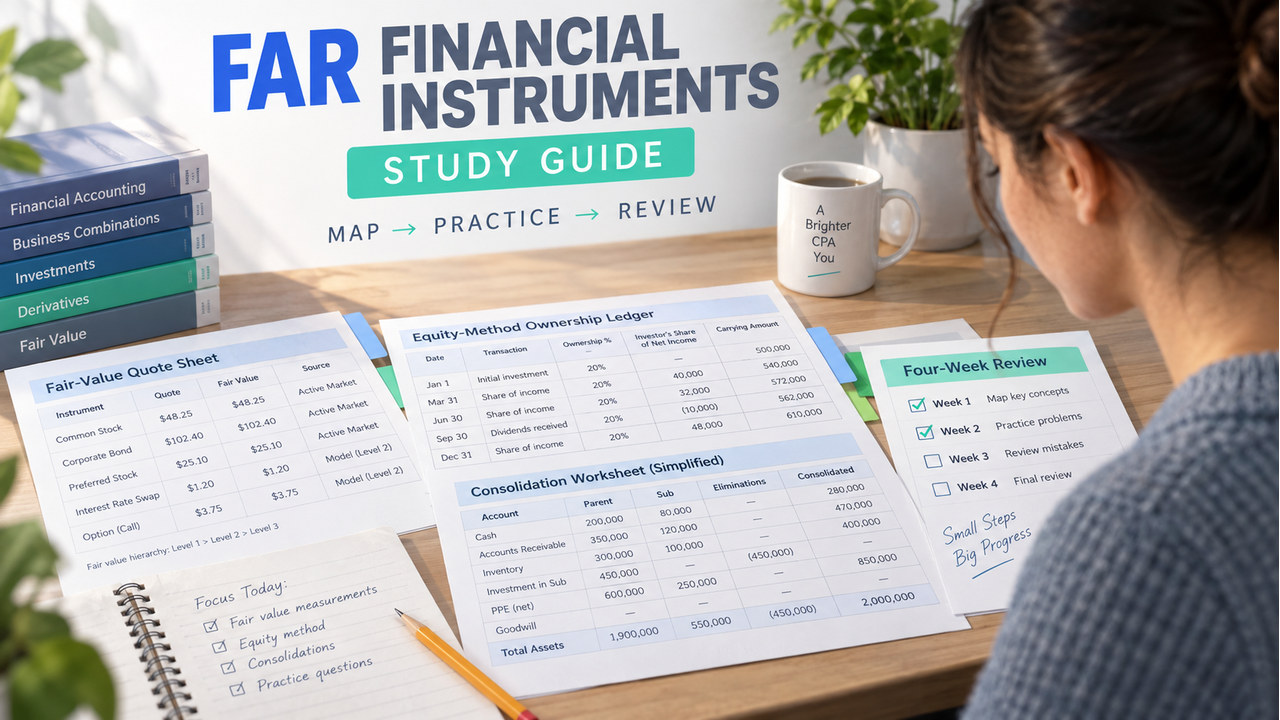

Direct answer: Use this FAR financial instruments study guide as a four-week map: identify the tested boundary, separate measurement from relationship, practice consolidation eliminations, and retry one changed fact. The guide uses original simplified examples and does not reproduce official, recalled, or leaked exam questions.
Editorial scope note: This learning page serves US CPA candidates and uses the current AICPA Blueprint as its October 2, 2026 scope checkpoint. Our editorial packet independently authors the amounts, cases, explanations, visual labels, and study sequence. A real reporting conclusion still requires complete facts and current research.
For scope, reopen the AICPA CPA Exam Blueprint. For technical research, use the current FASB Accounting Standards Codification, including routes for Topic 321, Topic 323, Topic 810, and Topic 820. The NASBA CPA Exam FAQ covers administration, while the FAR review hub supports broader sequencing.
Build the FAR financial instruments study guide
Begin with three questions: which measurement does the case request, which relationship exists, and which group-level adjustment does the case need? Fair value starts with market evidence and the requested unit. The equity method starts with influence and a carrying-amount bridge. Consolidation starts with control and then asks which internal effects require elimination. This separation keeps familiar formulas from deciding the lane too early.
Next, write a one-line scope boundary from the Blueprint and a one-line technical research route from the Codification. Do not treat a study sequence as an official exam weighting. Instead, use it to decide which fact pattern deserves the next block. If a live problem changes the instrument, voting arrangement, market evidence, or reporting date, reopen the relevant source.
Finally, keep a review card with four fields: controlling fact, requested output, nearest shortcut, and next retry. A correct answer with a weak explanation stays on the card because it may not transfer. In contrast, a wrong answer with a clearly named broken field gives you a narrow repair target.
Map the three FAR accounting lanes
Use the map below before solving a mixed set. First label the lane. Next underline the fact that controls it. Then write the smallest bridge that produces the requested output. Also record the error type if the answer still feels uncertain.

| Lane | Controlling fact | Smallest bridge | First review action |
|---|---|---|---|
| Fair value | Market evidence and unit | Units × supported price | Repeat one measurement case |
| Equity method | Influence and investor share | Opening + share − distributions | Separate income from cash |
| Consolidation | Control and internal counterparty | Combine, then eliminate | Circle the group boundary |
Follow a four-week review route
A study guide should tell you what to do next, not only what the terms mean. Therefore, use one primary output per week. During the first week, make a boundary and vocabulary pass. In the second week, isolate measurement. During week three, test influence, control, and internal activity. In week four, mix the lanes and require a changed-fact retry.

- Week 1 — Scope: annotate the Blueprint route, define fair value, influence, control, observable evidence, and elimination, and make one example for each.
- Week 2 — Measure: complete unit-times-price cases and equity carrying-amount bridges. Write whether each number is an input, a result, income, or distribution.
- Week 3 — Relate: classify control before calculating. Then identify the internal counterparty and the balance or profit that cannot remain in the group result.
- Week 4 — Transfer: solve a mixed set, log the first broken field, change one fact, and retry only that lane. Reopen the technical source when the changed fact crosses a real reporting boundary.
Keep each block short enough to review the explanation while the mistake is fresh. Meanwhile, do not use a score band as a forecast. The evidence that matters is whether the same controlling fact still produces the correct route after one fact changes.
Work through original transfer checks
Attempt all five checks before opening the rationales. The cases are original, simplified, and designed to test the exact lanes named in this guide. First, name the lane. Next, write the requested output. Then, explain why the nearest shortcut fails. Finally, tag the next retry.
Check 1 — Fair-value unit
Facts: 250 identical units have a supported measurement-date quote of $48 per unit. Question: What amount should the simplified measurement bridge produce?
- A. $48
- B. $202
- C. $12,000
- D. $12,048
Reveal the reasoning
Best answer: C, $12,000. Multiply 250 units by $48. A is one-unit data, B subtracts unrelated values, and D adds instead of multiplying. Next retry: change the number of units while keeping the price fixed.
Check 2 — Equity-method bridge
Facts: significant influence exists. The opening investment balance is $420,000, the investor’s share of investee income is $36,000, and cash distributions are $9,000. Question: Which ending balance fits the simplified facts?
- A. $375,000
- B. $447,000
- C. $465,000
- D. $429,000
Reveal the reasoning
Best answer: B, $447,000. Use $420,000 + $36,000 − $9,000. A subtracts both movements, C adds the distribution, and D omits the distribution. Next retry: change only the distribution and keep income separate.
Check 3 — Consolidation elimination
Facts: a parent controls a subsidiary. The parent recorded a $22,000 profit on inventory sold to the subsidiary, and the inventory remains inside the group at period end. Question: Which simplified group-reporting response best fits?
- A. Add $22,000 to group profit
- B. Eliminate the unrealized internal profit
- C. Treat the sale as external because cash moved
- D. Increase ending inventory by $22,000
Reveal the reasoning
Best answer: B. The goods remain inside the controlled group, so the group has not realized the internal profit in this simplified case. A and D increase the group result incorrectly, while C confuses cash movement with an outside sale. Next retry: change the fact so the inventory goes to an outside customer.
Check 4 — Observable evidence
Facts: the question gives a closing quoted price for the identical instrument in an active market and asks for the strongest measurement evidence. Question: Which description is the best match?
- A. An observable quoted price for the identical instrument
- B. An unsupported internal forecast
- C. A prior carrying amount treated as today’s quote
- D. A management estimate used despite the supplied quote
Reveal the reasoning
Best answer: A. The supplied fact is an observable market quote for the identical instrument. B and D are estimates, while C mistakes a prior balance for current evidence. Next retry: replace the identical-market quote with a different evidence description and identify the research needed.
Check 5 — Control route
Facts: an investor owns 55% of voting shares and appoints a majority of the governing body. No contrary arrangement appears in the facts. Question: Which route should you test first?
- A. Consolidation because the facts indicate control
- B. Equity method because ownership is below 100%
- C. Fair value because ownership never affects the route
- D. No accounting because the subsidiary is legally separate
Reveal the reasoning
Best answer: A. The stated voting power and governing-body appointment indicate control in the simplified fact pattern, so consolidation is the first route to test. B confuses less-than-100% ownership with influence, C ignores the relationship, and D confuses legal separateness with group reporting. Next retry: change the voting arrangement and state what fact now controls the conclusion.
Reveal the transfer-check reasoning
Attempt the five original checks first. Then compare the answer, controlling fact, nearest shortcut, and next ten-minute retry.
Reveal the answer
Answer: Keep the first broken field—relationship, measurement, evidence, or elimination—and change one fact before retrying.
Compare your process with the reasoning shown above.
Route the first-broken-field review
After the checks, classify the first break instead of rereading the whole chapter. A measurement break means the learner missed the unit, quote, or requested output. A relationship break means the learner did not identify influence or control before choosing a method. An elimination break means the learner treated an internal counterparty or unrealized amount as external.
- Tag the lane: FAIR VALUE, EQUITY METHOD, or CONSOLIDATION.
- Name the field: unit, market evidence, income, distribution, control, counterparty, or elimination.
- Write the nearest shortcut: for example, “I added the distribution” or “I treated cash as an outside sale.”
- Change one fact: alter only units, distribution, ownership, market evidence, or outside sale status.
- Retry and schedule: keep the lane in the next block only if the changed fact still causes an error.
This route keeps the study action proportional to the evidence. For example, one fair-value multiplication miss calls for two unit-and-price drills, not a full restart. Similarly, a consolidation miss caused by an internal counterparty calls for one combine-and-eliminate worksheet before more mixed questions.
Refresh FAR financial-instruments research before reuse
Before reusing this FAR financial instruments study guide, reopen the AICPA CPA Exam Blueprint for scope and the FASB Codification for the technical boundary. Use Topics 321, 323, 810, or 820 as research routes only after checking complete current facts. These links support research; they do not turn simplified study cases into universal conclusions.
Finally, recheck every amount, option, assumption, image label, and review action. If a live problem changes voting rights, instrument classification, market evidence, reporting date, or internal-transaction facts, stop the shortcut and research the current source.
FAR financial instruments study guide FAQ
What should I study first?
Start by separating fair-value measurement, equity-method movements, and control-driven consolidation.
How long is the four-week route?
Use one focused review block per week, then add a changed-fact retry during the fourth week.
What if I miss a case?
Log the first broken field and repeat one narrow case with one fact changed.
Are these official exam questions?
No. These original simplified study cases came from this editorial packet, not an exam sponsor.