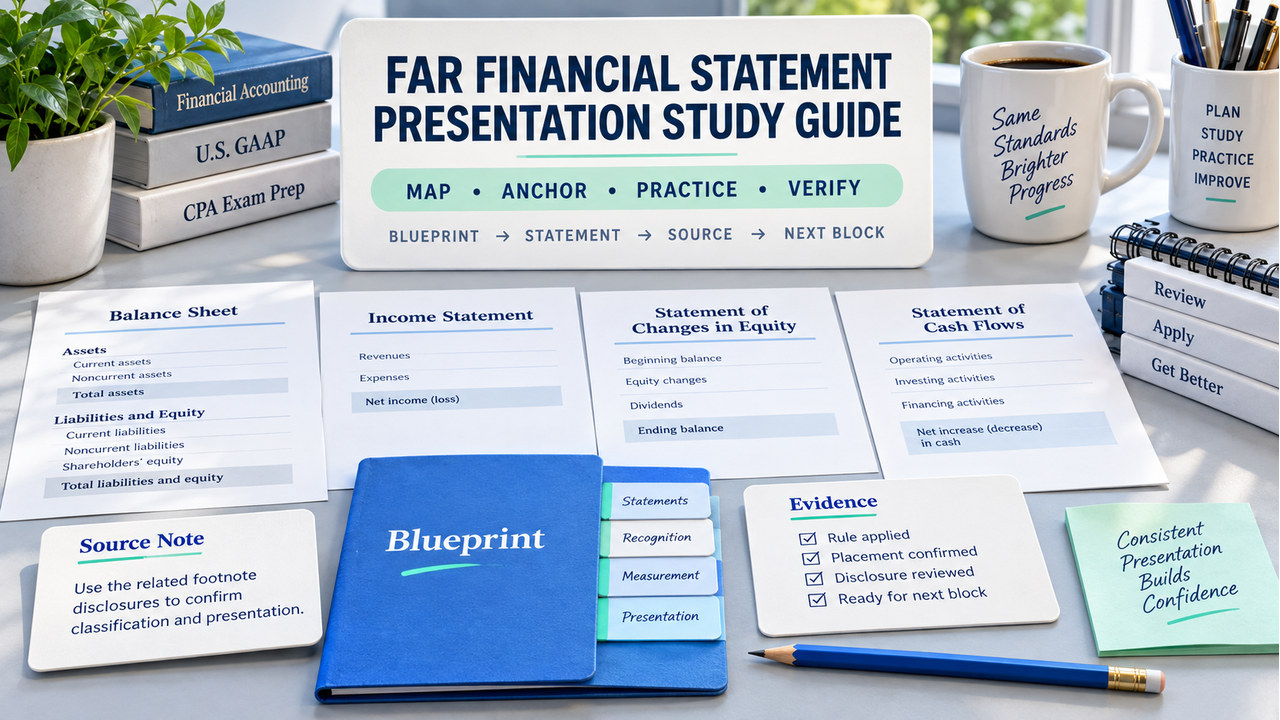

A financial statement presentation study guide should do more than list statement names. It should show you how to move from the current FAR scope to a source fact, from that fact to the correct statement or note, and from the result to the next study block. This guide uses that route: MAP → ANCHOR → PRACTICE → VERIFY.
What you will practice: identifying the tested presentation decision, separating recognition from measurement and display, and defending a destination with a short evidence card. The four checks are independently authored editorial practice. Difficulty is moderate because each check isolates one handoff, while the worked example asks you to keep several handoffs connected.
Assumptions: examples use simplified U.S. GAAP facts, no unusual tax effects unless stated, and no entity-specific elections. Reopen the applicable current Codification topic when the facts add scope, materiality, effective-date, industry, or tax complications.
For a broader preparation path, continue with our CPA Exam Study Guide.
What to study first in a financial statement presentation study guide
Start with the decision the learner must make, not with a pile of definitions. The AICPA Blueprints organize a section by Area, Group, Topic, task statements, skill levels, references, item types, and weighting. That structure gives you a boundary for study; it does not tell you which answer choice will appear on a particular form. Write the current topic and task verb at the top of your page, then turn it into a visible destination.
- Scope: name the FAR topic and the kind of task you are preparing to perform.
- Verb: translate words such as prepare, correct, classify, calculate, or investigate into an observable action.
- Destination: identify the statement line, subtotal, equity section, cash-flow classification, or note that should carry the result.
- Evidence: save the controlling fact, the rule or source to reopen, and one sentence explaining why the nearest distractor fails.
If you cannot name the destination, do not move to a larger question bank yet. A broad practice set can hide whether the problem is a missing fact, a measurement error, a classification error, or a disclosure gap. Your first study block should repair the earliest unsupported handoff.
Build the blueprint-to-study map for a financial statement presentation study guide
Use the five-card map below for every new subtopic. Start by keeping the session inside the current Blueprint boundary. Next, turn the task verb into a small job. Then avoid the common mistake of answering with a rule before deciding who owns the result. After that, create a short audit trail. Finally, keep the review bounded: one drill, one changed fact, and one decision about whether to move on.

A useful evidence card can fit on one screen or half a page. Write fact, rule to reopen, destination, and why not the nearest distractor. For example, “cash did not move” is a fact; “noncash investing and financing transaction” is a classification cue; “supplemental cash-flow disclosure” is the destination; and “including the transaction in the cash total” is the distractor to reject. This format makes your reasoning inspectable instead of leaving a correct letter with no transferable method.
Use the four-lane presentation filter in a financial statement presentation study guide
Many presentation misses happen because four different questions get collapsed into one. Run the lanes in order and stop when the answer is unsupported.

- Recognize: what asset, liability, equity change, income item, or cash event enters the reporting model?
- Measure: what amount, date, basis, period, or assumption controls the number?
- Present: which statement and line, subtotal, section, or cash-flow category carries the result?
- Disclose: which policy, detail, noncash explanation, or supporting note completes the story?
The filter is not a substitute for the Codification. It is a way to ask a better source question. A clear amount without a line calls for presentation guidance. A clear line without ownership calls for recognition or measurement guidance. When the statement appears correct but the reader still cannot understand the policy or a noncash event, reopen disclosure guidance.
Worked example: a noncash equipment purchase
Original practice fact pattern: On January 1, Northline Services acquires equipment with a fair value and recorded cost of $90,000 by issuing a $90,000 three-year note. No cash changes hands on the acquisition date. During the year, the company records $6,000 of depreciation. Assume a simplified U.S. GAAP study setting, no tax effects, and the indirect method for the operating section of the cash-flow statement.
Recognition: The company recognizes equipment and a note payable. The transaction is not ignored merely because cash did not move. Measurement: The example gives a $90,000 recorded amount and a $6,000 annual depreciation amount, so the year-end carrying amount before any other facts is $84,000. Presentation: equipment belongs with long-lived assets and the note belongs with liabilities according to the applicable classification and maturity facts. Disclosure: the acquisition is a noncash investing and financing transaction and needs the appropriate supplemental explanation outside the cash totals.
Now test the destination rather than repeating the fact. The $90,000 acquisition is not presented as a $90,000 cash outflow in investing activities because no cash moved. The $6,000 depreciation expense affects income and is added back in the indirect operating reconciliation because it reduced net income without using current-period cash. Those are two different noncash ideas: one is a transaction that belongs in supplemental cash-flow disclosure, and the other is a reconciliation adjustment.
Evidence card: fact = note issued and no cash paid; rule to reopen = noncash investing/financing presentation; destination = supplemental cash-flow disclosure plus the statement of financial position; distractor = cash outflow for equipment; next action = change the fact to a cash purchase and explain which lane changes.
Study check 1: which statement owns the result?
A company declares a $15,000 cash dividend on December 20. It will pay the dividend on January 20 of the next year. No other facts change. Which December 31 presentation is the best answer?
- Record a $15,000 operating expense and leave equity unchanged.
- Recognize a dividend payable and reduce retained earnings, subject to the stated assumptions.
- Ignore the declaration until cash is paid.
- Record the amount as other comprehensive income.
Reveal the answer, distractor, and next action
Answer: B. The controlling fact is the declaration before the reporting date, not the later payment date. A declared cash dividend is an equity distribution with a payable under the simplified facts; it is not an operating expense or an OCI item.
Nearest distractor: C confuses cash movement with recognition of a liability. The payment date affects settlement, not whether the declared obligation exists at December 31. Next action: write a second evidence card for an undeclared year-end dividend and state which lane changes.
Study check 2: net income, OCI, and comprehensive income
Assume a company holds a debt security classified for this original practice item as available for sale. At year-end, its unrealized gain is $8,000. Ignore tax and assume no sale or impairment. Where should the gain be traced first?
- Net income only, with no comprehensive-income effect.
- Other comprehensive income, which is included in comprehensive income but is not net income under the stated facts.
- Revenue on the income statement.
- A cash-flow operating inflow.
Reveal the answer, distractor, and next action
Answer: B. The fact pattern specifies an unrealized gain on the stated available-for-sale security and removes sale, impairment, and tax complications. Trace the gain to OCI, then remember that comprehensive income includes net income plus OCI. Do not turn an unrealized amount into revenue or cash.
Nearest distractor: A recognizes that the amount changes reported performance but puts it in the wrong performance layer. Next action: redraw the evidence card with three destinations: net income, OCI, and comprehensive income, then add one changed fact for a realized sale.
Study check 3: cash-flow classification versus cash movement
During the year, a company pays $4,000 of interest in cash. For this simplified U.S. GAAP practice item, which cash-flow classification is the best starting answer?
- Operating cash flow.
- Investing cash flow because interest relates to an investment of capital.
- Financing cash flow because interest is paid to a lender.
- No cash-flow presentation because interest is an income-statement item.
Reveal the answer, distractor, and next action
Answer: A. The controlling fact is the cash payment and the classification convention stated for this U.S. GAAP study item. Interest paid is an operating cash-flow item in the standard starting model used here. The fact that a lender receives the cash does not automatically make the payment financing.
Nearest distractor: C uses the counterparty instead of the cash-flow category. Next action: create a three-row classification drill for interest paid, principal repayment, and equipment purchased for cash; write the trigger that changes each destination.
Study check 4: statement versus note disclosure
A company uses a material accounting policy for revenue recognition that a reader needs in order to understand the reported numbers. Which presentation destination should you test first?
- Add the entire policy as a new revenue line on the income statement.
- Place the policy explanation in the notes, with the statements carrying the measured results.
- Move the policy to the cash-flow statement because revenue affects cash.
- Record the policy as an asset.
Reveal the answer, distractor, and next action
Answer: B. The question asks where the explanatory policy belongs, not where the measured revenue appears. The statements carry the recognized amounts; the notes provide the material policy context and other required detail under the applicable literature.
Nearest distractor: A confuses a policy explanation with a line-item measurement. Next action: take one statement line from your notes and write the supporting policy or estimate disclosure that lets a reader interpret it.
Choose the next study block in this financial statement presentation study guide
Count a check as defensible only when you could name the controlling fact, destination, and nearest distractor without reopening the answer. Four defensible checks mean you can move to a mixed FAR presentation set. Two or three mean repeat the weakest lane with one changed fact. Zero or one means rebuild the map and worked example before adding breadth.
Keep the result narrow. A small diagnostic is valuable because it tells you what to do next, not because it predicts an exam score. Save the evidence card with the date and source topic you plan to reopen. If a later source refresh changes the conclusion, update the card rather than defending an old note.
Repair the first weak lane before adding more questions
When an answer is wrong, label the earliest lane that failed. Recognition calls for a plain-language restatement of the event. Measurement requires the amount, date, and assumption. Presentation requires the statement and line. Disclosure requires the note or supporting explanation. Then change exactly one fact and retest the same path.
This repair sequence prevents a familiar trap: using a new question to escape an old uncertainty. The goal is not to remember a destination in isolation. The goal is to reproduce the path from fact to rule to display and explain why a plausible alternative fails.
Common traps in financial statement presentation study
- Task-verb drift: a prompt asking you to present is answered with a recognition rule. Circle the verb before reading the choices.
- Cash-only thinking: a noncash event can still create an asset, liability, equity effect, reconciliation adjustment, or supplemental disclosure.
- Destination guessing: knowing a number does not prove that you know its statement, line, subtotal, or note.
- Counterparty shortcut: the person or entity receiving cash does not by itself determine the cash-flow category.
- Policy-line confusion: a note can explain the policy while the statement carries the resulting measured amount.
- Old-source confidence: a familiar study note may not reflect a current Blueprint boundary or effective-date rule.
Use one sentence to repair each trap: “The fact that controls this answer is ___; the destination is ___; the distractor fails because ___.” If you cannot fill all three blanks, keep the topic in your next study block.
Source refresh: when to reopen the Blueprint and Codification
Refresh the official boundary before building a dated plan. The AICPA CPA Exam Blueprints page is the scope source for current task statements and exam-format context. The FASB Accounting Standards Codification is the technical source to reopen for the applicable U.S. GAAP topic. The AICPA sample-test resource can help you rehearse the testing interface, while the NASBA CPA Exam FAQ is a separate exam-process reference.
Before you move on, your evidence packet should contain four items: the current scope cue, the controlling fact, the destination, and the changed-fact retry. That is the practical finish line for this financial statement presentation study guide. It gives you a reasoned next step without pretending that a short article can replace the current source literature or a full FAR study plan.