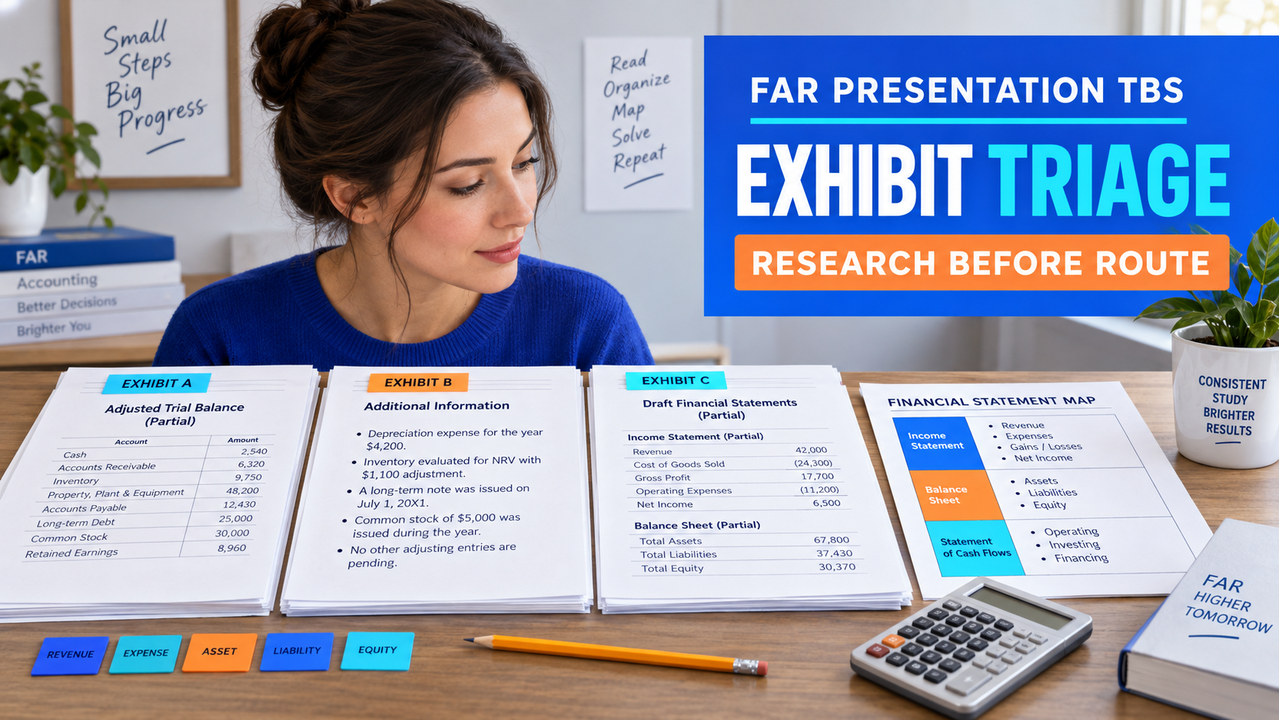

Far financial statement presentation task based simulation practice is less about memorizing a label and more about preserving the route from exhibit to evidence to destination. In a real TBS-style study block, a prompt may combine a draft statement, a transaction schedule, a cash-flow clue, and a disclosure question. Your first job is to identify what the cell asks before you calculate or research.
Quick answer: use an evidence-first sequence: scope the task, extract the date and event, reopen the current authoritative topic, route the effect to the right statement or disclosure lane, and write one sentence that rejects the nearest distractor. The simulation below is original editorial practice, not an official or memory-based CPA Exam question.
Assumptions and difficulty: Northstar Components is a calendar-year company. The facts are simplified U.S. GAAP study facts with no unusual tax effects, hidden effective-date exceptions, or industry-specific overlays. Difficulty is moderate: the arithmetic is light, but the exhibits deliberately separate income-statement effects, cash-flow classification, noncash disclosure, and presentation scope. When a conclusion depends on a changed fact, return to current literature.
For broader preparation context, continue with our CPA Exam FAR review hub. Use this page when you want one bounded TBS route instead of another disconnected list of rules.
What this FAR financial statement presentation task based simulation is testing
The current AICPA exam resource describes Blueprints as a map of Areas, Groups, Topics, task statements, skill levels, references, item types, and weighting. It also lists FAR TBS testlets with 2, 3, and 2 simulations. That context matters, but a blueprint line does not replace the work of reading an exhibit. This original practice set targets four handoffs:
- Scope: restate the required output: classify, calculate, correct, present, or disclose.
- Extract: mark the reporting date, event, amount, cash movement, and stated assumption.
- Route: identify the statement, cash-flow category, line, or note that receives the effect.
- Defend: reject the closest distractor with one fact-based sentence.
A weak TBS attempt often starts with a remembered rule and forces every exhibit into it. A stronger attempt lets the event and the required output choose the research path. The goal is not to pretend that a small original set predicts an official result. The goal is to make your reasoning visible enough to repair.
Set up the original simulation before opening the exhibits
Set a 30-minute timer and create three answer cells on paper: research path, correction map, and proof sentence. Read the task instruction first. Do not begin by calculating every number in the exhibits.
Scenario: Northstar Components is preparing December 31 financial statements. A staff draft contains four unrelated-looking items:
- Equipment disposal: equipment cost $300,000, accumulated depreciation $210,000, and cash proceeds $120,000. The draft placed the cash proceeds in operating revenue and left the equipment balance unchanged.
- Equity issuance: Northstar issued common shares for $200,000 cash. The draft labeled the receipt as service revenue because the entry was posted through the general receipts screen.
- Lease commencement: the company recognized a $150,000 right-of-use asset and lease liability on December 31. No cash was paid at commencement, but the draft included $150,000 as a cash outflow.
- Component disposal: a small business component was sold on December 30. The prompt states that the simplified criteria for separate disposal presentation are met, but the draft left the component results in continuing operations without a separate presentation or disclosure review.
Under the study assumptions, you are not being asked to settle every technical exception. You are being asked to identify the controlling fact, choose the next research step, and route the correction. Write a question mark beside any conclusion that would change if the waiver, tax status, effective date, materiality, or disposal criteria changed.
Map the exhibits to the correct presentation question
Before you choose an answer, connect each exhibit to the question it actually raises. The same cash receipt can affect a balance, an income statement, and a cash-flow statement differently. Keep those lanes separate.
- Equipment: calculate carrying amount first: $300,000 cost less $210,000 accumulated depreciation equals $90,000. The $120,000 proceeds create a $30,000 gain under the simplified facts. Research the asset-disposal presentation and cash-flow treatment; do not call the proceeds revenue merely because cash arrived.
- Shares: the controlling fact is the source of cash: owners contributed capital. Research the equity and financing presentation path; the receipt is not service revenue.
- Lease: the controlling fact is that recognition occurred without cash at commencement. Research noncash transaction and supplemental disclosure requirements before classifying later lease payments.
- Component: the stated disposal criterion controls the scope question. Research the current presentation and disclosure topic before deciding where the component result and related gain belong.

Notice the pattern: an exhibit does not tell you the answer by its largest number. The event, the reporting date, and the required output determine which source and which statement lane you need. If you skip that mapping step, a plausible calculation can still land in the wrong presentation.
Complete the three answer cells before revealing the logic
Reveal the three-cell answer logic
Attempt the research path, correction map, and proof sentence before opening the answer logic.
Reveal the answer
Answer: Start with the event and controlling fact, compute only the linked amount, route the item to the correct statement or disclosure lane, and reject the nearest distractor that changes the event label.
The correct route separates income-statement effects from cash-flow classification, keeps noncash recognition out of cash totals, and sends the component-disposal question back to the current presentation and disclosure topic.
Attempt the cells without opening the reveal. Use short entries; a TBS answer cell rewards a defensible route, not a paragraph of unstructured memory.
- Research path: for each exhibit, write the event, the controlling fact, and the current authoritative topic you would reopen. Example format: equipment sale — carrying amount and proceeds — disposal and cash-flow presentation.
- Correction map: write the linked correction: $90,000 carrying amount, $30,000 gain, and $120,000 proceeds for the equipment; $200,000 financing receipt for the shares; noncash lease recognition and supplemental disclosure path; and a separate presentation and disclosure review for the component.
- Proof sentence: complete this sentence: Because the event is ___ and the controlling fact is ___, the effect belongs in ___ rather than ___. Use one sentence for the exhibit you found hardest.
Verify the research step before you change the draft
Use the current FASB Accounting Standards Codification for the technical topic, and use the AICPA Blueprint to confirm that the practice task remains within the intended exam boundary. The official sample test is useful for software familiarity, but it is not a scored readiness measure and its content can age. A retired FAR TBS can show the public format of a multi-step accounting task, but it is not permission to copy its facts or assume that the same item will appear.
Research in this order:
- Identify the event: sale, owner contribution, noncash recognition, or component disposal.
- Identify the output: amount, statement destination, cash-flow category, or disclosure.
- Open the current topic: check scope, definitions, exceptions, and effective-date notes.
- Reconcile the draft: compare the proposed route with the controlling fact and linked calculation.
- Write the boundary: state which changed fact would require a fresh research pass.

This order keeps research from becoming a substitute for reading. If you open a long topic before identifying the event and required output, you may collect true facts that answer a different question. In the actual Codification, use the current topic and relevant subtopics rather than relying on a remembered summary.
Reveal the answer logic and the distractors
The simulation is designed around a presentation distinction that repeatedly causes avoidable errors: the statement effect, the cash-flow category, and the disclosure path are related but not interchangeable. For the simplified Northstar facts, the answer logic is:
- Equipment: compute the carrying amount and gain; route the proceeds through the appropriate investing presentation and remove the old asset balance. Do not substitute the cash amount for revenue.
- Equity: route the owner contribution through financing and equity; do not let the general-receipts label decide the substance.
- Lease: keep the noncash commencement event separate from later cash payments and research the required supplemental disclosure.
- Component: treat the supplied disposal criterion as a scope gate, then research the current presentation and disclosure route before analyzing the gain.
When an answer feels obvious, ask which exhibit fact would make it false. That question is the fastest way to expose a distractor built from a familiar label, an incomplete cash-flow assumption, or a conclusion made before scope was established.
Turn a miss into the next research action
Do not record only that you were wrong. Record the first handoff that broke. A wrong destination after a correct calculation is a route problem; a wrong calculation caused by a missed amount is an extraction problem; a correct route that ignores an exception is a research problem.
Run a focused retry before increasing question volume
For a scope or extraction miss, use a 10-minute retry with two exhibits and no new calculation. For a research miss, reopen the current topic and write the exact definition or exception that changed the route. For a routing miss, use the same numbers but change the statement destination. For a defense miss, write three one-sentence distractor rejections.
Then change one fact while keeping the others fixed. For example, change the equipment proceeds from $120,000 to $80,000, or state that cash was not received until the next reporting period. Recompute only the linked conclusion and say whether the destination changes. If you change every fact at once, you are testing improvisation instead of transfer.
A useful completion standard is not “I got four labels right.” It is: I can identify the event, show the evidence, cite the current topic, route the effect, and explain why the nearest distractor fails. That is the proof trail a TBS-style practice block is meant to build.
Refresh the official boundary before you expand
The AICPA CPA Exam Blueprints page is the current scope source for task statements, skill levels, item types, and weighting. The AICPA sample-test resource is for software and format rehearsal, not a scored readiness measure. The retired FAR TBS resource is a public format reference only. The FASB Accounting Standards Codification is the technical source to reopen for the applicable presentation, cash-flow, and disclosure topic. The NASBA CPA Exam FAQ is a separate process reference.
This page uses original editorial facts and does not reproduce official, released, memory-based, or provider-owned questions. It does not promise a score. Before you expand the set, save the first broken step, the controlling fact, the statement destination, the rejected distractor, and the changed-fact result.