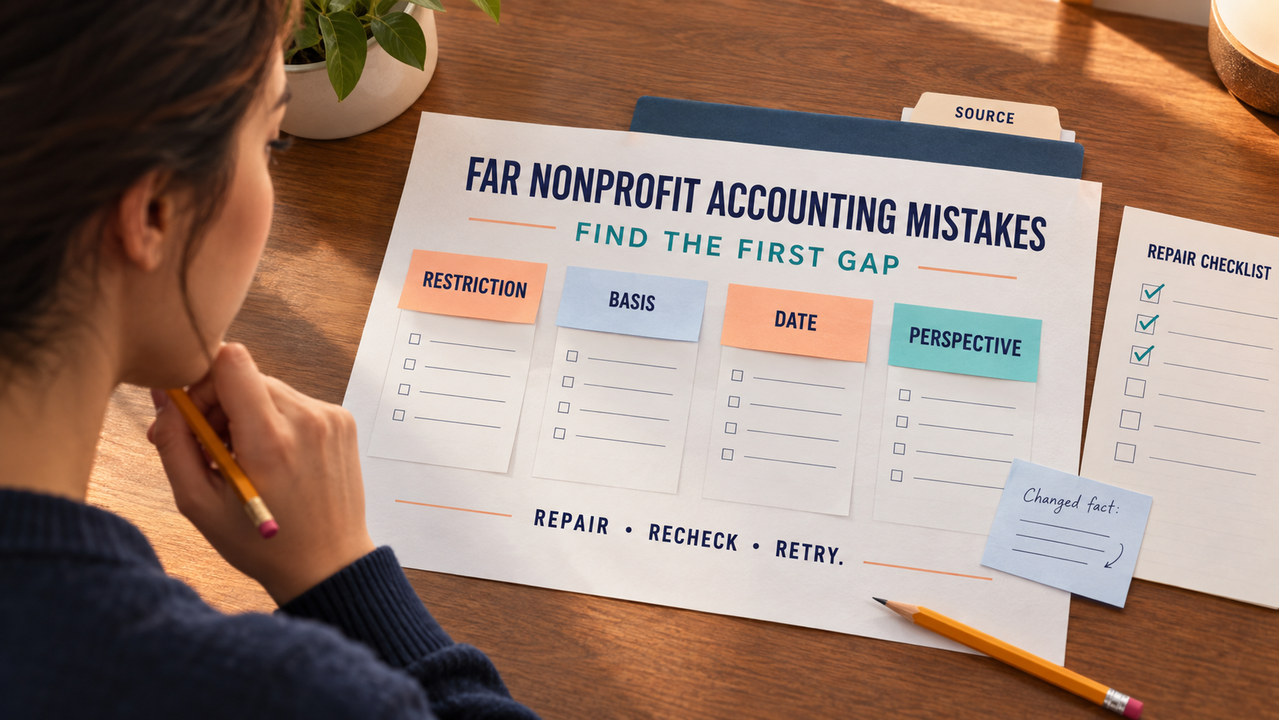

Direct answer: The most costly far nonprofit accounting mistakes are routing errors: reading cash before donor wording, applying a tax rate before comparing carrying amount with tax basis, ignoring the reporting-date condition, or switching a named governmental-fund prompt into a government-wide analysis. Fix the first broken field, then replay one changed fact.
Scope and originality note: This is original editorial practice for US CPA candidates searching for far nonprofit accounting income taxes subsequent events government accounting common mistakes. The examples, amounts, answer choices, rationales, and repair checklist are independently authored. They are not official, recalled, leaked, or provider-owned exam items. The editorial review role is scope mapping and source QA, not a personal licensure claim.
Use the AICPA CPA Exam Blueprint as the scope checkpoint. Use current FASB Topic 958, Topic 740, and Topic 855 for the accounting research routes, and current GASB material for the government-perspective correction. The AICPA sample tests help with interface familiarity; the NASBA FAQ handles administration questions.
FAR nonprofit accounting mistakes: fix the first broken field
This far nonprofit accounting mistakes clinic uses four failure modes and one repair rule. A wrong answer is evidence, not a diagnosis. First name the field that broke: scope, restriction, basis, date, or perspective. Then choose the smallest source check or changed-fact replay that can test that field.
The same discipline applies across the full query. Donor wording can matter more than the cash total in a nonprofit item. In an income-tax item, sequence matters before the stated rate. A subsequent-event item separates the condition date from the discovery date. For a government item, the requested reporting perspective controls the route.
Use a first-broken-field checklist
Before any answer is revealed, write four columns: tempting move, why it fails, repair, next check. Keep the repair narrow. Do not respond to one mistaken basis sequence by rereading every FAR topic.

- Restriction: read the donor phrase before classifying from cash evidence.
- Basis: compare carrying amount and tax basis before applying the stated rate.
- Date: separate the reporting-date condition from the later discovery.
- Perspective: honor the named governmental fund before analyzing the transaction.
Use the label that matches the first broken move. A scope error means the prompt or Blueprint route was misread. A reading error means a qualifier, date, or requested reporting level was skipped. Calculation errors mean the inputs or sequence were mishandled. Transfer errors mean the original rule looked familiar but failed after one fact changed. These labels keep review work small and prevent a vague conclusion such as “I need more FAR practice.”
When two fields appear wrong, repair the earliest one in the chain. For example, do not debate a final amount if the prompt first asked for a governmental-fund perspective and you silently changed it. Likewise, do not adjust a tax result before confirming which amount is the carrying amount and which is the tax basis. The first broken field is the best starting point for the next block.
Mistake 1 — using cash before donor wording
Skill: identify the classification trigger. Assumptions: Northline Learning Foundation receives $72,000, and the donor letter says $18,000 supports a youth program; no other agreement is supplied. Difficulty: foundational. What should the learner read first?
- The full $72,000 cash amount.
- The donor’s stated purpose for $18,000.
- The income-tax rate from a separate worksheet.
- The government perspective from a different prompt.
Reveal the answer and repair
Answer: B. The donor phrase is the first broken-field check because it supplies the purpose condition. The cash total is real, but it does not answer the restriction question. Repair: circle the wording that changes the use of the funds. Next action: remove the purpose phrase and restate which classification question now needs research under Topic 958.
Mistake 2 — applying the rate before the basis difference
Skill: sequence a temporary-difference calculation. Assumptions: an asset has a $168,000 carrying amount, a $124,000 tax basis, and a stated 22% rate; use the rate only after the difference. Difficulty: moderate. Which step comes first?
- $168,000 × 22%.
- $124,000 × 22%.
- $168,000 − $124,000.
- $168,000 + $124,000.
Reveal the answer and repair
Answer: C. The first difference is $44,000. In this bounded example, applying 22% afterward gives $9,680. Starting with the rate hides the book-versus-tax comparison. Repair: write carrying amount on the left and tax basis on the right before writing the rate. Next action: change the tax basis to $130,000 and redo the sequence. Reopen Topic 740 for the complete recognition and measurement analysis.
Mistake 3 — letting the discovery date replace the condition date
Skill: test evidence about the reporting-date condition. Assumptions: year-end is December 31; a customer enters bankruptcy on February 14; a memo says the financial difficulty existed before year-end. Difficulty: moderate. What should the learner ask before deciding?
- Whether the later information provides evidence about the December 31 condition.
- Whether all events after year-end are ignored.
- Whether donor wording decides the customer balance.
- Whether a governmental fund decides the date.
Reveal the answer and repair
Answer: A. The later discovery date does not answer the condition-date question by itself. The pre-year-end evidence is the route that must be evaluated under Topic 855, with complete facts. Repair: write two separate dates: condition date and discovery date. Next action: move the financial difficulty to February 1 and write the new research question before repeating the conclusion.
Mistake 4 — switching the named reporting perspective
Skill: honor the reporting level named in the prompt. Assumptions: the question asks for a governmental-fund analysis and does not request government-wide statements. Difficulty: foundational. What is the first routing action?
- Use the named governmental-fund perspective.
- Switch automatically to government-wide statements.
- Apply the donor-purpose rule.
- Apply the temporary-difference calculation.
Reveal the answer and repair
Answer: A. The prompt’s named perspective controls the first route. A government-wide analysis may be relevant to another request, but substituting it here changes the task. Repair: write the requested reporting level at the top of the work area. Next action: rewrite the prompt to request government-wide statements, then note which source and analysis step would change. Reopen current GASB guidance.
Record the first broken field
Do not write only “wrong.” Record the tempting move, the first broken field, the controlling evidence, the repair, and the next check. That distinction matters because a correct answer reached through the wrong route is fragile, while a wrong answer with a precise broken field is repairable.
Keep the record short enough to use after every practice item. One line can hold the prompt verb, one line can hold the controlling fact, and one line can hold the repair. If the same field breaks twice, keep the next attempt in the same lane. If the field stabilizes after one changed fact, mix it with a neighboring lane only after the repair is visible.
Change one fact before replay
A replay should hold the response format stable while changing one input. Remove the donor purpose, change the tax basis, move the condition date, or change the requested reporting perspective. If every fact changes, you cannot tell which repair worked.

Use this order: name the gap, hold the other facts, change one input, reopen the named source route, and retry the same cell. A narrow replay is more informative than a long second attempt that mixes restriction, basis, date, and perspective changes.
Keep exam tips source-aware
The AICPA Blueprint controls scope and task statements; it does not turn this clinic into official exam content. FASB Topics 740, 855, and 958, plus current GASB material, provide research routes for the simplified examples. Reopen the live sources after a blueprint or standards update.
Use sample tests for interface familiarity, not copied wording. Administration and licensure questions belong with the relevant official channels and jurisdiction. The local workbook still has null Semrush US volume and KD fields; no search-volume claim is invented here.
The practical takeaway for far nonprofit accounting mistakes is simple: repair the route before adding more questions. Name the broken field, change one fact, verify the source, and retry the same response format.
FAR nonprofit accounting mistakes FAQ
What is the first thing to review after a wrong answer?
Name the first broken field: scope, restriction, basis, date, or perspective. Then choose one bounded repair.
Why should I write the basis difference before the rate?
The bounded example asks you to compare carrying amount and tax basis first; the stated rate comes afterward. Reopen Topic 740 for the complete analysis.
Does a later bankruptcy automatically answer a year-end question?
No. Separate the later discovery from the condition at the reporting date and evaluate the complete facts under current Topic 855 guidance.
How should I replay a mistake?
Hold the response format stable, change one fact, reopen the named source route, and retry the same cell.