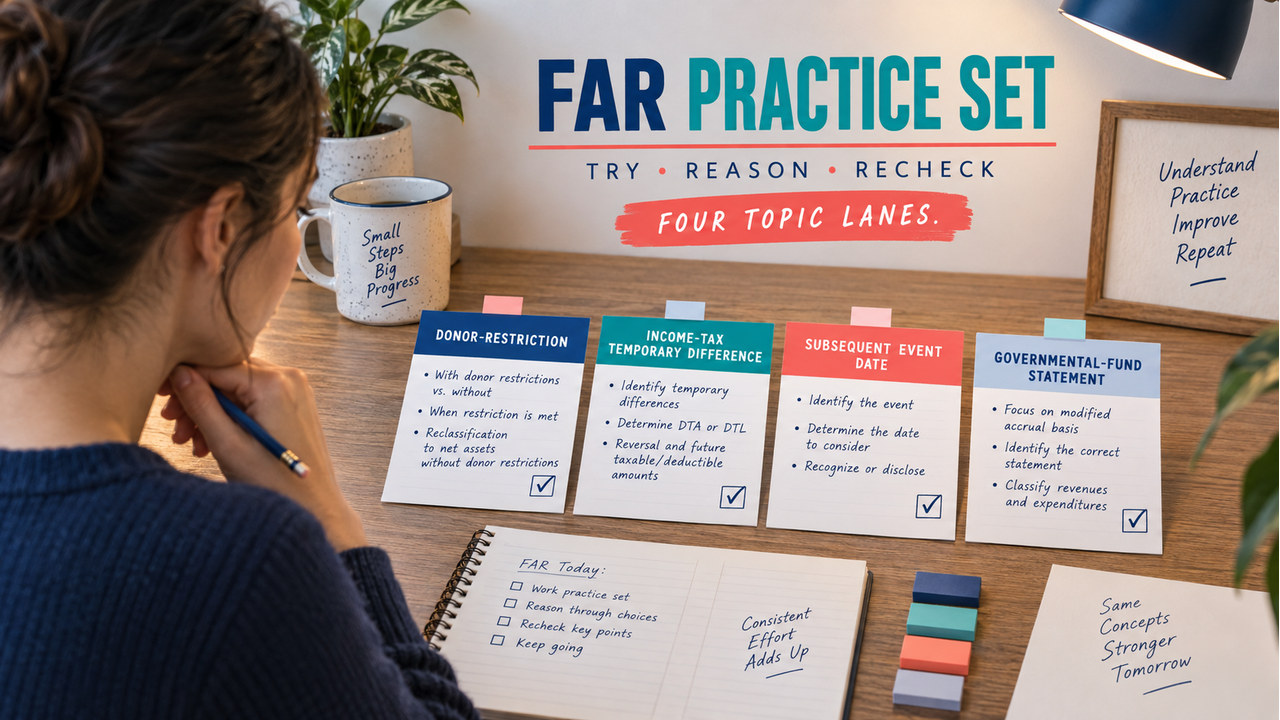

Direct answer: FAR nonprofit accounting practice questions are most useful when you attempt each item, identify the decisive trigger, and read the rationale only afterward. This set covers donor restrictions, income-tax differences, subsequent events, and governmental-fund framing. Every question is original practice, not official or recalled content.
Scope note: This original practice set is for US CPA candidates and uses the current AICPA Blueprint as its October 2, 2026 scope checkpoint. The questions, amounts, answer choices, rationales, and blueprint mapping are independently authored. A live accounting conclusion requires complete facts, jurisdictional context, and current research.
For scope, reopen the AICPA CPA Exam Blueprint. Use the current FASB Accounting Standards Codification, including Topic 740 and Topic 958, for the relevant technical routes. Government-accounting questions require current GASB research. The NASBA CPA Exam FAQ covers administration, while the FAR review hub can hold the broader study sequence.
FAR nonprofit accounting practice questions
Use four labels before reading the answer: NONPROFIT, INCOME TAX, SUBSEQUENT EVENTS, and GOVERNMENT. The label is not the conclusion. It tells you which facts deserve attention first and which source route should be reopened if the simplified facts change.
Attempt each item without searching. Write a one-sentence reason beside your choice. Then open the rationale and compare the trigger, the distractor, and the next action. That process is more valuable than collecting answer letters without explaining them. Use these FAR nonprofit accounting practice questions as a repeatable reasoning drill.
The examples are bounded learning cases. They do not assign official weights, predict a score, reproduce provider questions, or replace the current Blueprint or authoritative accounting guidance.
How to use this original practice set
- Route: identify the topic lane.
- Trigger: circle the fact that controls the question.
- Attempt: select an answer and state why.
- Rationale: identify the nearest distractor.
- Replay: change one fact and predict the new result.
Keep the workpaper small. On the nonprofit line, write restriction and purpose. For income taxes, write book amount, tax basis, and temporary difference. At the subsequent-event question, write whether the condition existed at the reporting date. In government accounting, write the fund perspective before the government-wide perspective.
Blueprint and source boundaries
This page uses a local study map rather than an official weight claim. The four lanes correspond to the reader tasks requested by the row: nonprofit accounting, income taxes, subsequent events, and government accounting. The AICPA Blueprint supplies the scope checkpoint. FASB Topics 740 and 958 and current GASB materials supply research routes.
Do not infer that a simplified answer applies to every entity or reporting framework. If the facts change the donor restriction, tax basis, event condition, fund type, or governing standard, stop and research the changed fact.
Question 1: nonprofit donor restriction
Tested skill: separating donor restrictions. Difficulty: foundation. Assumption: a nonprofit receives $60,000 cash; the donor states that $20,000 must support a youth program, while the remaining $40,000 has no donor-purpose restriction. Question: Which simplified classification is the best starting point?
- A. Classify all $60,000 as without donor restrictions
- B. Classify $20,000 as with donor restrictions and $40,000 as without donor restrictions
- C. Classify all $60,000 as a liability
- D. Classify $40,000 as with donor restrictions because it is the larger amount
Reveal the rationale after your attempt
Best answer: B. In this simplified case, the donor’s stated purpose attaches to $20,000, while the remaining $40,000 has no stated donor-purpose restriction. Why the distractors fail: the larger amount does not determine restriction, and cash is not automatically a liability. Next action: change the donor language and explain which portion changes classification. Reopen Topic 958 for a live conclusion.
Question 2: income-tax temporary difference
Tested skill: identifying a temporary difference. Difficulty: foundation. Assumption: an asset has a $120,000 carrying amount and a $90,000 tax basis. Use a 25% enacted rate only for this original simplified calculation. Question: What amount is the starting deferred-tax measurement?
- A. $7,500 deferred-tax amount
- B. $30,000 deferred-tax amount
- C. $37,500 deferred-tax amount
- D. No difference because the carrying amount is positive
Reveal the rationale after your attempt
Best answer: A, $7,500. The temporary difference is $120,000 − $90,000 = $30,000. Applying the stated 25% rate gives $7,500 in this simplified exercise. Why the distractors fail: $30,000 is the difference before tax, while $37,500 uses addition rather than the stated difference. Next action: change the tax basis and recompute the difference before applying the rate. Reopen Topic 740 when recognition or measurement facts are more complete.
Question 3: subsequent event
Tested skill: distinguishing a later event from evidence about the reporting date. Difficulty: intermediate. Assumption: after year-end, a customer enters bankruptcy, and the available evidence shows that the customer’s financial difficulty existed before year-end. Question: What is the first question to ask?
- A. Whether the later event provides evidence about a condition existing at year-end
- B. Whether every later event must be ignored
- C. Whether the bankruptcy automatically creates a new asset
- D. Whether the event should be classified as a donor restriction
Reveal the rationale after your attempt
Best answer: A. The first question is whether the later information provides evidence about a condition that existed at the reporting date. The simplified case points to that analysis. Why the distractors fail: later events are not all ignored, and the event does not become a nonprofit or tax issue merely because it occurs after year-end. Next action: change the facts so the condition begins after year-end and state how the research question changes.
Question 4: government-accounting perspective
Tested skill: selecting the reporting perspective. Difficulty: intermediate. Assumption: a prompt asks about a governmental fund transaction and does not yet ask for the government-wide statements. Question: Which first framing is most useful?
- A. Start with the governmental-fund measurement perspective and the facts supplied
- B. Start with nonprofit donor restrictions
- C. Start with a corporate equity-method bridge
- D. Ignore the fund type because all statements use one identical basis
Reveal the rationale after your attempt
Best answer: A. The prompt names a governmental fund and does not ask for the government-wide perspective, so the first step is to route the facts to the named fund perspective. Why the distractors fail: nonprofit and corporate methods answer different questions, and fund type is not decorative information. Next action: change the prompt to government-wide statements and write the new source route. Reopen current GASB guidance before using a live conclusion.
Map the four practice lanes
Now compress the four answers into a lane map. NONPROFIT asks what donor language restricts. INCOME TAX asks what differs between book carrying amount and tax basis. SUBSEQUENT EVENTS asks whether the later information relates to a reporting-date condition. GOVERNMENT asks which fund or reporting perspective the prompt names.

The map is a memory aid, not a substitute for a standard. Its value is routing: once the trigger is visible, the wrong source route becomes easier to reject.
Map the four practice lanes
Before opening the explanation, label the item nonprofit, income tax, subsequent event, or government accounting, then write the decisive trigger.
Reveal the answer
Answer: The trigger determines the research route: donor restriction, temporary difference, condition at the reporting date, or governmental-fund measurement basis.
Compare your process with the reasoning shown above.
Build the rationale board
For every missed item, write four fields. Choice records what you selected. Why explains the rule or trigger that supports the correct route. Distractor names the tempting alternative. Source route records the Blueprint, FASB, or GASB material to reopen.

A strong rationale is short but specific. “B is correct” is not enough. “B follows the donor’s stated purpose; D treats amount size as the restriction test” tells you what to watch for in the next case.
Replay one changed fact
After each rationale, change one fact. Increase the restricted nonprofit amount, lower the tax basis, move the customer’s financial difficulty to after year-end, or switch from a governmental fund to a government-wide question. Then predict which line or source route moves.
One changed fact reveals whether the learner understood the trigger. If every change produces the same memorized answer, the practice set has not yet become a usable method.
Avoid answer-only review
Answer letters do not explain why a distractor looked plausible. The tax distractor may catch a learner who confuses the temporary difference with the tax-effected amount. On the nonprofit item, choice D can reflect ignored donor language. For the subsequent-event item, choice B can reflect treating every later event as irrelevant.
Next, write the broken trigger in plain language. Then choose the next item that keeps the topic but changes that trigger. This makes review targeted without claiming that a single question predicts exam performance.
Keep the source map current
As a final check, reopen the AICPA CPA Exam Blueprint, the FASB Codification, and current GASB guidance before reuse. Topics 740 and 958 and the governmental-accounting route are research paths, not substitutes for complete facts. This original set does not assign official weights, predict an exam result, or replace current technical research.
Finally, check each amount, answer choice, image label, source note, and rationale. If the live fact changes the entity, restriction, tax basis, event condition, fund type, or standard, pause the shortcut and reopen the current source.
FAR nonprofit accounting practice questions FAQ
Are these official exam questions?
No. They are original simplified practice cases.
What should I write before choosing?
Write the topic lane and decisive trigger.
Why read the rationale after attempting?
Delayed review shows whether the answer came from reasoning or recognition.
When should I research further?
Research when the entity, basis, event condition, fund perspective, or standard changes.