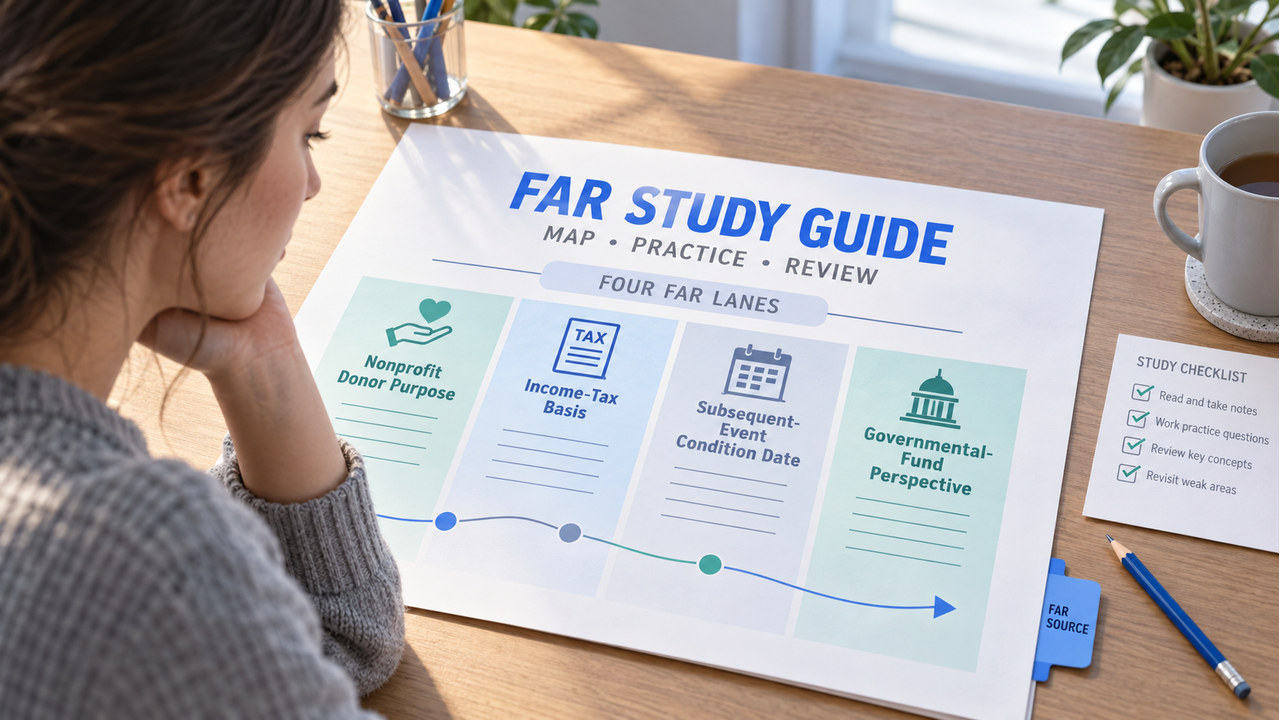

Direct answer: A useful FAR nonprofit accounting study guide should map the four topic lanes to the current Blueprint, give one bounded worked checkpoint for each lane, and end with a clear next-study decision. This guide does that for nonprofit accounting, income taxes, subsequent events, and government accounting.
Scope and review note: This guide is for US CPA candidates. It uses the AICPA Blueprint as its October 2, 2026 scope checkpoint. The worked examples, amounts, checklists, and decision aid are independently authored. The editorial review role is scope mapping and source QA, not a personal licensure claim.
For scope, reopen the AICPA CPA Exam Blueprint. Use the current FASB Accounting Standards Codification, including Topics 740, 855, and 958, for the relevant research routes. Government-accounting questions require current GASB research. The NASBA CPA Exam FAQ covers administration, while the FAR review hub can hold the broader study sequence.
FAR nonprofit accounting study guide
This FAR nonprofit accounting study guide is a map, not a list of disconnected definitions. Start with the trigger in the prompt. Then choose the worked checkpoint that matches it. Finally, write the next action that would close the gap.
The four lanes are intentionally different. Donor purpose routes nonprofit classification. Book amount and tax basis drive the first income-tax calculation. A later event is tested against a reporting-date condition. A government question begins with the perspective named in the prompt.
Use the map in order. First confirm scope. Next work one original example. After that, reopen the source. Then replay one fact change. This sequence keeps broad study work tied to evidence.
Blueprint checkpoint
The AICPA Blueprint is the scope checkpoint, not a substitute for the accounting literature. Use it to confirm the area and skill. Use FASB or GASB materials to research the actual rule. Keep those jobs separate.
- Scope: name the lane and skill.
- Trigger: underline the fact that controls the first move.
- Example: solve a bounded case without searching.
- Source: reopen the relevant standard route.
- Next check: change one fact and solve again.
When the prompt changes entity, purpose, basis, date, fund type, or standard, stop using the shortcut. Record the changed fact. Then rebuild the route from the source.
Read the map in two passes
Use a first pass for orientation. Read the lane title, scope statement, and source tab. Do not solve yet. Ask what kind of trigger the lane expects. A purpose is a classification trigger. A basis is a calculation trigger. Timing depends on the date. The fund name sets the perspective trigger.
Use a second pass for transfer. Cover the worked checkpoint. State the answer and the reason in your own words. Next, uncover the source route and compare your trigger. Finally, change one fact. This exposes whether you recognized the rule or only remembered a phrase.
Keep the study note compact. Write one sentence for the rule, one line for the example, and one line for the next check. That structure makes the card reusable during a later review block. It also prevents the guide from becoming an unstructured collection of copied definitions.
Map the four FAR lanes
Use one card for each lane. Each card needs a scope statement, a worked checkpoint, a source route, and a next check. A completed card is more useful than a long list of unchecked topics.

Check the four-lane map
For each lane, mark scope, worked example, source route, and next check. Leave a blank only when you can name the missing evidence.
Reveal the answer
Answer: A complete lane has a Blueprint link, one bounded example, a source route, and a next-study action. A blank field becomes the next review task.
Compare your process with the reasoning shown above.
Worked checkpoint 1: donor purpose
Skill: route classification from donor language. Difficulty: foundation. Assumption: a nonprofit receives $96,000 cash. The donor says $32,000 must support emergency housing. The remaining $64,000 has no donor-purpose restriction. Question: Which starting classification is best?
- A. Treat all $96,000 as without donor restrictions.
- B. Treat $32,000 as with donor restrictions and $64,000 as without donor restrictions.
- C. Treat all $96,000 as a liability.
- D. Treat $64,000 as restricted because it is larger.
Reveal the worked answer
Answer: B. In this bounded example, the stated emergency-housing purpose attaches to $32,000. The remaining amount has no stated donor-purpose restriction. The trigger is the donor sentence, not the larger amount. Source route: reopen Topic 958. Next check: remove the purpose from the donor wording and restate the classification.
Worked checkpoint 2: tax basis before rate
Skill: sequence the book-versus-tax calculation. Difficulty: foundation. Assumption: an asset has a $184,000 carrying amount and a $136,000 tax basis. Use a 21% enacted rate only for this original example. Question: What is the starting tax effect?
- A. $48,000 before applying a rate.
- B. $38,640 because the carrying amount is multiplied by 21%.
- C. $10,080 after applying 21% to the $48,000 temporary difference.
- D. $0 because the carrying amount is positive.
Reveal the worked answer
Answer: C. First subtract $136,000 from $184,000. The temporary difference is $48,000. Then multiply by 21% to get $10,080. Source route: reopen Topic 740. Next check: change the tax basis to $144,000 and recompute before applying the rate.
Worked checkpoint 3: condition date
Skill: connect later information to the reporting-date condition. Difficulty: intermediate. Assumption: after year-end, a customer enters bankruptcy. Evidence shows the financial difficulty existed before year-end. Question: What should the analysis ask first?
- A. Whether the later information provides evidence about a condition existing at year-end.
- B. Whether all later events must be ignored.
- C. Whether the event changes donor restrictions.
- D. Whether the event changes tax basis.
Reveal the worked answer
Answer: A. The first trigger is the condition at the reporting date. Later information may provide evidence about that condition. Source route: reopen Topic 855. Next check: move the financial difficulty to after year-end and describe the changed research question.
Worked checkpoint 4: fund perspective
Skill: choose the requested reporting perspective. Difficulty: intermediate. Assumption: a prompt asks about a governmental-fund transaction and does not request government-wide statements. Question: What is the first framing?
- A. Start with the governmental-fund perspective named in the prompt.
- B. Start with donor-purpose classification.
- C. Start with a corporate equity-method analysis.
- D. Ignore the fund type.
Reveal the worked answer
Answer: A. The named fund is the first routing fact. The prompt does not request government-wide statements. Source route: reopen current GASB materials. Next check: change the requested statement level and write the new perspective before analyzing the transaction.
Turn the map into a next-study decision aid
Use the decision aid after each checkpoint. Name the weak lane. Write the missed trigger in one sentence. Choose the source route. Then pick one bounded block: read, calculate, classify, or replay.
Choose read when the scope or source route is missing. For a calculation gap, use calculate when the carrying amount, tax basis, or rate sequence is wrong. When donor purpose or reporting perspective is unclear, use classify. Finally, use replay when the rule is known but a changed fact breaks the route.

Use the seven-block review sequence
- Block 1 — scope: name the lane and Blueprint skill.
- Block 2 — trigger: underline the controlling fact.
- Block 3 — example: solve one fresh bounded case.
- Block 4 — rationale: explain the nearest wrong path.
- Block 5 — source: reopen Topic 958, 740, 855, or GASB as applicable.
- Block 6 — change: alter one fact while holding the rest steady.
- Block 7 — log: write the next item and stop.
Stopping matters. A review block should close one gap, not become an unbounded reading session. If the gap remains, schedule the same lane again with a different fact pattern.
For example, a tax-basis gap should end with a fresh subtraction and a rate application. A condition-date gap should end with two dates and one changed fact. A perspective gap should end with the requested statement level written before the transaction. In each case, the next item proves whether the trigger transferred.
Keep credentials and sources visible
The editorial review role for this guide is evidence mapping: connect the AICPA scope checkpoint to the relevant FASB or GASB research route, then test the map with original bounded examples. That role is not a substitute for a licensed accountant, current technical consultation, or complete engagement facts.
Before reuse, reopen the AICPA CPA Exam Blueprint, the FASB Codification, and current GASB guidance. The FAR nonprofit accounting study guide should be refreshed when scope, standards, exam administration, or the publisher’s study sequence changes.
FAR nonprofit accounting study guide FAQ
What should I study first?
Start with the trigger map: donor purpose, tax basis, condition date, and fund perspective.
How do I know which block to choose?
Read for a scope gap, calculate for a basis gap, classify for a restriction or perspective gap, and replay for a changed-fact gap.
Are the worked checkpoints enough for a live conclusion?
No. They are bounded study cases. Reopen current FASB or GASB guidance when facts are complete.
What should my review log contain?
Record the lane, trigger, source route, next block, changed fact, and next item.