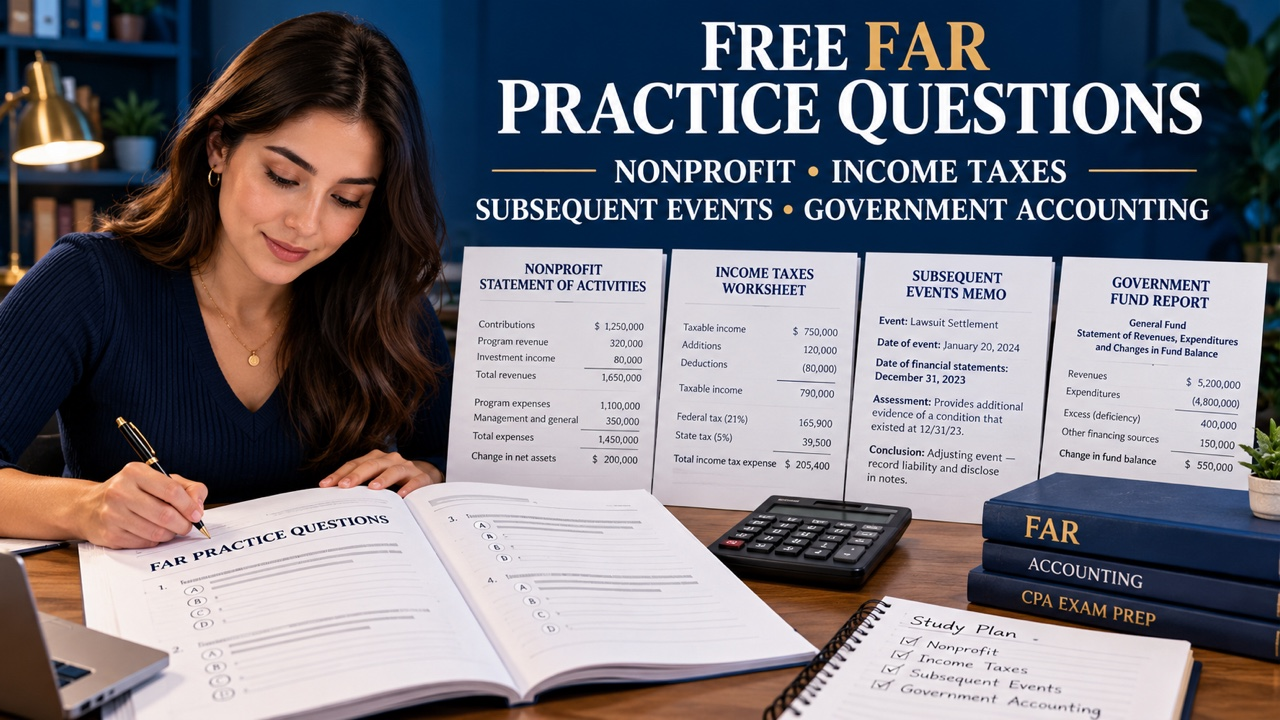

Direct answer: The most useful far nonprofit practice questions are short, original cases that force one decision at a time. Set the task verb, identify the controlling fact, write the evidence you would inspect, and record one repair before you attempt another item.
That sequence keeps nonprofit restrictions, income-tax basis, subsequent-event timing, and government accounting from collapsing into one vague memory exercise. It also gives you a study record you can revisit when a changed fact sends the answer down a different path.
Scope note: This is original educational material. Reopen the AICPA CPA Exam Blueprints for current tested boundaries and the NASBA CPA Exam FAQ for administration, jurisdiction, and score questions.
Use the FAR review hub for section orientation, the CPA study guide for a broader plan, and the Blueprint format guide, topic MCQ page, or TBS practice guide when you need another retrieval format.
FAR Nonprofit, Income Taxes, Subsequent Events, and Government Accounting: Original Practice
These topics share a useful discipline: name the reporting question before you calculate or classify anything. Donor restrictions can change the presentation lane. A temporary tax difference can turn on basis and reversal. Later events can be adjusting or disclosure-only depending on the condition at period-end. Government prompts can require the fund and reporting model before the amount means anything.
For that reason, the cases below use a compact evidence card. Each card has a task verb, a controlling fact, a date or basis, a proof point, and a next action. The amounts and names are invented for practice; they are not official, recalled, leaked, or exam-memory questions.
far nonprofit practice questions: choose the task verb
Begin with the verb: classify, measure, recognize, disclose, reconcile, or recommend. “Classify” calls for a lane and defining feature. “Measure” calls for a basis, period, or amount. “Disclose” calls for the information a reader needs and when. “Recommend” calls for a bounded next step.
If your note cannot repeat the verb, slow down. A familiar phrase such as “subsequent event” does not answer whether the condition existed at the reporting date. Likewise, “tax expense” does not supply the tax basis or the expected reversal pattern.
far nonprofit practice questions: keep the four signals separate
Write four labels in the margin: entity and restriction, tax basis, event date, and government fund or model. Pick one as the primary lane. Add a second only when the facts create a direct bridge. This prevents a fund label from replacing a reporting objective or a tax difference from swallowing an event-timing question.
For every item, save five lines: task verb; controlling fact; date, basis, or model; evidence to inspect; and repair if the answer fails. A blank line is useful information because it tells you what to review next.

Turn the practice set into an evidence map
Before opening an answer, give yourself a small reading window and a separate decision window. Speed is not the goal. The point is to see whether your reasoning survives one changed input. If the lane is unclear after the reading window, mark the missing field and continue; do not hide the uncertainty inside a guessed letter.
far nonprofit practice questions: what counts as proof
For a nonprofit case, the donor communication, restriction language, entity type, and reporting framework may be the decisive proof. An income-tax case compares book carrying amount with tax basis, then asks when the difference reverses and whether the framework recognizes the resulting item.
For a subsequent event, draw a two-point timeline: the reporting date and the event date. Ask whether the underlying condition existed at period-end. For a government case, record the fund category, measurement focus, basis of accounting, and reporting objective before interpreting the balance.
Use the distractor as a diagnostic
Write the strongest wrong answer before you read the rationale. A good distractor is tempting because it uses a true word in the wrong lane, applies the right rule to the wrong date, or skips the governing framework. Naming that temptation is more useful than merely recording that your choice was incorrect.
Then separate certainty from speed. Quick responses with an empty proof field are not completed attempts. A slower response that names the evidence gives you a reliable repair target for the next study block.
Attempt three original cases
Attempt each case cold. Record the five lines first, choose an answer, and only then open the rationale. These far nonprofit practice questions use simple values so the controlling fact stays visible.
Reveal the practice reasoning
Attempt each original case, write the five evidence lines, then reveal the rationale and mark one missing field.
Reveal the answer
Answer: The strongest route names the task verb, lane, controlling fact, evidence check, and repair.
Compare your process with the reasoning shown above.
Case 1: a restricted nonprofit contribution
Fact pattern: Harbor Path receives a $120,000 donor commitment restricted to renovating a community clinic. The letter names the project and says unused funds remain restricted. Its accounting summary labels the receipt “support,” but it does not identify the reporting framework or show whether any renovation work has occurred.
Question: What should the learner resolve first?
- Use the word support and treat the amount as unrestricted.
- Ignore the donor letter because the amount is easy to calculate.
- Confirm the entity and framework, read the restriction, and explain the presentation or release question that follows.
- Move directly to an income-tax basis calculation.
Answer and rationale: Choice 3 is the disciplined route. The donor purpose, entity context, and framework are the controlling evidence. One route treats a label as a rule. A second route discards the strongest document. The fourth route changes lanes before the nonprofit fact is resolved.
For the repair, write “restriction and framework” in the proof field, then name the document you would inspect before deciding how support is presented or released.
Case 2: a temporary tax difference
Fact pattern: A nonprofit reports equipment at a $74,000 carrying amount. The tax basis is $58,000 because tax depreciation was accelerated. No expected reversal pattern appears in the file, and the reporting framework is also unstated.
Question: Which note shows the correct first move?
- Record tax expense equal to the $16,000 difference without further analysis.
- Compare the carrying amount and tax basis, identify the temporary difference, then check recognition and reversal under the stated framework.
- Assume the difference is permanent because the equipment is already in service.
- Use the nonprofit restriction analysis from Case 1.
Answer and rationale: Choice 2 keeps measurement, timing, and framework together. One shortcut turns a difference into an answer without testing the rule. Another shortcut confuses current use with permanence. A final shortcut imports the wrong lane.
As the repair, add the missing reversal evidence: expected timing, enacted tax rate or other applicable input, and the framework that controls recognition.
Case 3: a later event and a government fund
Fact pattern: On February 6, a city learns that a vendor entered bankruptcy. The December 31 statements are still being prepared, and the city had already received repeated late-payment notices in December. A separate question asks whether an expenditure belongs in a governmental fund report, but the prompt does not name the fund or measurement focus.
Question: What is the best next step?
- Call every February event nonadjusting and use the general fund answer for the separate question.
- Ask whether the bankruptcy condition existed at December 31, then identify the fund and measurement focus before deciding the government reporting treatment.
- Use the largest balance because it is most likely to be material.
- Skip both questions and add more mixed items.
Answer and rationale: Choice 2 respects both evidence lanes. December notices may indicate a condition that existed at period-end, while the government answer cannot be selected without the fund and reporting model. One shortcut replaces analysis with a date shortcut. Another shortcut substitutes size for the reporting objective. Finally, the shortcut adds volume before repairing the missing facts.
The repair step is to draw the two-date timeline and write the fund, measurement focus, and basis of accounting that the prompt requires.
far nonprofit practice questions: read each rationale
After the attempt, compare your five-line note with the explanation in the same order. First, find the task verb. Next, underline the fact that controls the lane. Then verify the date, basis, or model. Finally, state why the strongest distractor does not answer the task.
When the first answer feels obvious, change one input. Remove the donor restriction, change the tax basis, move the event condition to January, or switch the government fund. When the answer changes, write the new controlling fact. If it does not change, explain why the altered fact is irrelevant.
This transfer step is what makes far nonprofit practice questions useful beyond a single answer. You are testing the route, not memorizing a sentence.
far nonprofit practice questions: replay one changed fact
Use the repair card below when a proof field is empty. Select the earliest missing step, complete that one step, and replay only one case. Do not add a larger mixed set until the replay gives a complete explanation.
For example, if Case 2 failed because the reversal date was missing, reopen the source boundary, add a one-sentence timing note, and run the same calculation with a different basis. If Case 3 failed because the fund was unnamed, classify the fund before revisiting the event analysis.

The second visual is a compact record of that replay: question, evidence, changed input, and why the conclusion moved. Use it as a prompt for your own note rather than as an answer key.
far nonprofit practice questions: make the next block specific
At the end of a session, keep one line for scope, one for the controlling fact, one for the source or exhibit checked, one for the distractor rejected, and one for the changed-fact result. That record tells you whether the next block should be a terminology check, a timeline drill, a tax-basis calculation, or a fund-classification example.
Use current AICPA material for scope and current professional guidance for a live engagement conclusion. The cases, explanations, and repair cards here are independently written study prompts. For exhibits, move to the TBS practice guide. When recall is the weak point, use the topic MCQ page.
far nonprofit practice questions checklist
- Save the current Blueprint row and its checkpoint date.
- Circle the task verb before reading the options.
- Choose one primary lane: restriction, tax basis, event date, or government fund/model.
- Write the controlling fact and the evidence you would inspect.
- Attempt the original scenario before opening the rationale.
- Name the strongest distractor and why it is tempting.
- Change one input and explain whether the route changes.
- Record the earliest missing proof field as the next action.
- Retry one case before adding more volume.
A strong far nonprofit practice questions routine is observable: state the scope, isolate the fact, verify the evidence, explain the distractor, and show transfer after one changed input.
far nonprofit practice questions FAQ
Are these official CPA Exam questions?
No. The scenarios and rationales are original editorial practice. Use current AICPA material for authoritative scope and terminology.
What should I write when I miss an item?
Record the task verb, controlling fact, proof point, strongest distractor, and one changed-fact retry.
How do I practice the four topics without mixing them up?
Choose one primary lane first, then add a second lane only when the facts create a direct bridge.
Does this method promise a passing result?
No. It creates a visible reasoning trail and a focused next action; actual results depend on current rules, preparation, and performance.