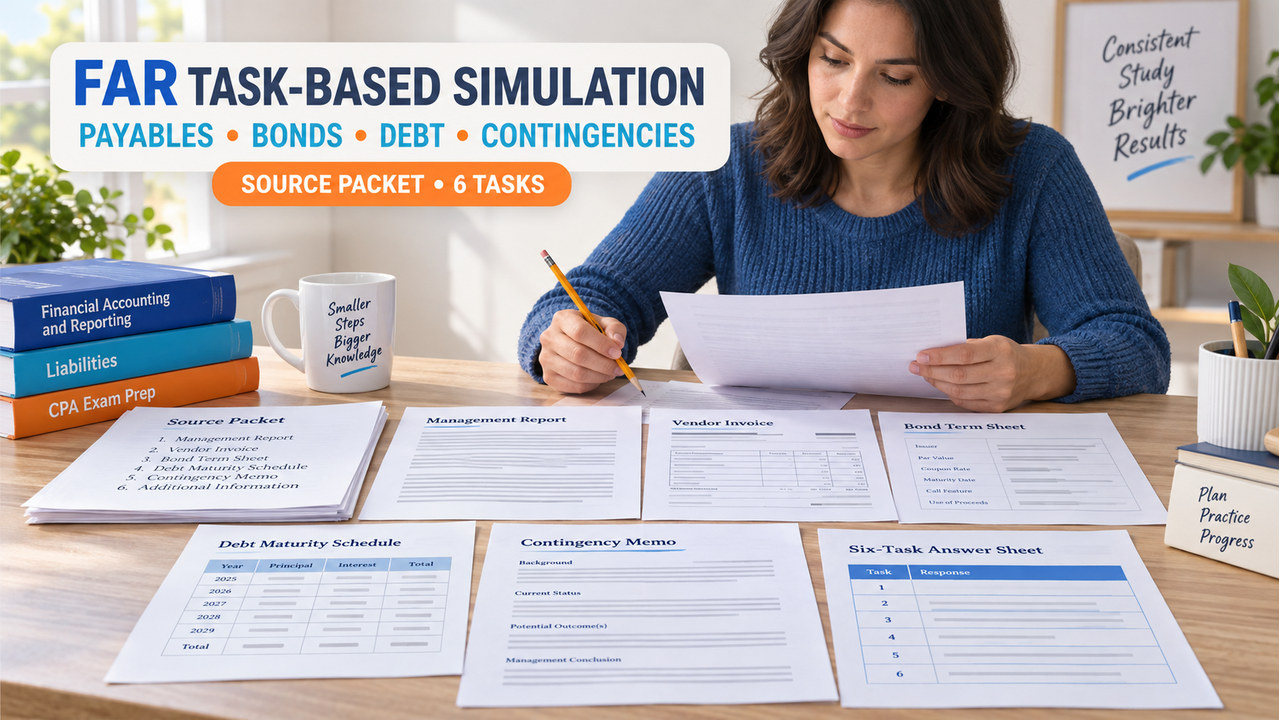

Direct answer: Use this payables bonds debt and contingencies simulation as an evidence handoff. Read the source record, identify the rule trigger, return the requested unit, write one support sentence, and log the first broken field. The cases below are original study material. Set a 16-minute limit for six tasks and open each answer only after choosing an option.
Editorial review: The CPA Exam Prep editorial team checked the scope boundary against the current AICPA Blueprint and saved the accounting research checkpoint on September 24, 2026. Amounts, documents, options, rationales, visual labels, and study actions are independently authored. A real reporting conclusion still requires current research and the complete facts.
For scope, reopen the AICPA CPA Exam Blueprint. On technical conclusions, use the current FASB Accounting Standards Codification. Meanwhile, the NASBA CPA Exam FAQ covers administration separately. The AICPA sample-test resource can orient you to software and format, but it does not turn this local simulation into a score predictor.
What this payables bonds debt and contingencies simulation tests
This payables bonds debt and contingencies simulation tests whether you can keep five fields separate when the packet contains several plausible numbers. First, identify the source record: a receiving report, bond term sheet, maturity schedule, counsel memo, or note. Next, mark the reporting date or elapsed period. Then, name the accounting lane—payable, interest expense, current debt, contingency, accrued interest, or cash interest. After that, return the unit requested by the prompt. Finally, support the response in one sentence.
Instead, do not treat the number correct as a score, readiness estimate, or pass probability. The useful output is a visible evidence trail. However, a correct answer without a source or period is fragile; a missed answer with a named broken field is repairable. Keep the first attempt intact and postpone reveals until every task has an option selected.
Which record controls?
Which period applies?
Which accounting field?
What must you return?
Why does it follow?
Build the source packet for a payables bonds debt and contingencies simulation
Before calculating, sort the packet into six evidence tabs. For example, pair the receiving report with the invoice for cutoff; group bond face amount, carrying amount, coupon, yield, and payment period; place the maturity schedule beside the reporting date; and put the counsel memo, note principal, rate, elapsed days, and day-count convention in their own rows. Therefore, a memorable number is less likely to answer the wrong question.
Similarly, for each tab, write the requested output in plain language: year-end payable, four-month expense, current principal, recognized claim, accrued interest, or six-month cash interest. Otherwise, if a number is not needed for that unit, mark it as a distractor instead of forcing it into the formula.

Run the payables bonds debt and contingencies simulation
First, use the same five-step routine for all six original tasks: read the record, research the trigger, decide, support, and review the first broken field. Assume a calendar year-end, no tax effects, no unusual elections, and only the stated facts. A changed real-world fact can change the conclusion.
1. Receiving report and accounts payable
For Task 1, tested skill: identify the cutoff evidence. Assumptions: goods were accepted before year-end, no return is stated, and the question asks for the simplified payable. Difficulty: foundational. Harborline received and accepted $58,400 of inventory on December 30. The vendor invoice was entered on January 4 and cash was paid on January 23.
Question: What amount belongs in the December 31 payable?
- A. $0 because the invoice was entered after year-end
- B. $58,400 because accepted goods were received before year-end
- C. $23,000 because that is the payment date
- D. $81,400 because invoice entry and payment are combined
Reveal Task 1 answer and reasoning
Answer: B. Therefore, the receiving report and acceptance date place the obligation in the year-end period, so the simplified payable is $58,400. Option A follows data entry rather than receipt. By contrast, option C treats cash timing as liability timing, and option D invents an addition. Next action: draw receipt, invoice entry, and payment on one line before retrying another cutoff task.
2. Effective interest on a bond
Next, Task 2 tested skill: apply the effective yield to carrying amount for elapsed time. Assumptions: the annual yield remains constant and the question asks for four-month interest expense. Difficulty: measurement. A bond has a $900,000 carrying amount at the start of the period and a 6% annual effective yield.
Question: What simplified four-month interest expense should be calculated?
- A. $13,500
- B. $18,000
- C. $54,000
- D. $36,000
Reveal Task 2 answer and reasoning
Answer: B. Accordingly, use carrying amount, effective yield, and elapsed fraction: $900,000 × 6% × 4/12 = $18,000. Option A uses three months, option C uses a full year, and option D uses eight months. Next action: label carrying amount, rate, and time fraction before touching an answer choice.
3. Current portion of debt
Then, Task 3 tested skill: classify principal at the reporting date. Assumptions: only principal is requested and no refinancing exception is stated. Difficulty: classification. A $640,000 installment note has $140,000 of principal due during the next twelve months and $500,000 due later.
Question: What current portion should be presented in the simplified answer?
- A. $0
- B. $140,000
- C. $500,000
- D. $640,000
Reveal Task 3 answer and reasoning
Answer: B. As a result, current principal is the amount scheduled within the next twelve months: $140,000. Option A ignores the schedule, option C selects the later amount, and option D leaves current and later debt unsplit. Next action: put the reporting date in the middle of the maturity schedule before reviewing interest.
4. Probable and reasonably estimable claim
Meanwhile, Task 4 tested skill: keep probability separate from measurement. Assumptions: use the simplified recognition exercise and do not invent insurance recovery. Difficulty: judgment. Counsel says a claim loss is probable and the best estimate at year-end is $72,000.
Question: Which response follows from the stated fields?
- A. Recognize a $72,000 loss and liability
- B. Disclose only because no cash was paid
- C. Recognize the claimant’s opening demand automatically
- D. Ignore the claim because the estimate is noncash
Reveal Task 4 answer and reasoning
Answer: A. Therefore, under the stated simplified facts, probable plus reasonably estimable supports recognition of the $72,000 loss and liability. Option B confuses payment with recognition. Conversely, option C substitutes a demand for the best estimate, and option D treats noncash measurement as irrelevant. Next action: write probability and estimate on separate lines before combining them at the response step.
5. Accrued interest by elapsed days
Afterward, Task 5 tested skill: accrue interest for an elapsed reporting period. Assumptions: use a 360-day year and simple daily accrual. Difficulty: time-apportioned calculation. A $500,000 note carries an 8.4% annual rate, and 45 days have elapsed since the last payment.
Question: What accrued interest should be recorded?
- A. $1,750
- B. $5,250
- C. $21,000
- D. $42,000
Reveal Task 5 answer and reasoning
Answer: B. Thus, annual interest is $500,000 × 8.4% = $42,000. Apply the elapsed fraction: $42,000 × 45/360 = $5,250. Option A uses too little time, option C uses half a year, and option D records a full year. Next action: write the annual amount, day count, and denominator before calculating.
6. Six-month cash interest
Finally, Task 6 tested skill: return the requested cash-interest unit rather than effective expense. Assumptions: interest is paid semiannually and the question asks for cash paid. Difficulty: requested-unit control. A $780,000 bond has a 7% annual coupon. Its carrying amount and effective yield are supplied elsewhere but are not needed here.
Question: What six-month cash interest is paid?
- A. $13,650
- B. $27,300
- C. $54,600
- D. Carrying amount multiplied by effective yield
Reveal Task 6 answer and reasoning
Answer: B. Consequently, cash interest uses face amount, coupon, and six months: $780,000 × 7% × 6/12 = $27,300. Option A uses one quarter, option C uses a full year, and option D answers expense instead of cash. Next action: write “cash” or “expense” above the formula before selecting inputs.
Support each simulation answer with a research trail
After the first attempt, do not merely copy the answer letter. Next, build a compact support sentence that names the source record, trigger, requested unit, and nearest distractor. The table below is a study scaffold, not a substitute for the current Codification when a real case changes an assumption.
| Task lane | Evidence to name | Proof to keep |
|---|---|---|
| Cutoff | Receiving report and acceptance date | $58,400 payable at year-end |
| Bond measurement | Carrying amount, yield, and four months | $18,000 expense formula |
| Classification | Maturity schedule at reporting date | $140,000 current principal |
| Contingency | Probability and best estimate | $72,000 recognition response |
| Accrual / cash | Rate, face, carrying amount, and period | $5,250 accrual or $27,300 cash |
For a current conclusion, reopen the authoritative source for the question. In particular, use the AICPA Blueprint for scope, the Codification for technical accounting, and NASBA or the relevant jurisdiction for administration. This simulation forces the handoff to be explicit; it is not authority by itself.
Route a payables bonds debt and contingencies simulation result to a next drill
In practice, score only after writing a support sentence for every task. Additionally, count a point only when the answer, source record, period, requested unit, and rejected distractor are visible. If the option is right for the wrong reason, mark it for repair.

For a 0–2 result, rebuild: sort the packet, label the five fields, and redo Tasks 1, 3, and 5. Next, for 3–4, target the first weak lane with two changed facts. Finally, for 5–6, transfer one task by changing one fact and explaining why the distractor still fails. None predicts a CPA result.
Log the first break in the payables bonds debt and contingencies simulation
First, classify the earliest broken field, not the last arithmetic mistake. A source break means you used the invoice entry, cash date, or claimant demand instead of the controlling record. Next, a date break means you skipped receipt timing, reporting date, maturity, or elapsed days. Then, a measurement break means you mixed carrying amount with face amount or coupon with yield. After that, a judgment break means you combined probability and estimability without checking both. Finally, a unit break means you answered cash when the prompt asked for expense, or expense when it asked for cash.
Next, write the first break as “I used ___, but the task asked for ___.” However, change one fact only: move the receipt to January 2, change the yield to 5%, move $140,000 of principal outside twelve months, remove the reliable estimate, change 45 days to 60 days, or switch cash to expense. As a result, a controlled change tests transfer.
Retry one changed fact before leaving the simulation
Use Task 4 as the judgment retry. Keep the claim probable, but change the fact so counsel can no longer make a reasonable estimate. Do not reuse the old $72,000 recognition answer automatically. Instead, separate the probability field from the measurement field, state the simplified disclosure response, and explain why the claimant’s demand cannot fill the missing estimate. If your first answer changed without a rule sentence, the retry is not complete.
Next, choose the lane with the weakest support sentence. If you calculated $5,250 but missed the 360-day assumption, do an elapsed-period drill. When you selected $27,300 using carrying amount, do a cash-versus-expense drill. When $140,000 was current but lacked a reporting-date anchor, rebuild the maturity schedule.
Refresh the payables bonds debt and contingencies simulation before reuse
Before reusing this payables bonds debt and contingencies simulation, reopen the AICPA CPA Exam Blueprints for scope and the FASB Codification for the technical boundary. Use the AICPA sample test for software familiarity and the NASBA FAQ for administration. These links set boundaries; they do not change the original cases.
Finally, recheck every number, date, assumption, image label, and answer reveal. In addition, keep the simulation clearly labeled as original study material. If a real prompt supplies a different standard, jurisdiction, reporting date, or contractual term, stop the shortcut and research the current source.
Payables bonds debt and contingencies simulation FAQ
Is this a provider-issued task-based simulation?
No. It is original simplified study material for evidence selection, rule triggers, requested units, and review actions.
What should I do before opening the answers?
Read all six cases, select an option, name the source and period, and write the rejected distractor.
How should I use a low result?
Use the first broken field to choose a narrow rebuild or target drill.
Why separate cash interest from interest expense?
Cash interest uses face amount and coupon, while effective interest uses carrying amount and effective yield for the requested period.