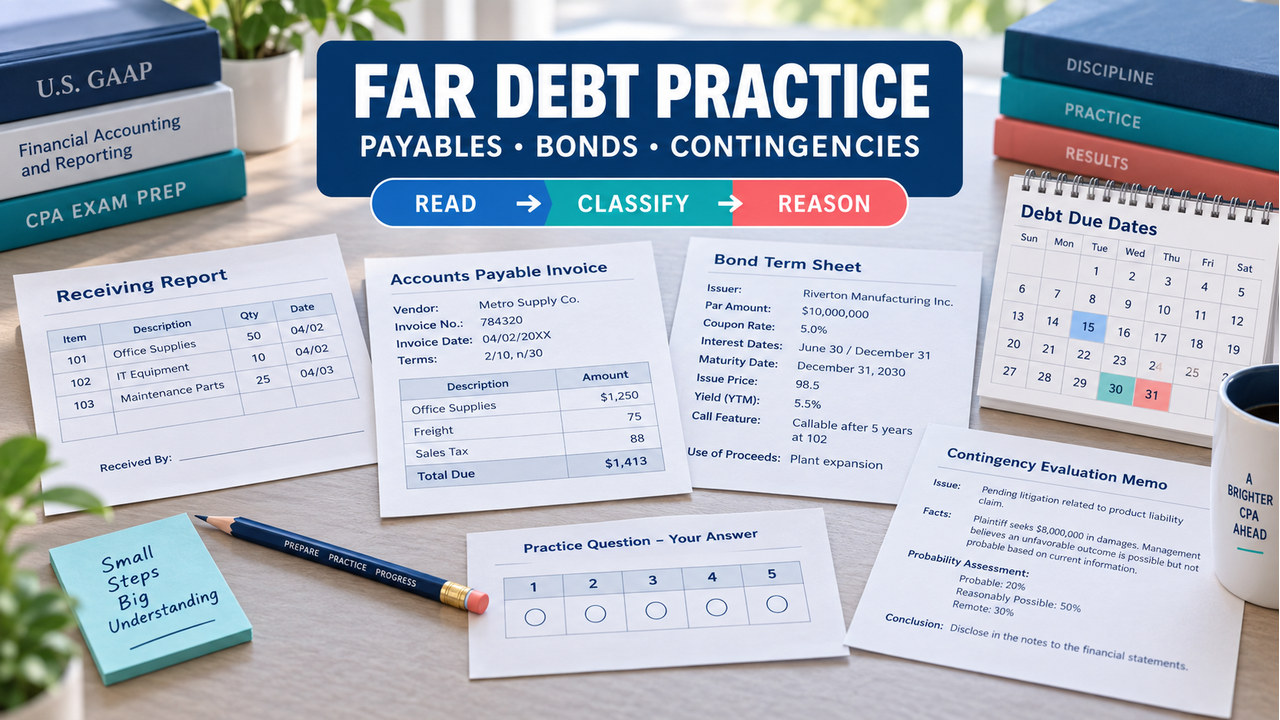

Direct answer: The fastest way to use bonds debt practice questions is to force every case through four fields: identify the source, name the accounting lane, choose the measurement or reporting-date test, and write the requested response unit. In practice, this routine separates a receiving date from a payment date, a bond coupon from effective interest, a due date from a label, and probability from estimation. The cases below are original study material with delayed explanations.
Editorial review: The CPA Exam Prep editorial team checked the scope against the current AICPA Blueprint and linked FASB research boundaries on September 24, 2026. The questions, amounts, answer rationales, visuals, and study actions are original simplified material, not provider-owned exam content, a licensed accounting opinion, or a score prediction.
For scope, reopen the AICPA CPA Exam Blueprint. For technical research, use the current FASB Accounting Standards Codification, especially the applicable debt, interest, and contingency topics. The NASBA CPA Exam FAQ is a separate administration checkpoint.
How bonds debt practice questions sort the answer row
First, treat the prompt like a handoff between four workpapers. The source tells you where the fact came from. The lane tells you which liability model is relevant. The measurement field tells you whether to record, classify, calculate, or disclose. Finally, the response unit tells you whether the question wants an amount, a balance-sheet category, a journal-entry direction, or a disclosure conclusion.
- Source: circle the invoice receipt date, bond terms, note maturity, probability memo, or waiver notice.
- Lane: label accounts payable, bond debt, note classification, loss contingency, or covenant evidence before calculating.
- Measure: choose cutoff, effective interest, reporting-date classification, recognition versus disclosure, or the stated simplified measurement.
- Response: write the requested unit: liability amount, interest expense, current or noncurrent, accrue or disclose, or the reason a shortcut fails.
That sequence matters because plausible answers often use a true number in the wrong role. For example, a coupon rate can be real but still fail to answer an effective-interest question. Similarly, a payment date can be real but still fail a goods-received cutoff. A loss estimate can be precise but still require a different response when probability changes. Therefore, do not start with arithmetic; start with the controlling fact.
Use bonds debt practice questions as a four-field routine
Write source → lane → measure → response in the margin. Next, place one fact beside each word. If a field is blank, the case is not ready for a formula. If two facts appear interchangeable, describe their roles in plain language: face amount, carrying amount, market yield, maturity date, probability, or estimate. In contrast, do not let a clean-looking answer row hide an unsupported assumption.
Invoice, term sheet, due date, or memo.
AP, bond, note, or contingency.
Cutoff, yield, date, or probability.
Record, classify, disclose, or explain.

Original bonds debt practice questions
Before starting, note the tested skill and difficulty: these are five original, medium-difficulty mixed-liability cases. Assume a calendar year-end, no tax effects, no unusual elections, and only the facts stated in each exhibit. Attempt the prompt before opening its reveal. The purpose is to make the reasoning visible, not to imitate any provider’s item bank.
Case 1: accounts-payable cutoff
Exhibit A — receiving file: A $84,000 shipment arrived and was accepted on December 29. The vendor invoice was entered on January 3, and cash was paid on January 12. The goods were still on hand at December 31. The prompt asks for the accounts-payable treatment at year-end.
Prompt: Which date controls the liability, and what amount belongs in the December 31 accounts-payable balance?
Reveal Case 1 answer and reasoning
Answer: Therefore, record $84,000 at December 31 in this simplified cutoff case because the goods were received and accepted before year-end. The January 3 entry date and January 12 payment date are later processing events; they do not move the obligation out of the period in which the goods were received.
Distractor: “Record when paid” sounds operationally tidy but uses the cash date instead of the liability evidence. Repair: Circle the receiving report date before looking at the invoice-entry date.
Case 2: bond discount and effective interest
Exhibit B — bond term sheet: Face amount is $500,000, the annual coupon rate is 6%, cash interest is paid annually, and the stated issue price is $463,000 because the market yield is 8%. The prompt asks for first-year cash interest, effective interest expense, and discount amortization.
Prompt: Which rate belongs in the effective-interest row, and what is the first-year discount amortization?
Reveal Case 2 answer and reasoning
Answer: First, cash interest is $30,000, or $500,000 × 6%. Using the supplied issue price and 8% market yield, first-year effective interest is $37,040, or $463,000 × 8%. Consequently, discount amortization is $7,040, the difference between effective interest and cash interest. The ending carrying amount is $470,040 before the next period’s calculation.
Distractor: Applying 6% to the issue price would answer a coupon-style question, not the effective-interest question. Repair: Write “cash” beside the coupon row and “expense” beside the market-yield row.
Case 3: debt classification at the reporting date
Exhibit C — note schedule: A $240,000 note is due on June 30 of the next calendar year. A long-term refinancing agreement was signed on January 10 after the December 31 reporting date. The prompt asks for the December 31 current-versus-noncurrent classification under the stated simplified facts.
Prompt: Which evidence should control the December 31 classification?
Reveal Case 3 answer and reasoning
Answer: However, classify the note as current under these simplified facts because it is due within the next year and the refinancing agreement was signed after the reporting date. The question is testing the reporting-date evidence, not the later comfort created by the January agreement.
Distractor: Calling the note long-term because management later arranged refinancing skips the balance-sheet date. Repair: Put a vertical line at December 31 and label every later event as post-reporting-date evidence.
Case 4: contingency recognition versus disclosure
Exhibit D — counsel memo: A claim loss is probable and reasonably estimable at $96,000. The prompt asks for the simplified year-end response. A transfer question later changes only the probability from probable to reasonably possible while keeping the estimate at $96,000.
Prompt: What response follows before the probability changes, and what changes after it does?
Reveal Case 4 answer and reasoning
Answer: Accordingly, under the simplified facts, recognize a $96,000 loss and liability when the loss is probable and reasonably estimable. After probability changes to reasonably possible, do not accrue the loss under this exercise; prepare the appropriate disclosure of the nature and estimated exposure instead. The amount alone does not decide the lane.
Distractor: Accruing every quantified risk ignores the probability field. Repair: Write probability first, estimate second, and response third.
Case 5: covenant waiver evidence
Exhibit E — lender notice: A $600,000 loan would be callable because of a covenant violation at December 31. Before the financial statements are issued, the lender signs a waiver that lasts through the next reporting year. The prompt asks which evidence should be reviewed before classifying the debt.
Reveal Case 5 answer and reasoning
Answer: In that case, read the covenant violation, the lender’s call right, the waiver date, and the waiver period together. Under this simplified fact pattern, the waiver obtained before issuance and lasting beyond one year supports a noncurrent classification, subject to the applicable current guidance and the complete facts.
Distractor: “Violation means current” stops at the first fact and ignores the waiver evidence. Repair: Add a second line to the source field whenever a notice changes the lender’s enforceable right.
Review bonds debt practice questions by broken field
After the reveals, label the first broken field rather than only counting correct answers. An evidence error means you used the payment date instead of the receiving report, or skipped the waiver notice. With a lane error, you treated a contingency like a bond or a note like a payable. Measurement fails when you use the coupon instead of the market yield, or accrue without checking probability. Finally, a response error means your calculation was useful but you answered the wrong unit.
For this reason, use that label to choose the next retry. Case 1 misses call for three receiving-report cutoffs. For Case 2, write cash interest and effective interest in separate rows. Draw the reporting-date timeline for Case 3 or Case 5. On Case 4, switch only probability and keep the estimate fixed. This approach is more useful than a single percentage because it identifies what to rehearse next.

Turn bonds debt practice questions into a targeted review plan
Choose one first-miss field and repeat that move for ten minutes. First, for cutoff, mark receipt, invoice entry, and payment on three timelines. Next, for bonds, calculate cash interest, effective interest, amortization, and ending carrying amount from two term sheets. Then, for classification, draw the reporting date and place every refinancing or waiver event after it. Finally, for contingencies, make a two-column record for probability and estimate before choosing recognize, disclose, or neither.
| First broken field | Ten-minute drill | Proof to keep |
|---|---|---|
| Source | Mark receipt, payment, notice, and waiver dates. | The controlling document is named. |
| Lane | Label AP, bond, note, or contingency before solving. | The lane appears before the equation. |
| Measurement | Separate coupon, yield, probability, and estimate. | Each input has a named role. |
| Response | Rewrite the result as amount, category, or disclosure. | The final row answers the prompt’s verb. |
Research and refresh bonds debt practice questions
For live conclusions, use the current AICPA CPA Exam Blueprints for scope and the current FASB Accounting Standards Codification for the applicable debt, interest, and contingency guidance. The AICPA sample test can help you learn the software format, but it is not a readiness determination. This page intentionally uses simplified facts and does not replace current research for a complete reporting conclusion.
Before publication, refresh time-sensitive scope pages and recheck every arithmetic row. Also, treat the self-check as a study signal, not an official score, pass probability, or licensing conclusion.
Bonds debt practice questions FAQ
What should I identify before calculating a debt answer?
Identify the source, liability lane, measurement test, and requested response unit. The controlling fact may be a receipt date, market yield, due date, probability, or waiver.
Why is the bond coupon not always the interest expense?
The coupon determines cash interest, while the effective-interest row uses the market yield applied to the carrying amount in the simplified case.
What is the quickest contingency repair?
Write probability and estimate on separate lines. Then choose recognize, disclose, or neither under the stated facts and current guidance.
How should I use a practice-set result?
Find the first broken field and assign a narrow retry. Do not treat the result as a readiness score or a licensing conclusion.