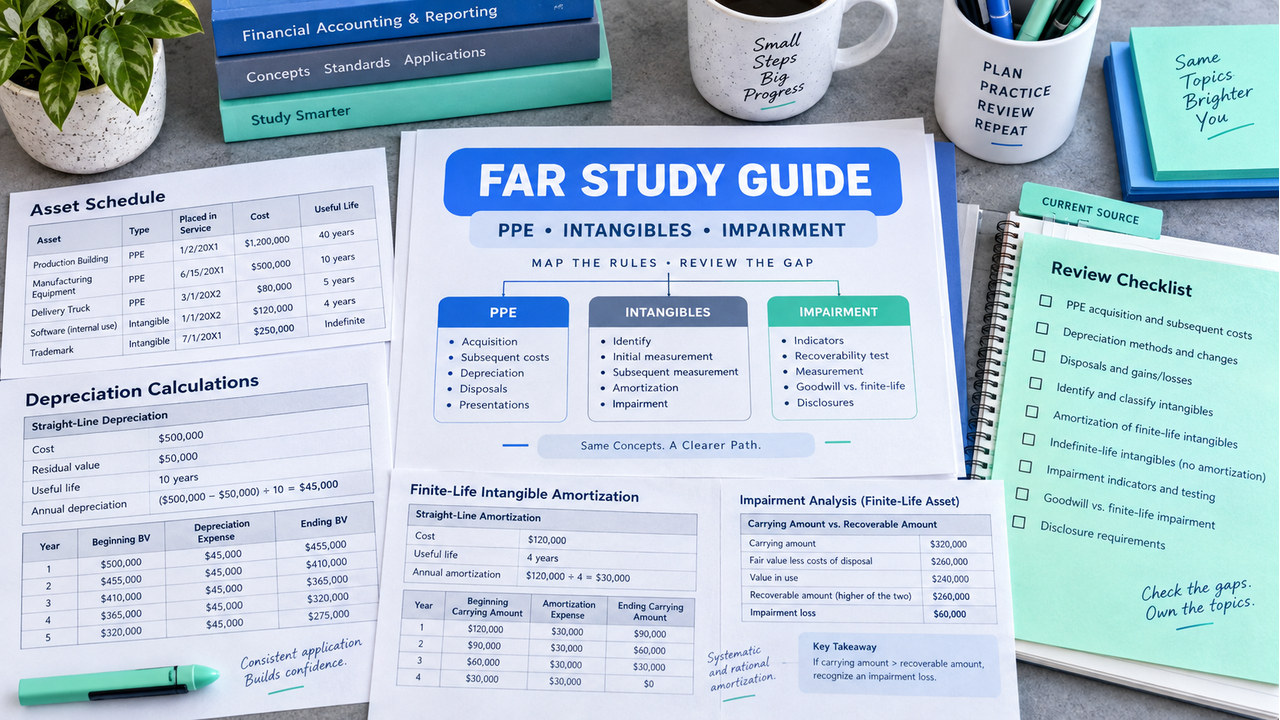

Quick answer: This FAR PPE depreciation intangibles and impairment study guide is most useful when you treat the topic as a decision order, not one giant formula. First classify the asset. Then lock the basis and the ready-for-use clock. Next separate estimate changes, finite-life amortization, indefinite-life impairment, and the held-and-used recoverability gate. Finally, use the first broken fact to choose your next review block.
Editorial review: Written by the CPA Exam Prep editorial team and technically checked against the current AICPA Blueprint and linked FASB boundaries on September 24, 2026. This page is educational study material, not a licensed accounting opinion or official exam content.
For scope, reopen the AICPA CPA Exam Blueprint. For live US GAAP conclusions, reopen the FASB Accounting Standards Codification. The FAR review hub is the broader navigation route, while the NASBA CPA Exam FAQ is the separate place for administration questions.
What this FAR study guide helps you decide
Use the following map before you reach for a calculator. The tested skill is not just arithmetic; it is identifying the fact that controls the arithmetic. The examples below use simplified assumptions so the reasoning is visible. In a real fact pattern, current Codification guidance can add components, taxes, disposal classifications, or another impairment model.
| Lane | First question | Output | Evidence to write |
|---|---|---|---|
| PPE basis | What cost belongs in basis? | Depreciable basis | Invoice, freight, installation, testing, salvage |
| PPE clock | When was the asset ready for use? | Months in service | Date available, not the date you remember the invoice |
| Estimate | Did residual value or life change? | Prospective amount | Use the new carrying amount and remaining life |
| Finite life | When was the right available for use? | Amortization | Cost less residual, spread over remaining useful life |
| Indefinite life | Is routine amortization appropriate? | Impairment test | Test under the current Topic 350 boundary |
| Held and used | Did the recoverability gate fail? | Loss measurement | Compare undiscounted cash flows before fair value |
| Review | Which fact first broke? | Next block | Redo one changed fact without notes |
Difficulty: medium overall, with one hard sequencing example. Assumptions: straight-line depreciation or amortization where stated, no residual value for the patent, and simplified impairment facts. Study goal: explain why the chosen lane controls before you calculate.
Build a one-page FAR study guide map
Start with the object and the requested output. A machine, patent, brand, and held-and-used asset group may all appear in the same FAR session, but they do not share the same first step. For example, the machine asks you to build basis and count months. The patent asks when the right became available for use. The brand asks whether the impairment lane applies. The held-and-used group asks whether recoverability fails before fair value measures a loss.

- Classify the asset. Write PPE, finite-lived intangible, indefinite-lived intangible, or held-and-used asset group.
- Mark the controlling date. Use the ready-for-use or available-for-use date when the question supplies one; do not substitute the invoice date.
- Build the requested amount. Show included cost, excluded cost, salvage, life, remaining life, or the comparison gate before looking at the choices again.
- Separate the lane. A changed estimate is prospective under these simplified facts; an impairment gate is not the same as the measured loss.
- Write the review action. If the answer failed because of basis, review basis. If it failed because of sequencing, retry the changed fact before switching topics.
FAR study guide: work the PPE basis and clock
For a straight-line PPE example, the basic work is depreciable basis divided by useful life, multiplied by the fraction of the year in service. The difficult part is usually upstream: deciding which costs belong in basis and when the asset was ready for use. Under the simplified example below, freight, installation, and testing are included; salvage is not a cost and therefore reduces the depreciable amount.
| Field | Amount | Reason |
|---|---|---|
| Invoice + freight + installation + testing | $385,000 | Simplified capitalized basis |
| Less salvage value | ($15,000) | Not depreciable under the example |
| Depreciable basis | $370,000 | $370,000 ÷ 4 × 9/12 = $69,375 |
Therefore, the annual amount is $92,500 and the first nine months produce $69,375. If a distractor gives $72,188, it probably forgot salvage. If it gives a full-year amount, it ignored the ready-for-use clock. That diagnosis is more useful than merely circling the correct number.
Separate estimate changes from prior-period errors
Next, keep a revised residual value or useful life in the current and future periods under these simplified facts. An asset costing $260,000 with a $20,000 residual value and a five-year life has annual depreciation of $48,000. After two years, its carrying amount is $164,000. If residual value changes to $8,000 and four years remain, the revised annual amount is ($164,000 − $8,000) ÷ 4 = $39,000.
In other words, do not rebuild the first two years merely because the estimate changed. If the prompt instead describes an error in an earlier calculation, stop and analyze the error model separately. The study habit is to label the event before touching the number: estimate means revise forward; error may require a different correction analysis.
FAR study guide: use availability for finite-lived intangibles
A finite-lived patent or customer relationship has a life and an amortization clock. In the worked example, $168,000 of patent cost plus $12,000 of direct registration cost creates a $180,000 amount. With a six-year life, the annual amount is $30,000. If the right is available for use on July 1, the first-year amount is $15,000. The point is not to memorize July; it is to connect the output to the date the asset became available for use.
Keep finite-life amortization separate from an indefinite-life impairment test. If a choice uses a full-year amount when the right became available halfway through the year, the broken fact is timing. If a choice amortizes a brand merely because it is an intangible, the broken fact is classification.
Keep indefinite-lived impairment in its own lane
An indefinite-lived brand is not placed on a routine finite-life schedule in the simplified study example. If carrying amount is $410,000 and the impairment comparison produces fair value of $372,000, the indicated shortfall is $38,000. Reopen the current Topic 350 and Codification guidance for live conclusions because the actual test, unit of account, and timing can depend on the facts.
Here the nearest distractor is often $0, because the learner has carried finite-life logic into the indefinite lane. Another distractor may state fair value itself as the loss. Write the requested output in the margin: shortfall, not new carrying amount.
Apply the held-and-used recoverability gate first
For the simplified held-and-used example, carrying amount is $760,000, undiscounted cash flows are $740,000, and fair value is $690,000. Because $740,000 is below $760,000, the recoverability gate fails. Only then do we measure the simplified loss as $760,000 − $690,000 = $70,000.
Change only the undiscounted cash flows to $780,000 and the gate passes. Under the same simplified facts, the loss becomes $0 even though fair value remains $690,000. This one-fact change is a good review test because it catches the common sequencing error: using fair value before deciding whether the gate failed.
Use the review checklist to choose what to study next
Now convert the guide into a study action. Before revealing an answer, write the lane, controlling fact, and requested output. After the reveal, record the nearest distractor and complete one changed-fact retry. If the same lane breaks twice, keep the next block narrow: ten to fifteen minutes on basis and clock, estimate changes, finite-life timing, indefinite-life classification, or recoverability sequencing.

What to study next after this FAR study guide
If the basis or date was wrong, redo the PPE table and one six-month versus nine-month variation. For a wrong revised estimate, practice a prospective change without restating prior periods. When finite and indefinite were mixed, write a two-column comparison before solving another question. For a sequencing error at the gate, repeat the $740,000-to-$780,000 retry and explain why fair value comes later under the simplified facts.
Finally, return to the current Blueprint and Codification before using this page for a live plan or a material accounting conclusion. The strongest result from a study guide is a named next action: one lane, one changed fact, and one short review block.
FAR study guide questions
Is this an official CPA exam study guide?
No. It is original editorial study material. Use the current AICPA Blueprint for scope and do not treat the examples as provider-issued or score-predictive content.
What should I write first for a PPE depreciation question?
First identify the ready-for-use basis, residual value, useful life, and time in service. Then calculate only the output the question asks for.
Why are finite and indefinite intangibles separate in this guide?
They answer different study questions: finite-lived assets use an amortization clock, while indefinite-lived assets require an impairment-focused analysis rather than routine amortization.
What should I review after using fair value too early?
Review the held-and-used recoverability gate, retry the changed-cash-flow example, and then log whether the gate or the loss measurement was the first broken step.