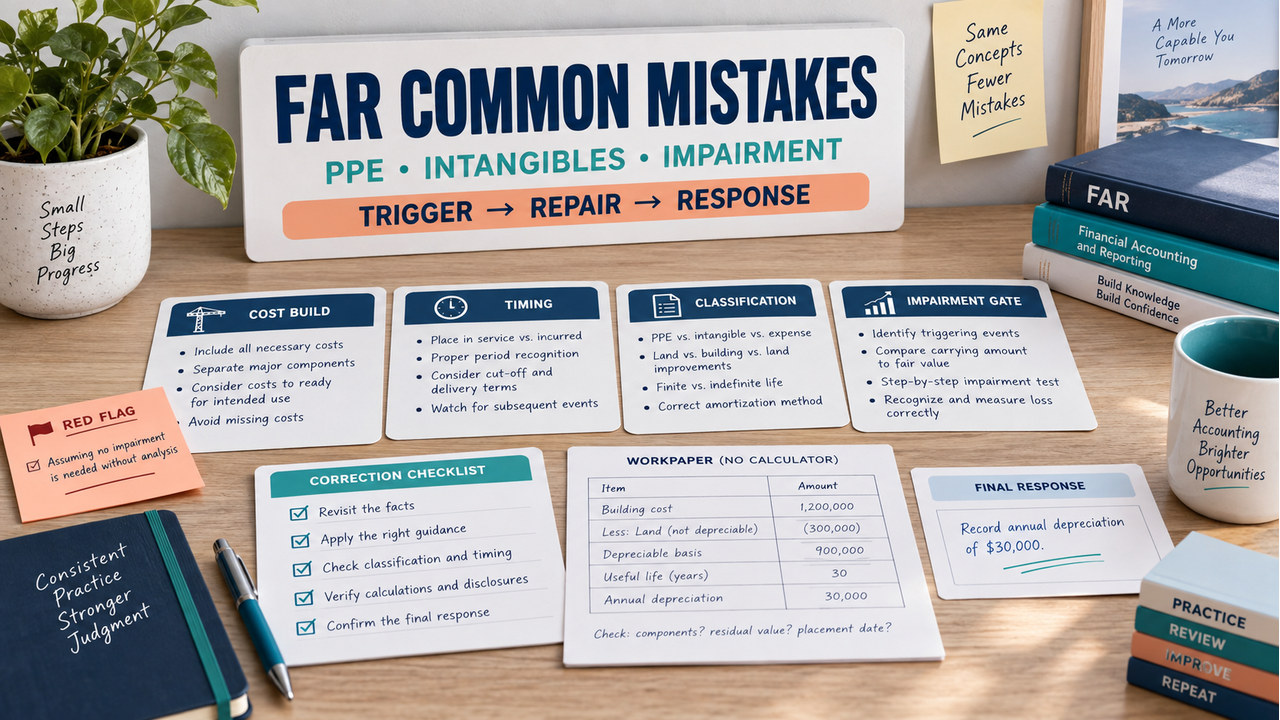

Direct answer: The fastest way to fix ppe depreciation intangibles mistakes is to stop treating every miss as a formula problem. First identify the trigger, then name the accounting lane, apply the controlling date or gate, and finally write the exact output the task requests. The four recurring errors in this guide are cost build, timing, classification, and impairment sequence. Each original case below shows the shortcut that fails and the repair that should replace it.
Editorial review: The CPA Exam Prep editorial team wrote this guide and checked it against the current AICPA Blueprint and linked FASB boundaries on September 24, 2026. The cases, amounts, explanations, visuals, and review actions are original simplified study material, not official exam content, a licensed accounting opinion, or a score prediction.
For scope, reopen the AICPA CPA Exam Blueprint. For technical boundaries, reopen the FASB Accounting Standards Codification and the saved FAR review hub. The NASBA CPA Exam FAQ is a separate administration checkpoint.
PPE depreciation intangibles mistakes: why they repeat
Most mistakes happen before the arithmetic. A learner sees a familiar word such as equipment, patent, trademark, or fair value and jumps to a remembered formula. However, a task-based row can ask for a different unit, period, lane, or decision gate. Therefore, read the request before you calculate.
- Cost error: an amount appears in the memo, so it is added without asking whether it brings the asset to the required condition.
- Timing error: a learner reports an annual expense even though the asset was ready for use or available for use partway through the year.
- Classification error: a learner uses a finite-life amortization pattern for an indefinite-lived asset or treats every comparison as a held-and-used screen.
- Gate error: fair value is used immediately even though the simplified task first asks whether the recoverability screen passes.
As a result, use a four-word margin check: TRIGGER, LANE, GATE, and OUTPUT. Start by identifying the fact that controls. Next, choose the model that applies. Then, check whether a screen comes before measurement. Finally, write the output that belongs in the response row.

Build a repair map for ppe depreciation intangibles mistakes
Next, replace a vague note such as “review depreciation” with a repair map. The table connects the visible trigger to the wrong shortcut and then to a proof that can be checked on the next attempt.
| Mistake | Trigger to circle | Repair proof |
|---|---|---|
| Cost | Does the cost prepare the asset for use? | Show included and excluded amounts separately. |
| Timing | When was the asset ready or available? | Annual amount and time fraction appear on separate lines. |
| Classification | Finite, indefinite, or held-and-used? | Write the lane before the formula. |
| Gate | Does recoverability come before measurement? | State the screen result before fair value. |
Original ppe depreciation intangibles mistakes practice set
In practice, the following four cases are original and simplified. Assume no tax effects, no disposal complications, no entity-specific elections, and no facts outside the stated exhibits. Attempt each prompt before opening the reveal. The point of these ppe depreciation intangibles mistakes is not to memorize a new answer; it is to catch the broken link between evidence and output.
Case 1: cost build and the full-year shortcut
Exhibit A — equipment memo: Invoice cost is $480,000, freight is $8,000, installation is $12,000, and employee training is $6,000. The equipment is ready for use on October 1. Salvage is $20,000 and useful life is five years. The task asks for depreciable basis and first-year straight-line depreciation.
Prompt: Which costs belong in basis, and what first-year amount should the response row report?
Reveal Case 1 answer and reasoning
Answer: Basis is $500,000: $480,000 + $8,000 freight + $12,000 installation. Exclude training from this simplified cost build. Annual depreciation is ($500,000 − $20,000) ÷ 5 = $96,000. As a result, three months from October 1 produces $24,000. The common mistake is to add training or report the full $96,000.
Repair: First rebuild the basis schedule. Then circle October 1 and multiply the annual amount by three months divided by twelve.
Case 2: available-for-use timing
Exhibit B — patent file: Purchase price is $144,000 and directly related registration cost is $12,000. The patent is available for use on October 1, has an eight-year finite life, and has no residual value. The task asks for the first-year amortization amount.
Prompt: What is the simplified basis, and which date controls the first-year fraction?
Reveal Case 2 answer and reasoning
Answer: The simplified basis is $156,000. Annual amortization is $19,500. Three months from October 1 produces $4,875. In contrast, the available-for-use date controls; the invoice date is not the same as the start of amortization. The common mistake is to report $19,500 for a full year.
Repair: Write “available for use: October 1” beside the schedule before doing any division.
Case 3: indefinite-lived classification
Exhibit C — brand review: The trademark remains indefinite-lived under the simplified facts. Its carrying amount is $860,000 and the applicable comparison gives fair value of $745,000. The task asks for the shortfall to carry into the response row.
Prompt: What amount belongs in the row, and why is a routine amortization schedule not the first step?
Reveal Case 3 answer and reasoning
Answer: The shortfall is $115,000: $860,000 − $745,000. Because the simplified facts classify the asset as indefinite-lived, use the applicable impairment comparison rather than a routine finite-life amortization formula. Instead, label the lane before dividing the carrying amount by an invented life or reporting fair value itself.
Repair: Label the lane “indefinite-lived” before writing carrying amount less fair value.
Case 4: recoverability gate before fair value
Exhibit D — asset-group forecast: Carrying amount is $1,050,000, undiscounted cash flows are $1,120,000, and fair value is $820,000. Under these simplified held-and-used facts, the task asks whether the screen passes and whether a loss should be reported.
Prompt: What must you decide before using fair value?
Reveal Case 4 answer and reasoning
Answer: The recoverability screen passes because $1,120,000 of undiscounted cash flows exceeds the $1,050,000 carrying amount. Therefore, under the simplified two-step case, record no impairment loss after a passing screen, even though fair value is lower. The common mistake is to jump directly to a $230,000 fair-value difference.
Repair: Write “screen passes; stop” before considering fair value. The gate, not the most dramatic number, controls the requested output.
Review the first ppe depreciation intangibles mistakes row
After the reveals, do not average the four cases into one confidence label. Instead, name the first row that broke. Evidence errors mean the learner selected the wrong amount or exhibit. Cost errors mix included and excluded amounts. Timing errors replace the service or available-for-use date with a full year. Classification errors blur finite, indefinite, and held-and-used lanes. Gate errors skip or reverse the recoverability screen. Finally, response errors hide the requested unit, period, pass/fail result, or loss row even when the calculation is right.

Use the first broken row to choose tomorrow’s work. For a cost miss, rebuild two included-cost schedules; for a timing miss, solve three date fractions. A classification miss calls for five asset labels before calculation. For a gate miss, write three screen-before-measurement responses. The purpose of this ppe depreciation intangibles mistakes guide is repair, not a decorative score.
Turn ppe depreciation intangibles mistakes into a ten-minute plan
However, an error label helps only when it changes the next block. Next, choose one row from the checklist and keep one piece of proof. Do not add a harder simulation until the same failure mode is stable.
| First broken row | Next ten-minute drill | Proof to keep |
|---|---|---|
| Cost | Build two basis schedules from short memos. | Included and excluded costs are labeled. |
| Timing | Solve three service-date or availability-date fractions. | Annual amount and fraction are separate. |
| Classification | Label five facts as PPE, finite, indefinite, or held-and-used. | The lane is written before the formula. |
| Gate | Write three screen-before-measurement responses. | Pass or fail is stated before fair value. |
| Response | Rewrite two answers in the requested unit and period. | Result, reason, and exhibit appear together. |
Research and refresh ppe depreciation intangibles mistakes
For live conclusions, use the current AICPA CPA Exam Blueprints to orient tested scope and use the current FASB Accounting Standards Codification for technical research. In addition, we keep the FASB long-lived-asset impairment summary and Topic 350 reference as checkpoints, not substitutes for current research. Meanwhile, this page uses simplified facts so the error path can be audited; it does not cover every asset-group, disclosure, tax, disposal, or jurisdiction-specific issue.
Also, before publication, refresh any time-sensitive source and recheck the arithmetic. Do not interpret one practice result as an official score, pass probability, or readiness determination.
PPE depreciation intangibles mistakes FAQ
What is the first check when an equipment answer looks wrong?
First, rebuild the basis from the memo and separate costs that prepare the asset for use from training or other excluded amounts. Then apply the service-date fraction.
Why can a full-year expense be a mistake?
Because the asset may become ready or available partway through the year. Write the controlling date before dividing or multiplying the annual amount.
Should an indefinite-lived trademark be amortized in this practice guide?
No. In this simplified case, label the asset as indefinite-lived and use the applicable impairment comparison instead of inventing a finite life.
Why should the recoverability gate come before fair value?
Therefore, state whether the simplified screen passes or fails before measuring a loss. A lower fair value does not by itself answer a screen-first task.