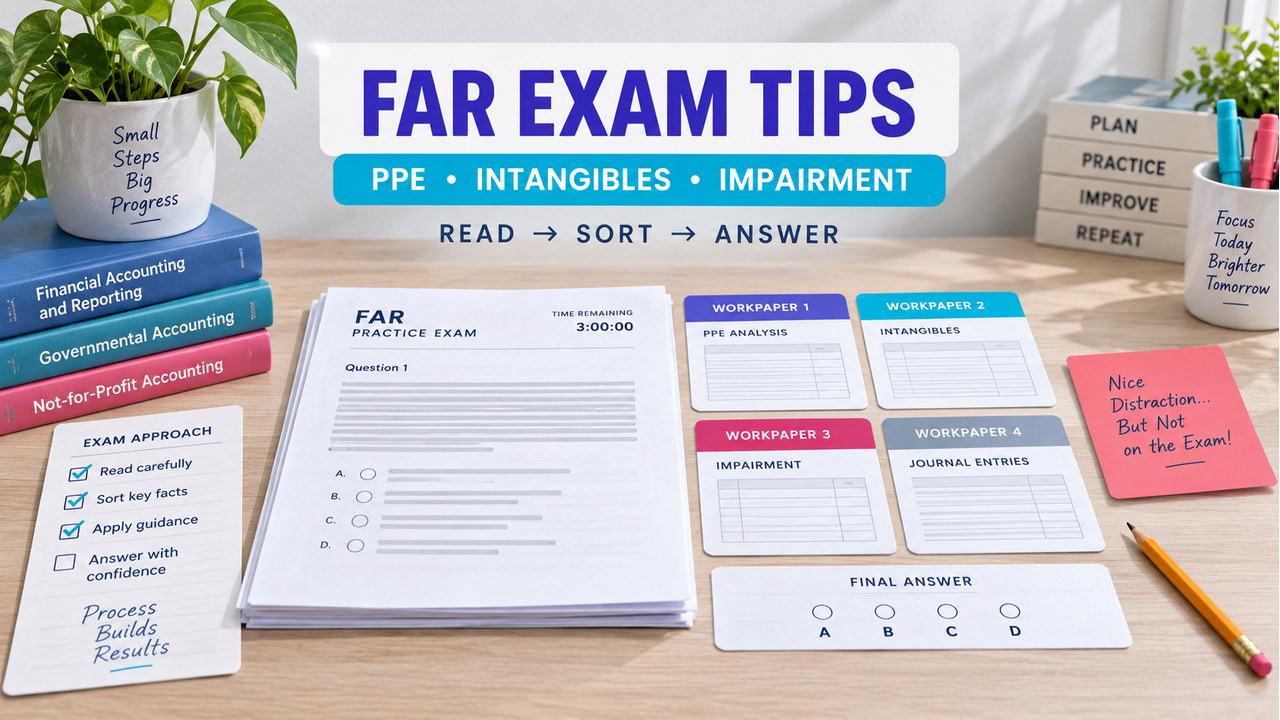

Direct answer: The most useful ppe impairment exam tips are five margin checks: identify the evidence, name the asset lane, circle the controlling date or life, choose the formula or impairment gate, and write the requested response unit. In practice, use the sequence on every mixed FAR row. As a result, an attractive distractor is less likely to replace the actual task.
Editorial review: The CPA Exam Prep editorial team checked this guide against the current AICPA Blueprint and linked FASB boundaries on September 24, 2026. Meanwhile, the cases, amounts, explanations, visuals, and review actions remain original simplified study material, not official exam content, a licensed accounting opinion, or a score prediction.
For scope, reopen the AICPA CPA Exam Blueprint. For technical boundaries, use the current FASB Accounting Standards Codification and the linked FAR review hub. In addition, the NASBA CPA Exam FAQ is a separate administration checkpoint.
How ppe impairment exam tips control the row
First, under time pressure, the first number you see can become a false starting point. For example, a cost figure may be an invoice amount, a carrying amount, a fair value, or an excluded service. Similarly, a date may be a purchase date, a service date, or an available-for-use date. Therefore, read the verb and the requested unit before solving.
- Evidence: identify the document, schedule, date, or comparison that supplies the fact.
- Lane: label the case PPE, finite-lived intangible, indefinite-lived intangible, held-and-used impairment, or a requested component.
- Date or life: circle the service or available-for-use date, residual value, useful life, or indefinite classification.
- Formula or gate: choose basis less residual over life, a time fraction, amortization, or a recoverability screen before fair value.
- Response: write basis, annual amount, first-year amount, amortization, loss, no loss, or the exact component the prompt requests.
In contrast, a fast calculation can still miss the row. For that reason, full-year depreciation is wrong when the asset enters service partway through the year. Likewise, a patent and an indefinite-lived trademark do not share one life assumption. Under the simplified held-and-used sequence in this guide, a lower fair value does not bypass the recoverability gate.
Use five ppe impairment exam tips in the margin
Write the five checks as short labels beside the question. Next, refuse to calculate until each label has a fact. In other words, this is not extra work; it is a way to make the answer auditable. If the prompt asks for a first-year amount, keep the annual amount and the time fraction on separate lines. If it asks for a component, do not silently answer for the entire machine.
Use the margin as a control panel, not as a second set of notes. Put the controlling fact beside the label it supports, and mark any assumption that came from the prompt rather than from a calculation. When two values look interchangeable, write their roles in words: basis, carrying amount, fair value, or undiscounted cash flows. That small translation makes the next equation easier to check.
Circle the verb and requested unit.
Name the evidence and asset lane.
Reject the shortcut before writing the result.

Original ppe impairment exam tips practice set
Before you begin, note that the following four cases are original and simplified. Assume no tax effects, disposal complications, entity-specific elections, or facts outside the exhibits. Attempt each prompt before opening the reveal. The goal is to practice the decision sequence, not to reproduce provider-supplied exam content.
Case 1: separate basis from first-year depreciation
Exhibit A — equipment memo: Invoice cost is $410,000, freight is $16,000, installation is $12,000, and employee orientation is $8,000. The equipment is ready for use on October 1. Salvage is $15,000 and useful life is eight years. The task asks for depreciable basis and first-year straight-line depreciation.
Prompt: What belongs in basis, and what amount belongs in the first-year response row?
Reveal Case 1 answer and reasoning
Answer: Therefore, basis is $438,000: $410,000 + $16,000 freight + $12,000 installation. Exclude orientation from this simplified cost build. Annual depreciation is ($438,000 − $15,000) ÷ 8 = $52,875. Three months from October 1 produces $13,218.75, which may be rounded according to the prompt’s stated convention. The distractor is to include orientation or report the full annual amount.
Repair: First write the basis, then the annual amount, then the three-month fraction. Keep those rows separate.
Case 2: finite-lived patent timing
Exhibit B — patent file: Purchase price is $120,000 and registration cost is $6,000. The patent is available for use on April 1, has a twelve-year finite life, and has no residual value. The task asks for first-year amortization.
Prompt: Which date and life should control the calculation?
Reveal Case 2 answer and reasoning
Answer: By contrast, use a $126,000 basis, a twelve-year finite life, and nine months of use. Annual amortization is $10,500; the first-year amount is $7,875. The purchase date does not automatically replace the available-for-use date.
Repair: Label the lane “finite-lived” and circle April 1 before dividing the basis.
Case 3: indefinite-lived classification before measurement
Exhibit C — trademark note: The trademark remains indefinite-lived under the simplified facts. Carrying amount is $512,000 and fair value is $440,000. The task asks for the impairment shortfall.
Prompt: What should you not do before naming the classification?
Reveal Case 3 answer and reasoning
Answer: Consequently, the shortfall is $72,000. Do not invent a finite useful life or begin with a routine amortization formula. The classification is the controlling fact, so write “indefinite-lived” before the comparison.
Repair: When the word indefinite appears, cross out any answer that assumes an unstated life.
Case 4: impairment gate before fair value
Exhibit D — asset-group forecast: Carrying amount is $980,000, undiscounted cash flows are $760,000, and fair value is $800,000. Under the simplified held-and-used facts, the task asks for the screen result and any loss.
Prompt: Which result follows after the gate?
Reveal Case 4 answer and reasoning
Answer: After the gate, the recoverability screen fails because $760,000 is below the $980,000 carrying amount. The simplified impairment loss is $180,000, or $980,000 − $800,000. The distractor is to report $220,000 by comparing fair value with an amount that is not the carrying amount, or to skip the gate entirely.
Repair: Write “screen fails” first. Then use the supplied carrying amount and fair value for the measurement row.
Review ppe impairment exam tips by broken field
After the reveals, classify the first broken field. For instance, an evidence miss means you selected the wrong document or amount. A lane miss means you used the wrong accounting model. A timing miss means you substituted the purchase date for the controlling date. A gate miss means you measured before screening. Finally, a response miss means the calculation may be right but the requested unit is missing.
Use the first broken field, not the final score, to choose the next drill. In particular, that distinction matters because a learner can get a number right through a lucky shortcut and repeat the same error on the next fact pattern.

Turn ppe impairment exam tips into a ten-minute plan
Choose one field and repeat only that move. First, if timing is the issue, solve three different service-date fractions. Next, when classification is the issue, label five assets before calculating. For a gate error, write three screen-first responses. Finally, for a response-unit error, rewrite answers as basis, first-year amount, loss, no loss, or component basis.
| First broken field | Ten-minute drill | Proof to keep |
|---|---|---|
| Evidence | Circle the source amount in three short memos. | The selected source is named. |
| Lane | Label PPE, finite, indefinite, or held-and-used. | The lane appears before the equation. |
| Timing | Solve three service-date fractions. | Annual amount and fraction are separate. |
| Gate | Write three screen-first impairment responses. | Screen result precedes fair value. |
| Response unit | Rewrite three answers in the requested unit. | Final row answers the verb in the prompt. |
Research and refresh ppe impairment exam tips
For live conclusions, use the current AICPA CPA Exam Blueprints for scope and the current FASB Accounting Standards Codification for technical research. In addition, the FASB long-lived-asset impairment summary and Topic 350 reference are checkpoints, not substitutes for current research. However, this guide uses simplified facts and does not cover every disclosure, disposal, tax, or jurisdiction-specific issue.
Finally, before publication, refresh any time-sensitive source and recheck arithmetic. Also, do not treat a practice result as an official score, pass probability, or readiness determination.
PPE impairment exam tips FAQ
What should I write first on a mixed asset question?
Write the requested response unit, then name the evidence and asset lane before choosing a formula or gate.
Why is a full-year depreciation answer often a distractor?
The service date may create a partial-year fraction. Keep the annual amount separate from the first-year amount.
How should I handle an indefinite-lived trademark?
Label it indefinite-lived and do not invent a finite useful life before applying the stated impairment comparison.
What is the fastest repair after skipping an impairment gate?
Write the screen result first, then use carrying amount and fair value only if the simplified sequence reaches measurement.