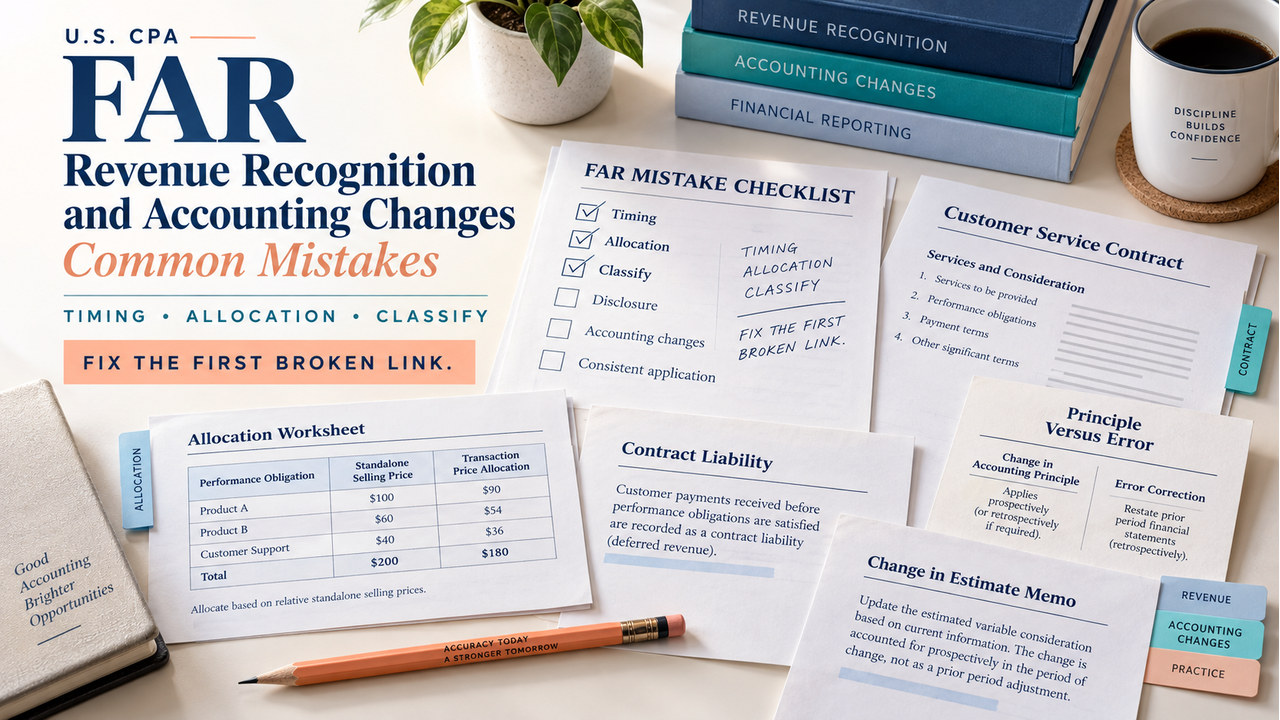

Direct answer: The most useful way to fix far revenue recognition and accounting changes common mistakes is to name the broken decision before changing the number. First ask whether the customer received the promised good or service. Next allocate a bundled price before applying timing. Finally classify a change as new information, a new principle, or missed information before deciding whether anything needs correction.
Editorial review note: This page was written and checked by the CPA Exam Prep study-content team for terminology, arithmetic, internal consistency, and learner usefulness. The examples, questions, answers, distractors, and checklist are original editorial practice, not released exam content.
These far revenue recognition and accounting changes common mistakes use simplified facts so the failure mode stays visible. The current AICPA Blueprint and FASB literature define the live boundary; this article gives you original practice cases and sends entity-specific conclusions back to current authoritative guidance. For broader routing, use the FAR review hub.
Build accounting changes common mistakes checklist for FAR revenue recognition
Before solving, write five short fields: ASK, CONTROLLING FACT, WORK, LANE, and CHECK. The fields prevent a familiar label from hiding the actual question. They also make it easier to find the first broken link after the reveal.
Write the accounting changes common mistakes output first
Circle the final verb. “Calculate” needs a visible equation. “Allocate” needs standalone selling prices and a ratio. “Classify” needs the reason for the change. “Explain” needs the controlling fact and the boundary that would trigger fresh research. A correct calculation that answers a different verb is still a miss.
Separate revenue recognition from accounting changes common mistakes
Revenue timing asks when a promised good or service transfers. Accounting-change analysis asks why an amount or method changed. The two topics can share one study session, but they do not share one automatic treatment. Keep the source fact beside the lane so a reviewer can see whether the problem is timing, allocation, estimate, principle, or error.
Use the source boundary as a stop sign
These cases assume a calendar-year entity, simplified contracts, no unusual financing component, no variable consideration unless stated, and current guidance as the final authority. When a real contract, transition rule, materiality judgment, disclosure requirement, or effective date changes, stop the shortcut and reopen current guidance.

The checklist is not a scorecard. It is a compact evidence map. If one field is blank, repair that field before repeating the entire question set. In particular, do not use the percentage correct to conceal a classification mistake that will reappear in a new fact pattern.
FAR revenue recognition and accounting changes common mistakes: five failure modes
Tested skill, assumptions, and difficulty: The original set below tests service timing, bundle allocation, estimate classification, principle-versus-error reasoning, and source-bound explanation. Attempt each case before opening the reveal. Difficulty is moderate: the arithmetic is short, but the controlling fact changes from one case to the next.
Every case follows the same repair pattern: name the trigger, state the wrong shortcut, write the correction, and record one check for the next attempt. That repetition is deliberate. It lets you compare mistakes without pretending that every mistake has the same accounting treatment.
Mistake 1 — Treating cash collection as earned revenue
Original practice prompt: Northstar Support receives $30,000 on January 1 for ten months of stand-ready service. The service is even, and two months have passed by February 28. A learner records all $30,000 as revenue on receipt. What should the simplified case show, and what shortcut failed?
Reveal Mistake 1 answer and repair
Answer: Earned revenue is $6,000 ($30,000 ÷ 10 × 2), and the remaining contract liability is $24,000. The shortcut treats payment as transfer. Therefore, repair it by writing cash received, months delivered, revenue earned, and liability remaining in separate fields. The next check is simple: ask what the customer has received by the reporting date.
Why the first mistake survives a quick review
The cash number looks complete, so a learner may stop before reading the service period. Yet the reporting question is about transfer, not collection. As a result, a contract liability can remain even when the cash balance is unchanged. When the prompt gives a service period and a reporting date, those facts deserve a box before the payment date does.
Mistake 2 — Skipping relative allocation in a bundle
Original practice prompt: Pinecrest sells equipment and eight months of maintenance for $96,000. Standalone selling prices are $80,000 for equipment and $40,000 for maintenance. The equipment transfers immediately, and two months of maintenance are delivered. A learner assigns the entire invoice to equipment. What allocation and maintenance balance should the simplified case show?
Reveal Mistake 2 answer and repair
Answer: Total standalone selling price is $120,000. Equipment receives 80/120 × $96,000 = $64,000; maintenance receives $32,000. Two of eight maintenance months earn $8,000, leaving a maintenance liability of $24,000. The shortcut uses invoice labels instead of relative standalone prices. Repair it by calculating the ratio before applying the service calendar.
Why accounting changes common mistakes hide inside a correct total
The invoice total may be correct while the performance-obligation amounts are wrong. That is why the learner should write the standalone-price total, each ratio, and each allocated amount before recognizing either item. Next, the service period answers a second question: how much of the allocated maintenance amount has the customer received?
Mistake 3 — Calling a new estimate an old-period error
Original practice prompt: Cedar Works has a machine with a $72,000 carrying amount at the start of Year 5. New production evidence changes the remaining useful life to three years. A learner restates the prior two years because the depreciation estimate changed. Under the simplified facts, what current-year amount should the learner use?
Reveal Mistake 3 answer and repair
Answer: Use $24,000 for the simplified current-year depreciation ($72,000 ÷ 3). The new evidence changes the remaining estimate; it does not, by itself, prove that the prior periods were wrong when recorded. Repair the mistake by writing “new information” beside the trigger and then recalculating prospectively. Reopen current guidance when the entity facts or transition requirements differ.
Mistake 4 — Treating every acceptable-method switch as an error
Original practice prompt: Lakeside changes from FIFO to weighted-average inventory costing, and both methods are acceptable under the stated facts. Separately, the team discovers an invoice that it possessed before prior-year statements were issued but omitted from the inventory records. A learner calls both facts estimates. How should the two lanes be separated?
Reveal Mistake 4 answer and repair
Answer: The move between acceptable methods is a change in accounting principle; follow the applicable transition and disclosure guidance. By contrast, the omitted available invoice is a prior-period error; analyze correction and materiality under current guidance. Repair the mistake by labeling the triggers “new principle” and “missed information.” Do not let the fact that both change a number erase the reason for the change.
Mistake 5 — Overclaiming what a practice result proves
Original practice prompt: A learner answers four local cases correctly and writes, “This result proves I will pass FAR.” What is wrong with that conclusion, and what should the study note say instead?
Reveal Mistake 5 answer and repair
Answer: A local practice result is not an official score, readiness judgment, or prediction. Instead, the note should state which decision lanes were stable, which fact caused hesitation, and which review block comes next. Repair the mistake by keeping the evidence useful without importing an official claim. Use the current AICPA and FASB sources for boundaries, not a local percentage for certainty.
Review FAR revenue recognition and accounting changes mistakes by the first broken link
After the reveals, record the case, requested output, controlling fact, first broken field, and repair verb. Use separate when timing or evidence was mixed, allocate when standalone prices were skipped, classify when the reason for a change was unclear, and bound when a local practice result was overclaimed. The repair verb should describe the next action, not merely the feeling that the answer was hard.
For example, a wrong Northstar answer needs a transfer-timing review, not another random revenue question. For Pinecrest, the next step is one relative-allocation calculation. If Cedar or Lakeside is wrong, compare the reason for the change. Finally, a wrong readiness statement needs a source-boundary note. This keeps the review block short and specific.

Retry FAR revenue recognition and accounting changes common mistakes after one changed fact
Change only the Northstar service date: assume six months of the ten-month service have been delivered by June 30 instead of two months by February 28. Keep the $30,000 advance payment and even service pattern fixed. Earned revenue becomes $18,000 ($30,000 ÷ 10 × 6), and the remaining liability becomes $12,000.
The conclusion that cash collected is not automatically earned revenue stays unchanged. Do not alter the allocation rule, invent a refund, or convert the remaining liability into an error. The point of the retry is to change one fact, recalculate the linked amounts, and preserve every unaffected conclusion.
FAR revenue recognition and accounting changes common mistakes FAQ
What should I write before doing the arithmetic?
Write the asked output, the controlling fact, and the treatment lane. Then show the equation or classification reason. This order keeps the arithmetic from answering a different question.
Why does a bundle require two separate checks?
Relative allocation determines how much of the transaction price belongs to each performance obligation. Transfer timing determines how much of each allocated amount becomes revenue. Skipping either check can produce a plausible but wrong total.
When should I reopen accounting changes common mistakes guidance?
Reopen it when the contract, entity, transition, materiality, disclosure, effective date, or available-fact pattern exceeds the simplified assumptions. A local practice explanation should not replace entity-specific research.
How do I use a practice result without overclaiming?
Record the first broken decision and the next review block. Treat the result as a local diagnostic, not an official score or pass prediction.
FAR revenue recognition and accounting changes common mistakes: sources and refresh boundary
For current tested-content scope, use the AICPA CPA Exam Blueprints. Also, the format context comes from the AICPA CPA Exam sample tests and the NASBA CPA Exam FAQ. For technical boundaries, use the FASB Revenue Recognition project summary and the FASB Accounting Standards Codification. These pages were checked September 23, 2026. Reopen current guidance when a real fact changes. All cases, calculations, distractors, and retry steps are original editorial study content.