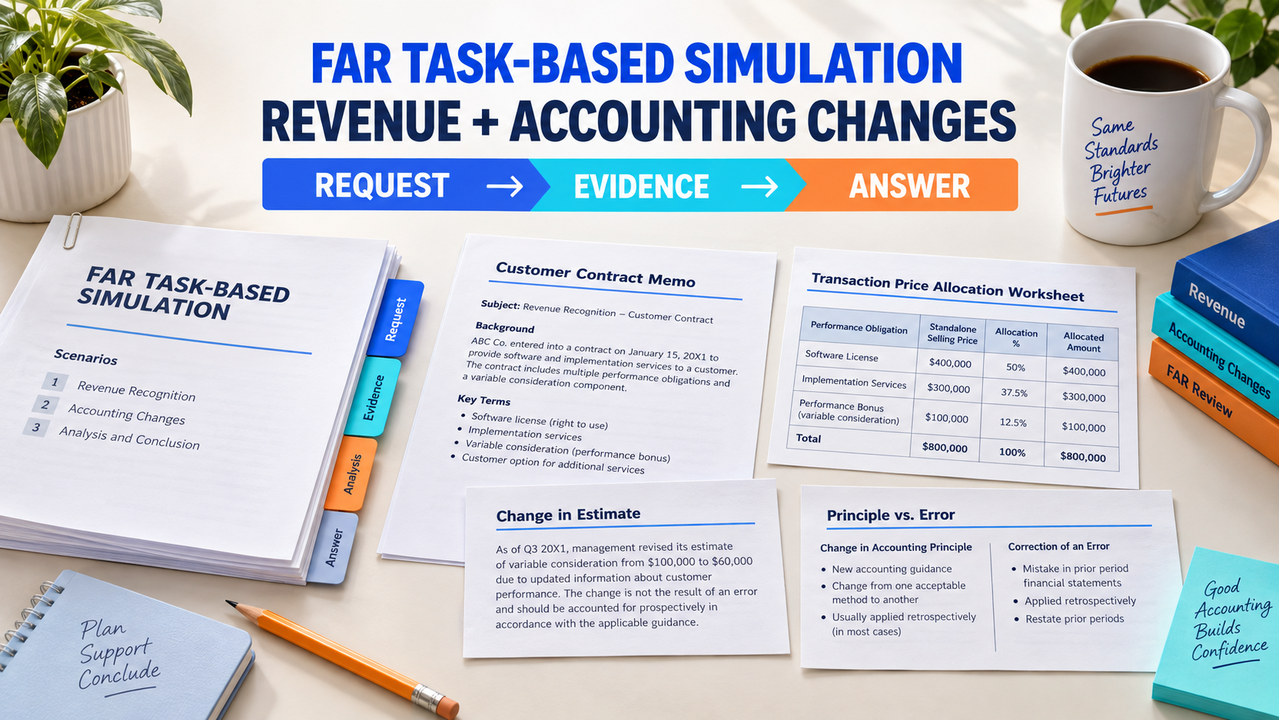

Direct answer: A FAR revenue recognition and accounting changes task-based simulation is easiest to defend when you lock the requested deliverable, preserve the controlling fact, show the work, classify the treatment, and finish with a short answer memo. This original packet combines revenue timing, bundle allocation, an estimate change, a principle change, and a prior-period error so the decision order is visible instead of hidden inside a score.
Editorial review note: The company, amounts, prompts, options, calculations, answer logic, and retry are original editorial practice. This packet contains independent study content; neither an exam body nor a review provider supplied it.
Use the FAR review hub for broader routing. The current AICPA Blueprint resource and FASB Accounting Standards Codification control live scope and technical conclusions when a fact falls outside this simplified FAR task-based simulation.
Set the FAR revenue recognition and accounting changes task-based simulation boundary
Tested skill: move from a mixed fact packet to the exact output requested. A task may ask for earned revenue, an allocation, a prospective depreciation amount, a change classification, or a concise explanation. A correct number attached to the wrong deliverable is still an incomplete response.
Assumptions: For this drill, use a calendar-year entity, simplified contracts, no unusual financing component, no variable consideration unless stated, no special transition instruction unless stated, and current guidance as the final authority. Difficulty is moderate: the arithmetic is short, but the controlling fact and the treatment lane must remain separate.
Before starting the FAR revenue recognition task-based simulation, write five fields: REQUEST, SOURCE FACT, WORK, CLASSIFY, and MEMO. Next, keep the local result diagnostic. It can choose your next study block, but it cannot predict an official score or readiness.
Build the revenue recognition and accounting changes evidence map
First, read the final verb. “Calculate” needs an equation. Next, “Classify” needs the reason for the lane. “Explain” needs the controlling fact and a boundary. Finally, “Identify the treatment” needs a short memo that answers only what the prompt asks. Copy the smallest fact that changes the answer instead of transcribing every number in the stem.
Lock the requested output
Write the deliverable at the top of the page before you calculate. With a service contract, state earned revenue and the remaining contract liability. For a bundle, calculate the allocated amount and the revenue earned to date. When a change appears, state the classification plus the next research question, not a full journal entry.
Circle the controlling source fact
Look for delivered months, standalone selling prices, new information, acceptable methods, or information that was available before issuance. Meanwhile, dates and amounts matter only after you know which fact controls the route. Put the controlling fact beside the output so a reviewer can follow the answer without guessing.
Show work, classify, then write
Show the allocation ratio, the service-period fraction, or the carrying amount divided by the revised remaining life. Then label the treatment lane: revenue timing, allocation, estimate, principle, or error. End with one sentence that answers the asked output and one sentence that names the evidence. This is the core of a defensible FAR task-based simulation response.

Stop rule: if any of the five fields is blank, do not start the next tasklet. Repair the blank field first. Therefore, a shorter completed evidence map is more useful than a longer answer with an unexplained number.
Run the original revenue recognition and accounting changes task-based simulation
This is one original packet with five connected tasklets. Attempt every tasklet before opening the answer reasoning. Keep the advance payment, service period, allocation facts, and change facts in separate evidence fields. The five items test different decisions, not a single official-style score.
Packet: Harborline Systems receives advance consideration for support, sells a machine with maintenance, updates a machine-life estimate after new evidence, changes an acceptable inventory method, and finds an invoice the team had before prior-year statements went out but left out of the inventory records. Use only the facts assigned to each tasklet. Keep revenue recognition and accounting changes in separate evidence lanes even when they appear in one packet.
Tasklet 1 — Separate earned revenue from the advance
Original prompt: Harborline receives $24,000 on January 1 for eight months of stand-ready support. Harborline provides the service evenly, and three months have passed by March 31. What are earned revenue and the remaining contract liability under the simplified facts?
- Revenue $24,000; liability $0
- Revenue $9,000; liability $15,000
- Revenue $15,000; liability $9,000
- Revenue $3,000; liability $21,000
Reveal Tasklet 1 answer and reasoning
Answer: B. Earned revenue is $24,000 ÷ 8 × 3 = $9,000; the remaining contract liability is $15,000. The nearest distractor treats the whole advance as revenue because the customer paid cash. The controlling fact is the service Harborline delivered, not the payment date.
Tasklet 2 — Allocate before recognizing the bundle
Original prompt: Harborline sells a machine and ten months of maintenance for $180,000. Standalone selling prices are $150,000 for the machine and $50,000 for maintenance. Harborline transfers the machine immediately and provides four months of maintenance. What machine allocation, maintenance revenue, and remaining maintenance liability should the simplified case show?
- Machine $150,000; maintenance revenue $20,000; liability $0
- Machine $135,000; maintenance revenue $18,000; liability $27,000
- Machine $120,000; maintenance revenue $24,000; liability $36,000
- Machine $180,000; maintenance revenue $0; liability $0
Reveal Tasklet 2 answer and reasoning
Answer: B. Total standalone price is $200,000. The machine receives 150/200 × $180,000 = $135,000; maintenance receives $45,000. Four of ten maintenance months earn $45,000 ÷ 10 × 4 = $18,000, leaving $27,000. The distractor uses invoice labels or recognizes the whole bundle when the machine transfers.
Tasklet 3 — Revenue recognition and accounting changes: route new information to an estimate change
Original prompt: A machine carries a $88,000 amount at the start of Year 4. New production evidence changes the remaining useful life to four years. Under the simplified facts, what current-year depreciation should the tasklet use, and should the earlier periods be restated merely because the estimate changed?
- $14,667 and restate earlier periods
- $22,000 and do not restate merely for the new estimate
- $88,000 and record an error correction
- $11,000 and defer all depreciation
Reveal Tasklet 3 answer and reasoning
Answer: B. $88,000 ÷ 4 = $22,000 for the simplified current-year amount. New information about the remaining life routes the question toward prospective estimate treatment; it does not, by itself, turn earlier periods into an error. Reopen current guidance for the actual entity and reporting facts.
Tasklet 4 — Revenue recognition and accounting changes: separate a principle change from an error
Original prompt: Harborline moves from FIFO to weighted-average inventory costing, and both methods are acceptable under the stated facts. Separately, Harborline finds an invoice the team had before prior-year statements went out but left out of the inventory records. How should the learner route the two facts for further analysis?
- Both are estimate changes
- The method switch is a principle-change question; the omitted available invoice is an error question
- Both are current-period revenue questions
- The invoice omission is a principle change and the method switch is an estimate
Reveal Tasklet 4 answer and reasoning
Answer: B. Moving between acceptable methods is a principle-change lane; follow applicable transition and disclosure guidance. An available fact that was omitted is a prior-period error lane; analyze correction and materiality under current guidance. The reason for the change controls the route.
Tasklet 5 — Write the answer memo without overclaiming
Original prompt: Draft a two-sentence memo for a reviewer who asks why the Harborline tasklet answers cannot be combined into one treatment. Your memo must name one revenue timing fact, one accounting-change fact, and the source boundary to reopen when the simplified assumptions no longer apply.
- Use one rule for every amount because all facts affect income
- Separate transfer timing from the reason for a change, then reopen current guidance for entity, transition, materiality, or disclosure facts
- Ignore the source boundary because the arithmetic is short
- Call every change retrospective to be safe
Reveal Tasklet 5 answer and reasoning
Answer: B. A concise memo should say that service delivery controls earned revenue while new information, an acceptable method switch, or an omitted available fact controls the accounting-change lane. The memo should also state that current AICPA scope and FASB guidance require a fresh review when the entity or reporting facts change. The distractors collapse different questions into one treatment.

Review the revenue recognition and accounting changes task-based simulation answers
Use the answer reveal as a diagnostic map, not as a score announcement. First, Tasklet 1 checks transfer timing: cash collected is not automatically earned revenue. Next, Tasklet 2 checks allocation: allocate the transaction price before applying each performance obligation’s timing. Finally, Tasklet 3 checks the reason for change: new evidence about a remaining estimate is not the same as information the team already had.
Meanwhile, Tasklet 4 separates the method switch from the omitted invoice. The first fact requires a principle-change research lane; the second requires an error-analysis lane. Tasklet 5 checks whether your memo can preserve that distinction in plain language. If your answer has the right number but the wrong lane, tag the first broken field as classify, not as arithmetic. This is the practical handoff between revenue recognition and accounting changes review.
After the reveal, record five fields: tasklet, requested output, controlling fact, first broken field, and repair verb. Use separate for timing or evidence, allocate for bundled consideration, classify for estimate/principle/error, and memo when the facts are correct but the explanation is incomplete. Therefore, the FAR task-based simulation stays useful without becoming an official readiness claim.
Retry the FAR revenue recognition task-based simulation with one changed fact
Change only Tasklet 1: Harborline delivered six months of the eight-month support service by June 30 instead of three months by March 31. Keep the $24,000 advance payment and even service pattern fixed. As a result, earned revenue becomes $18,000 ($24,000 ÷ 8 × 6), and the remaining liability becomes $6,000. The conclusion that cash received is not automatically revenue remains unchanged.
Then choose one repair lane from your first broken field. First, if you missed the output, rewrite the requested deliverable before calculating. Next, if you missed evidence, circle the delivered-month fact. If you missed allocation, repeat the standalone-price ratio on Tasklet 2. If you missed classification, compare new evidence with information the team already had. Finally, if you missed the memo, write the controlling fact and source boundary in two sentences.
FAR revenue recognition task-based simulation FAQ
Is this an official CPA Exam task-based simulation?
No. The Harborline packet, facts, choices, calculations, and answer logic are original editorial practice. Instead, use the current AICPA resources for scope and format context, but do not report this local result as an official score or pass prediction.
Why do revenue recognition and accounting changes use separate lanes?
First, revenue timing asks when a promised good or service transfers and how a bundled price is allocated. Accounting-change analysis, however, asks why an amount or method changed. The controlling facts and research lanes are different even when both appear in one FAR study session.
What should I do when the fact pattern changes?
When the fact pattern changes, keep the evidence map, change one fact, and rerun only the affected decision. Therefore, reopen current FASB guidance when the entity, transition, materiality, disclosure, effective-date, or contract facts exceed the simplified assumptions.
Should I use a score to decide what to study next?
Use the first broken field instead of the percentage alone. A correct number with an unsupported lane still needs an evidence or classification repair. A changed-fact retry tests whether the method transfers.
FAR revenue recognition task-based simulation sources and refresh boundary
For scope, use the current tested-content boundary in the AICPA CPA Exam Blueprints. In addition, use the AICPA CPA Exam sample tests for format context and the FASB Revenue Recognition project summary for framework background. Finally, use the FASB Accounting Standards Codification for technical refresh and the NASBA CPA Exam FAQ for candidate-process routing. Reopen current guidance when the reporting entity, contract, transition, materiality, disclosure, or effective-date fact changes. All tasklets, answer choices, calculations, explanations, and retries are original editorial study content.