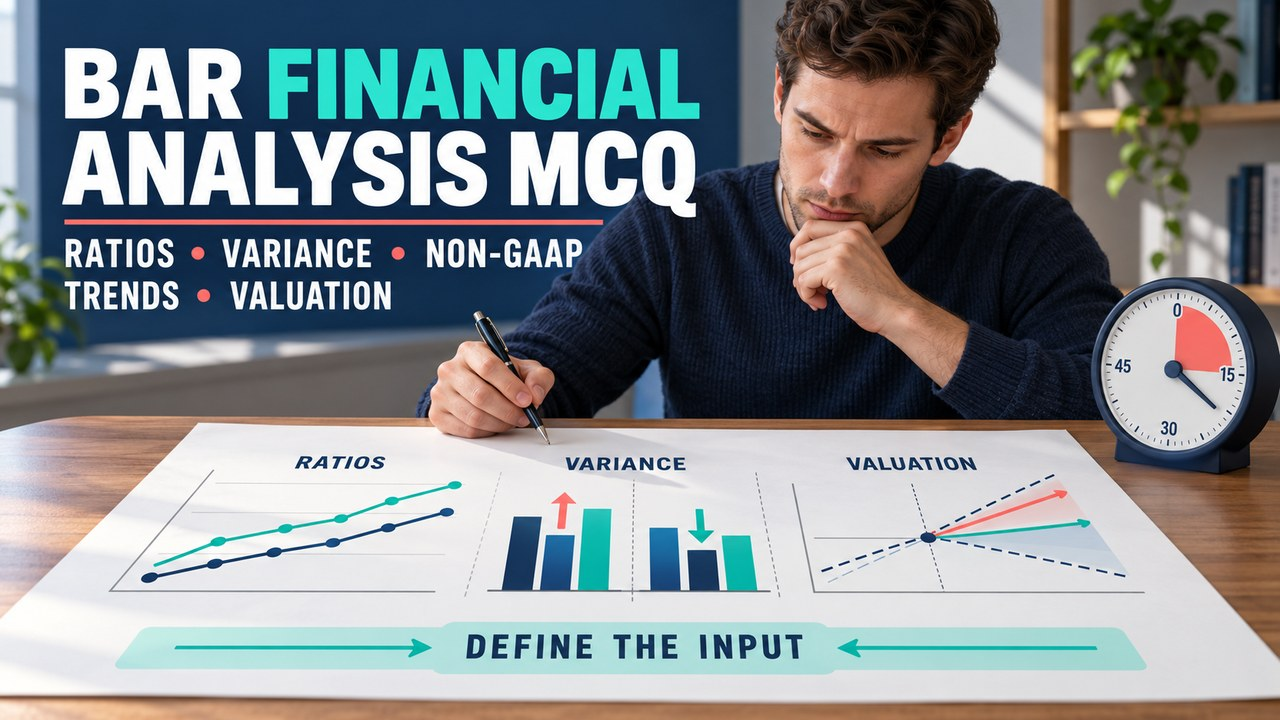

Direct answer: A useful financial analysis valuation study block starts with one narrow BAR decision, identifies the input that controls the result, and makes you explain the strongest distractor. Work through an original item, write the evidence you would verify, then change one fact before you add more questions. The goal is a defensible reasoning trail, not a lucky answer letter.
Scope and freshness note: This page answers the search need behind bar financial analysis ratios variance non gaap and trends mcq with original study scenarios. It is editorial practice, not an exam-authority publication or a released question set, and it does not promise a score. Reopen the AICPA CPA Exam Blueprints for the current testing boundary and task language, and use the NASBA CPA Exam FAQ for eligibility, scheduling, jurisdiction, and score questions.
Use the BAR review hub to place the topic in the section. For task statements and skill levels, open the CPA Exam Blueprint format guide. If the gap is item discrimination, continue with the CPA MCQ by topic guide; if it is evidence assembly, switch to the CPA TBS practice guide.
For a broader preparation path, continue with our related CPA study resources.
financial analysis valuation: define the decision before the option
Financial analysis questions can look familiar while testing different work. A ratio may test the quality of the numerator, a trend may test whether the denominator changed, a variance may test the driver rather than the total, and a non-GAAP measure may test whether the adjustment changes the story. A valuation prompt may turn on one assumption about risk, timing, or capital structure. Start by writing the task verb and the output it requests.
Use this four-line opening note: input, measure, variance or trend, and decision. To begin, the input is the fact you must confirm. Next, the measure is the calculation or comparison. Then, the variance or trend is the movement that needs an explanation. Finally, the decision is the conclusion or next test. As a result, when one line is blank, you have found the repair target.
Keep the boundary visible. These scenarios simplify the facts so the reasoning can be checked on paper. They do not replace the current Blueprint, professional literature, or a live engagement conclusion. If a current rule or definition matters, save the source URL and the date you checked it before reusing the note.
Set one BAR evidence lane
Choose one lane for a timed block: ratio and trend interpretation, variance diagnosis, non-GAAP presentation, forecasting, or valuation and capital structure. A mixed block can come later. For the first pass, a narrow lane lets you see whether your miss came from arithmetic, definition, evidence, or decision logic.
Before the clock starts, write the assumption that would change the answer. For a ratio case, the assumption might be the quality of a current asset. In a variance case, it might be volume versus price. Meanwhile, a non-GAAP case might turn on whether an adjustment is recurring. For valuation, it might be the direction of a risk or financing change. Therefore, naming that assumption makes the later changed-fact retry meaningful.
Reveal the repair logic
Attempt the original items first. Write the controlling input, the boundary check, and the distractor you would reject before opening the explanation.
Reveal the answer
Answer: Compare your note with the rationale, mark the first missing proof point, and change one fact before retrying.
Compare your process with the reasoning shown above.

Write the case note, not a score
For every item, save five short lines: the task verb, the controlling fact, the option you selected, the distractor you rejected, and the evidence you would reopen. Add a sixth line after review: “If this fact changes, my answer changes because…” This note gives you a transfer test. A percentage correct without these lines cannot tell you what to study next.
Separate confidence from speed. If you reach an option quickly but cannot name the controlling input, mark the item as unresolved. If you run out of time while the boundary is unclear, record the exact source check and move on. Return to the item under the same time limit after the source check. That second attempt shows whether the repair changed the reasoning or only made the wording feel familiar.
Original MCQ 1: ratios, trends, and the controlling input
Assumptions: A company’s current ratio rises from 1.4 to 1.8. The increase is driven mainly by inventory that has not yet moved, while cash is flat. The question asks what a careful analyst should do next. This is an original practice case; no released question or answer source is being reproduced.
Question: Which response best interprets the trend?
- Conclude immediately that short-term liquidity improved because the ratio is higher.
- Ignore the ratio because a single period never matters.
- Inspect the asset mix and turnover evidence before treating the higher ratio as stronger liquidity.
- Replace the current ratio with a valuation multiple without explaining the change.
Answer and rationale: Choice 3 is the strongest. The changed input is inventory, so the analyst must test whether it can support near-term obligations in the relevant fact pattern. However, choice 1 treats the output as self-proving. Choice 2 throws away a useful signal instead of qualifying it. By contrast, choice 4 changes the question. Therefore, the evidence note should name inventory, turnover, and the period being compared.
Transfer test: Change the fact so receivables, rather than inventory, create the increase. Does your next check become collection timing and aging? If it does, you understood the input-to-measure relationship. If it does not, reopen the definition of the ratio and rewrite the controlling-fact line.
Original MCQ 2: variance and non-GAAP context
Assumptions: Operating margin looks favorable after a one-time restructuring cost is removed from an adjusted measure. The prompt asks whether the adjusted trend alone supports an operating conclusion. Treat the adjustment as a fact to investigate, not as a label that settles the answer.
Question: What is the most defensible next step?
- Use the adjusted margin as the only trend because it is higher.
- Compare the reported and adjusted views, identify the adjustment, and ask whether it changes the period-to-period operating story.
- Discard every non-GAAP measure without reading its reconciliation.
- Call the variance favorable and stop the analysis.
Answer and rationale: Choice 2 is strongest. It preserves the distinction between the reported result and the adjusted view while testing whether the item is isolated, recurring, or tied to the period. However, choice 1 lets a presentation choice replace analysis. Choice 3 is an absolute rule that hides useful context. By contrast, choice 4 names the direction but not the driver. Therefore, your note should show the reported number, the adjustment, the adjusted number, and the question that remains.
Transfer test: Change the fact so the adjustment recurs in two periods. The next action should shift toward a recurring-driver analysis rather than a one-time explanation. If your answer stays identical, label the missing proof as trend interpretation.
Original MCQ 3: valuation and capital structure
Assumptions: A forecast value changes after management replaces a debt assumption with a different financing mix. The prompt asks what the learner should verify before accepting the new valuation conclusion. The scenario is simplified to test the sequence of reasoning.
Question: Which response best protects the valuation analysis?
- Keep the old conclusion because the forecasted cash flows did not change.
- Accept the new conclusion because the capital structure changed.
- Trace the financing assumption, risk or discount effect, timing, and any changed sensitivity before comparing conclusions.
- Choose the answer with the largest value because it sounds more favorable.
Answer and rationale: Choice 3 is strongest. A financing change can alter the relevant risk, discounting, or sensitivity story, so the analyst must show which input moved and how the output responds. However, choice 1 freezes the prior assumption. Choice 2 treats a changed label as proof. By contrast, choice 4 substitutes preference for evidence. Therefore, save the original assumption, replacement assumption, direction of change, and one sensitivity check.
Transfer test: Keep the financing mix fixed but change the timing of the cash flow. The next check should move toward timing and sensitivity rather than capital structure. That contrast tells you whether the case note separates inputs or merely repeats the conclusion.
Read the rationale and reject the distractor
After each attempt, read the explanation in a fixed order. First, restate the task verb. Next, circle the fact that changes the measure or decision. Then identify why the strongest distractor sounds plausible. Finally, name the evidence that would make the distractor correct. This last step prevents you from memorizing a rejection without learning its boundary.
For ratios and trends, ask whether the denominator or asset quality changed. Next, for variances, separate volume, price, mix, and timing before calling the movement favorable. Likewise, for non-GAAP measures, compare the reported result with the reconciliation and ask whether the adjustment recurs. Finally, for valuation, identify the assumption, timing, risk, and sensitivity that connect the input to the output. These prompts are study checks, not professional advice.
Use the current AICPA materials for the tested scope and terminology. The questions, rationales, visual boards, and repair sequence on this page are independently written. When a question requires exhibits or a multi-step response, use the TBS guide rather than forcing an MCQ format to carry the wrong evidence.
Choose the next financial analysis repair
Classify the first unresolved line as scope, fact, definition, evidence, or transfer. Then choose one bounded repair. When scope is the gap, return to the Blueprint row. If the fact is missing, reopen the exhibit or reconciliation. For a definition gap, use the ratio or measure rule. When evidence is missing, schedule a source check. Finally, a transfer gap requires one changed-fact retry.

The repair is complete when you can write the controlling input, the reason the option fits, the reason the distractor fails, and the fact that would change the answer. Do not open a larger mixed set until those four lines are visible.
Run a 30-minute BAR financial analysis block
- Minutes 0–4: select one Blueprint row, lane, and decision verb. Write the assumption that would change the answer.
- Minutes 4–15: attempt the three original items. Record the input, measure, variance or trend, decision, and strongest distractor.
- Minutes 15–22: read the rationales. Reopen the source or reconciliation tied to the first unresolved line.
- Minutes 22–27: change one material fact in the weakest item and state whether the option changes.
- Minutes 27–30: schedule one next action: a source check, a ratio calculation, a variance decomposition, or a new transfer item.
This sequence makes volume conditional. If the changed-fact retry fails, narrow the lane. If it succeeds, add one neighboring fact and repeat the same evidence note. A longer set is useful only after the first repair is observable.
financial analysis valuation MCQ checklist
- Did I write the task verb and requested output?
- Did I identify the input that controls the ratio, variance, non-GAAP view, trend, or valuation?
- Did I separate the measure from the story I want it to tell?
- Did I record why the strongest distractor fails?
- Did I save the source, reconciliation, or exhibit I would verify?
- Did I change one fact and explain whether the answer changes?
- Did I turn the first unresolved line into one next review action?
A strong financial analysis valuation review note is short but testable. It names the boundary, isolates the controlling fact, shows the reasoning, and schedules the next proof. That is more useful than collecting answer letters that cannot explain the next miss.
financial analysis valuation FAQ
Are these authority-issued BAR questions?
No. The cases and rationales are original editorial practice. Use current AICPA sources for authoritative scope and current wording.
What should I do when a ratio trend looks favorable?
Inspect the input mix, denominator, timing, and evidence before treating the movement as an improvement. The ratio is a signal, not a complete explanation.
How should I review a non-GAAP measure?
Compare the reported result with the reconciliation, identify each adjustment, and ask whether the adjustment is isolated or recurring in the fact pattern.
Can this practice predict my result?
No. It creates a visible reasoning trail and a focused repair. Actual outcomes depend on current content, preparation, and performance.
Sources
- AICPA CPA Exam Blueprints
- NASBA CPA Exam FAQ
- BAR review hub
- CPA MCQ by topic guide