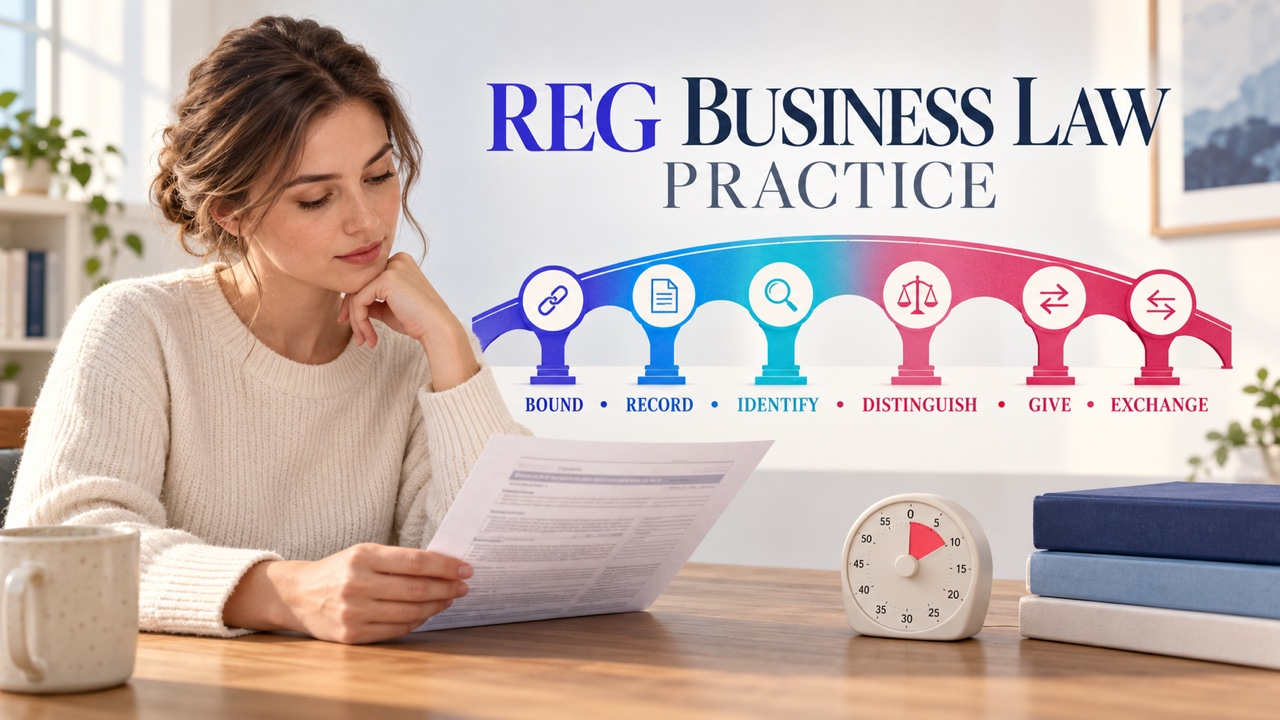

Direct answer: free business law questions should produce a review record, not just a letter choice. This BRIDGE route gives that record six moves: Bound the task, Record the relationships, Identify the decisive document or fact, Distinguish the tempting alternative, Give the consequence requested, and Exchange one fact for a transfer check. Original items below cover agency, agreements, creditor filings, bankruptcy posture, and entity exposure.
Scope note: This is an editorial practice asset. It is not an official question bank, legal advice, or a promise of a score. Check the AICPA CPA Exam Blueprints and tested-content resources for current scope. Use the NASBA CPA Exam FAQ for eligibility, scheduling, jurisdiction, and score administration.
The REG review hub is the orientation point. The Blueprint format guide helps decode task language, the topic MCQ resource supports retrieval, and the TBS practice guide is the next stop for exhibits and schedules.
For a broader preparation path, continue with our related CPA study resources.
Free business law questions: set the scope
Before reading the options, decide which lane is active. Agency concerns the link between a principal, an agent, and a third party. Contract work follows the document or performance event that creates, changes, or limits an obligation. Creditor work follows collateral, notice, perfection, and priority. Bankruptcy supplies a procedural setting that may alter collection or distribution, while the underlying record still needs to be named. Structure questions ask whether the entity, an owner, or a separate signer carries the requested obligation.
Write the question’s decision verb in the margin. Words such as bind, rank, recover, enforce, and classify point to different outputs. The topic label alone cannot supply that output. A short scope sentence—“I am deciding what evidence answers this verb”—keeps a vivid but secondary fact from taking over.
Choose one lane for a short study block. Mixed practice is valuable after the evidence record works on its own. Otherwise, every miss looks like a vocabulary problem even when the real issue is a missing filing, a limited signature, or an untested relationship.
Set the practice assumptions for free business law questions
BRIDGE is a paper trail. Fill the six fields in order:
- Bound: write the requested result and the lane that controls it.
- Record: list the people, organizations, roles, and links among them.
- Identify: quote the clause, filing, notice, authority signal, or formation document that can carry the result.
- Distinguish: state what the best wrong option proves and the separate point it cannot prove.
- Give: answer with the consequence plus the condition that limits it.
- Exchange: change exactly one material fact and predict the new result.
Do not turn Identify into a memory dump. Name the one record that would change the decision. If the stem does not supply it, mark that field “open.” A clear open field is more useful than an invented rule because it tells the next session what to find.
Use a five-minute first pass: one minute for Bound and Record, two for Identify and Distinguish, one for Give, and one for Exchange. Add time when the exhibit is dense, but preserve the sequence. The order is the guardrail that keeps agency signals, contract terms, and creditor records from being blended together.

Translate each stem into a BRIDGE record for free business law questions
One record can hold a mixed fact pattern if every line has a job. An agency item can start with “principal, assistant, supplier” in Record; its Identify line then points to the appointment and what the supplier saw. A creditor item names the debtor and claimants, then points to the collateral description and filing sequence. With an entity item, Record separates the LLC from its member, while Identify points to the lease, amendment, or guaranty.
Distinguish is where many near-miss answers fail. A public title may be relevant to a third party’s view, yet it is not the same proof as a private instruction. Meanwhile, a petition may frame a proceeding without substituting for the record that established a secured position. Even a member’s signature may show a guaranty without rewriting the entity’s contract. Write the contrast before choosing.
Finally, Give must mirror the question. When the prompt asks which claim to examine first, give the priority path. A request about a person’s modified amount calls for the exposure result and its limit. A correct rule applied to the wrong verb is still a wrong response.
Run the original practice
Hide the reasoning while you work. Each item is original editorial practice. Record a decision verb, a decisive record, a distractor contrast, and a one-fact exchange before you check the explanation.
Reveal the BRIDGE reasoning
Attempt the original item first. Write the Bound, Record, Identify, Distinguish, Give, and Exchange lines before opening the explanation.
Reveal the answer
Answer: Compare the evidence record with the reasoning, mark the first open line, and change one fact before retrying. Do not use a raw answer letter as the study record.
Compare your process with the reasoning shown above.
Scenario 1: the signed order and the unshared limit
Facts: Harborline Catering authorizes Leo to source refrigeration parts. The operations director emails Leo a $6,000 spending ceiling, but the email stays inside the company. Leo signs an $8,400 order with Frostline Supply using the company purchase form. Frostline has dealt with Leo for eight months and has never seen the internal email. Harborline rejects the order after delivery.
Question: What should the learner identify before deciding whether Harborline is bound?
- Use only the amount on the invoice.
- Trace the internal email, purchase form, repeated course of dealing, Frostline’s knowledge, and requested authority theory.
- Ignore the supplier’s information because Leo is not an owner.
- Use the rejection after delivery as the only authority event.
Reasoning: Choice 2 gives Identify enough evidence to separate an internal limit from what the supplier could reasonably observe. Exchange the fact that Frostline received the email before shipment. The changed fact tests whether notice, rather than the dollar amount, drives the result.
Scenario 2: a filing trail and a petition date
Facts: Maple Circuitry grants Cedar Bank a security interest in finished goods, and Cedar’s financing statement is accepted on March 3. On March 28, the debtor signs a second agreement with Harbor Capital; Harbor files on April 2. The debtor files a bankruptcy petition on April 18. A prompt asks which record should be reviewed first when the two lenders claim the same inventory.
Question: Which path is the best starting record?
- Compare the collateral language and filing sequence before using the petition date as a shortcut.
- Choose Harbor because its loan is more recent and therefore more relevant.
- Treat the petition as erasing both financing statements.
- Rank the loans by face amount before reading either filing.
Reasoning: Choice 1 starts with the evidence that can establish a priority position. Exchange the order in which the filings were accepted and state which BRIDGE line changes. The petition remains part of the procedural setting; it does not answer every priority question by itself.
Scenario 3: an amendment beside a narrow guaranty
Facts: Signal Ridge LLC leases a workshop from Alder Street Properties. The lease is signed by the LLC. Six months later, Alder and Signal Ridge sign an amendment that defers two rent installments. Meanwhile, the sole member signs a guaranty that covers the original base rent for the first six months and excludes amendments unless approved in a separate writing. Later, the landlord seeks the deferred installments from the member personally.
Question: Which evidence should support the requested remedy?
- Start with the member’s ownership percentage without reading the documents.
- Read the original lease, amendment, guaranty language, separate-writing condition, and requested remedy.
- Compare the amended balance alone because the LLC accepted the deferral.
- Use the member’s signature for the LLC as proof of a personal promise.
Reasoning: Choice 2 distinguishes entity performance from the scope of the personal promise. Exchange the guaranty’s exclusion clause for an approval clause and record whether the personal remedy expands. That is a transfer check, not another memorization prompt.
Compare distractors with the controlling fact
Use the sentence “This evidence establishes ___; the prompt still asks ___.” For the catering item, an internal email establishes an instruction, while the requested result may require the supplier’s notice or an apparent-authority analysis. On the filing item, a petition establishes a procedural event, while the requested result may require priority evidence. For the lease item, an LLC signature establishes entity participation, while the requested result may require the guaranty’s exact boundary.
Keep one label for the distractor: authority, term, priority, or structure. Then write the missing record beside it. The label is not a new rule. It is a routing instruction for the next review block.
There are two kinds of misses. When all six fields are complete and the consequence is wrong, compare the rejected option with the controlling record. If Identify or Distinguish is open, reopen one source or exhibit first. More questions will not repair an evidence line that was never filled.
Choose the next practice repair for free business law questions
Repair the earliest open field, then change one fact. An agency retry can change who received the limit or how the principal presented the agent. A contract retry can change the amendment, acceptance, or condition. When creditors or bankruptcy are at issue, change the filing acceptance or proceeding date. At the entity line, change the guaranty scope or the signer’s capacity. The point is to make one record move while the other facts stay still.
Compare the first record with the retry. When the consequence changes, circle the moved field and schedule a short block on that doctrine. If it does not, explain why the exchanged fact was not controlling. Either outcome gives you a smaller, testable next step.

Schedule a focused review block
End with an entry that another session can use: the decision verb, the active lane, parties and roles, the controlling record, the rejected distractor, the consequence, and the exchanged fact. Add the source or exhibit to reopen. A good entry can be read in less than a minute and still tell you what to do next.
Route the next resource to the problem you actually saw. Use the Blueprint guide for task-boundary confusion, the topic MCQ page for retrieval gaps, and the TBS guide for exhibit interpretation. Return to the REG hub when the lane itself is unclear. This keeps practice volume from replacing diagnosis.
Free business law questions checklist
- Write the decision verb and active lane first.
- Separate the parties, roles, and entity relationships.
- Name one document, filing, notice, or authority signal that can carry the result.
- Explain what the strongest distractor proves and what it cannot prove.
- Give the requested consequence with its limiting condition.
- Exchange one material fact and record which field moves.
- Reopen one source or exhibit before adding another mixed set.
- Schedule the next block from the earliest open BRIDGE field.
Strong free business law questions practice creates a visible route from a stem to a consequence. The record shows both the answer and the next repair, which is what makes the following attempt more informative.
Free business law questions FAQ
Are these official exam questions?
No. The scenarios and explanations are original editorial practice. Use current AICPA material for authoritative scope.
What belongs in the review record?
Write the decision verb, parties, controlling record, distractor contrast, requested consequence, and one changed-fact result.
Should I add more timed items after a miss?
Repair the earliest open BRIDGE field first. More volume can repeat the same gap when the evidence line is missing.
Does this method promise a passing result?
No. It creates observable study evidence and a focused next action; outcomes depend on current rules, preparation, and performance.
Sources
- AICPA CPA Exam Blueprints and tested-content resources
- NASBA CPA Exam FAQ
- REG review hub
- BRIDGE evidence record: original editorial method for this page