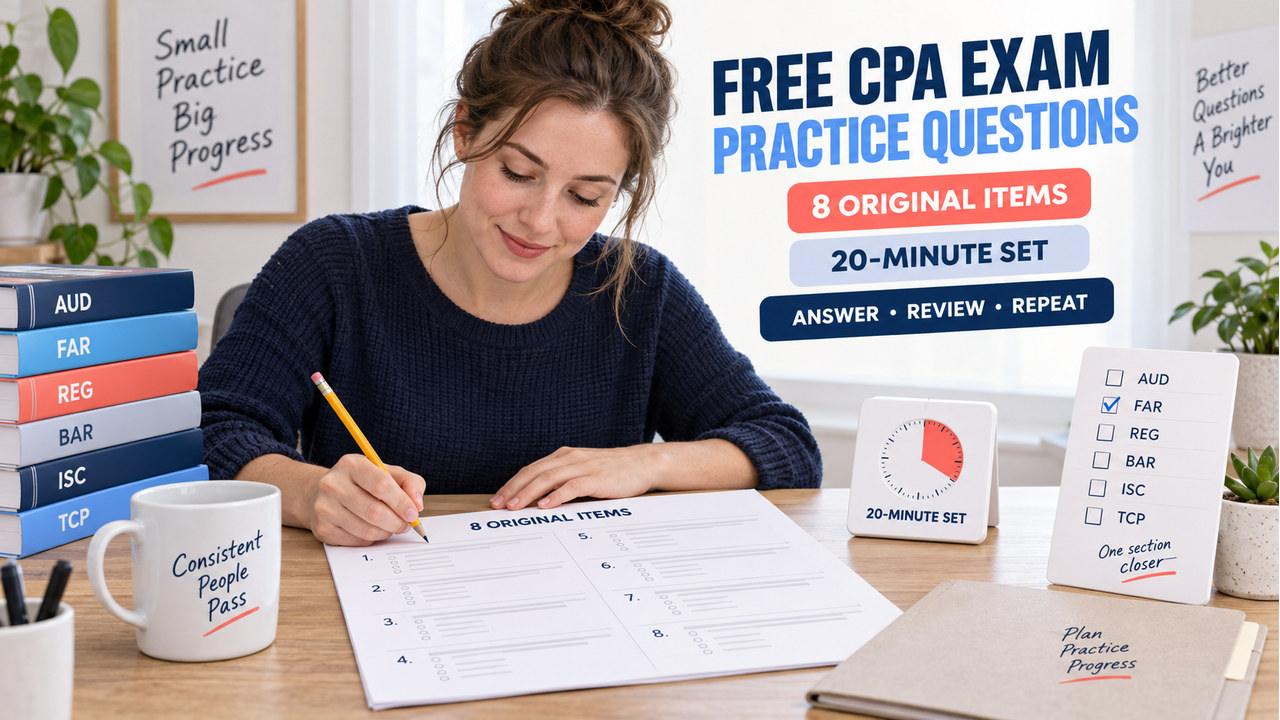

Quick answer: these free CPA exam practice questions give you eight original items across six sections. Set a 20-minute timer, answer without notes, and open each explanation after committing. Therefore, treat the result as a study signal, not an exam score.
First, each item names skill, assumptions, and difficulty. Then, the reveal explains the governing fact or variable, identifies the distractor, and gives a next action. Moreover, CPA Exam Prep authored them; they are not AICPA material or jurisdiction-specific guidance.
Therefore, use the CPA exam practice questions as a diagnostic, not a readiness forecast.
Free CPA Exam Practice Questions: How to Use This Set
First, write 1 through 8 on a blank sheet. Next, allow two minutes per item, but read the whole stem before guessing. In particular, underline the controlling fact: an assertion, period, rate, timing window, or user permission.
Next, choose one answer before opening a reveal. Show a formula for calculations or write the rule boundary in plain language. Consequently, a wrong answer becomes evidence about your process rather than a memorized phrase.

After the timer, record only first-pass answers. Instead, log revealed answers in notes, not the first-pass count. Finally, use the score and first miss to choose your next 15-minute block.
Pick the Question Type Before You Start
However, one reading habit cannot solve every CPA practice question. Therefore, identify the job the item asks you to perform before choosing. In practice, four lanes form a sorting tool.
| Question job | What to mark | Best first move | Items |
|---|---|---|---|
| Evidence | Assertion and direction | Match the procedure to the assertion | 1–2 |
| Period or amount | Dates, units, and rate | Write one formula before calculating | 3–4, 6, 8 |
| Timing rule | Trigger and boundary | Circle the date that starts the window | 5 |
| Access decision | Role and minimum permission | Remove unrelated privileges first | 7 |
In contrast, do not use the table as an answer key. It sets focus; assumptions control the answer.
CPA Exam Practice Questions: Eight Original Items With Explanations
First, every item is original practice. Read the skill and assumptions; answer; then open the reveal. Section names follow current AICPA Blueprint vocabulary; stems, numbers, choices, and explanations are written for this page.
CPA Exam Practice Questions: 1. AUD — Evidence for Inventory Existence
Tested skill: choose evidence that supports the existence assertion. Assumptions: the client reports 1,200 units in its year-end inventory listing, and the auditor is testing the recorded balance. Difficulty: foundational. Original practice question: Which procedure most directly supports existence?
- Select 25 items from the inventory listing and locate them on the warehouse floor
- Start with items on the warehouse floor and trace them into the inventory listing
- Inspect supplier invoices for purchases made during the year
- Ask the warehouse manager whether all listed units are present
Reveal the AUD answer and reasoning
Answer: 1. First, move from the recorded listing to physical evidence. Thus, listed units support existence; mark the assertion and direction first.
Key distractor: In contrast, choice 2 moves from the floor to the listing, which is the completeness direction. It does not directly show that every recorded unit exists.
Next action: Then, label the direction of two new existence and completeness procedures.
2. AUD — Test of Sales Occurrence
Tested skill: match a sales procedure to the occurrence assertion. Assumptions: the sales journal contains recorded invoices for the final month of the year, and shipping documents are available. Difficulty: foundational. Original practice question: Which selection best tests whether recorded sales occurred?
- Select sales entries from the journal and vouch them to the invoice and shipping document
- Select shipping documents and trace them forward into the sales journal
- Recalculate the sales-tax percentage used in the invoice
- Ask the controller whether the sales were authorized
Reveal the AUD answer and reasoning
Answer: 1. Next, start with recorded sales and vouch to the invoice and shipping document. Thus, documents show that the recorded shipment occurred.
Key distractor: In contrast, choice 2 starts with shipping documents and traces forward, the completeness direction. It answers a different question.
Next action: Then, mark “record to proof” or “proof to record” before naming the assertion in two new items.
CPA Exam Practice Questions: 3. FAR — Prepaid Insurance by Period
Tested skill: allocate a prepaid cost to the correct reporting period. Assumptions: a company pays $18,000 on October 1 for a 12-month policy, records no other insurance balance, and recognizes expense evenly. Difficulty: foundational calculation. Original practice question: What prepaid insurance balance should remain on December 31?
- $4,500
- $13,500
- $15,000
- $18,000
Reveal the FAR answer and reasoning
Answer: 2. Therefore, monthly cost is $18,000 ÷ 12 = $1,500. Thus, nine months remain after expiry, so prepaid insurance is $1,500 × 9 = $13,500.
Key distractor: However, choice 1 is the three-month expense, not the remaining asset; choice 4 ignores consumption.
Next action: Then, draw the twelve-month line before solving another prepaid-cost item.
4. FAR — Straight-Line Carrying Amount
Tested skill: calculate a straight-line carrying amount. Assumptions: equipment costs $72,000, has a $12,000 residual value, a five-year useful life, and no impairment or disposal. Difficulty: foundational calculation. Original practice question: What is the carrying amount after two full years?
- $24,000
- $36,000
- $48,000
- $60,000
Reveal the FAR answer and reasoning
Answer: 3. Therefore, depreciable cost is $72,000 − $12,000 = $60,000; depreciation is $12,000. Thus, after two years, carrying amount is $72,000 − $24,000 = $48,000.
Key distractor: However, choice 2 subtracts depreciation from the depreciable base instead of original cost. Residual value is a floor.
Next action: Then, label cost, residual value, depreciation, and accumulated depreciation.
CPA Exam Practice Questions: 5. REG — Wash-Sale Timing and Basis
Tested skill: apply a timing window and the replacement-basis consequence. Assumptions: an investor sells stock for a $2,000 loss on April 10 and buys substantially identical stock on April 25; assume the transaction falls within the relevant window and no exception changes the result. Difficulty: foundational application. Original practice question: What is the best description of the $2,000 loss?
- It is currently deductible with no adjustment
- It is permanently lost and never tracked
- It is disallowed currently and generally added to the replacement stock basis
- It becomes ordinary income immediately
Reveal the REG answer and reasoning
Answer: 3. First, under the assumptions, the replacement purchase falls inside the timing window. Thus, the loss is disallowed, and the amount is generally added to the replacement shares’ basis. Therefore, dates control.
Key distractor: However, choice 1 ignores the replacement purchase; choice 2 loses the later basis effect.
Next action: Then, draw the date line and verify current IRS guidance before reusing this tax concept.
6. BAR — Variable-Cost Spending Variance
Tested skill: compare actual variable cost with the cost allowed for actual output. Assumptions: actual output is 1,200 units, the standard variable cost is $7 per unit, and actual variable cost is $8,160. Difficulty: foundational calculation. Original practice question: What is the variable-cost spending variance?
- $240 favorable
- $240 unfavorable
- $1,200 favorable
- $1,200 unfavorable
Reveal the BAR answer and reasoning
Answer: 1. Thus, allowed cost is 1,200 × $7 = $8,400. Thus, actual cost is $8,160, or $240 lower; variance is $240 favorable.
Key distractor: In contrast, choice 2 reverses direction; the $1,200 choices confuse units with dollars.
Next action: Then, write “actual minus allowed” before adding F or U.
CPA Exam Practice Questions: 7. ISC — Least Privilege and Role Separation
Tested skill: reduce access to the minimum needed for a job and separate incompatible permissions. Assumptions: a payroll analyst needs to read payroll records but does not approve access changes; the current role also allows the analyst to create privileged administrator accounts. Difficulty: foundational application. Original practice question: Which change best addresses the control weakness?
- Give the analyst a second administrator account for emergencies
- Remove privileged-account creation from the analyst role and route it through an approved administrator
- Allow the analyst to keep the permission if the password changes monthly
- Make every employee a read-only administrator
Reveal the ISC answer and reasoning
Answer: 2. In practice, payroll data reading fits the role; creating privileged accounts does not. Therefore, removing permission applies least privilege and separates approval from routine work.
Key distractor: However, choice 3 treats password rotation as a substitute for authorization design. A stronger password does not justify excess access.
Next action: Then, list minimum read, create, approve, and administer permissions for a new role.
8. TCP — After-Tax Cash Benefit Under Stated Assumptions
Tested skill: compare after-tax cash benefits when the assumptions are explicit. Assumptions: Project A produces a $24,000 pre-tax cash benefit and Project B produces $30,000; both face a 25% tax rate, and there are no depreciation, financing, or other differences. Difficulty: foundational calculation. Original practice question: Which project produces the higher after-tax cash benefit, and by how much?
- Project A, by $4,500
- Project A, by $6,000
- Project B, by $4,500
- Project B, by $6,000
Reveal the TCP answer and reasoning
Answer: 3. Thus, Project A retains $24,000 × 75% = $18,000; Project B retains $30,000 × 75% = $22,500. Therefore, B is higher by $4,500.
Key distractor: In contrast, choice 4 uses pre-tax difference of $6,000 and skips the tax factor.
Next action: Then, write pre-tax amount, retained percentage, and after-tax amount on separate lines.
Record Your Result and Choose a Review Action
Therefore, count only answers selected before a reveal. Therefore, these bands are a study rule, not a scaled-score conversion. They turn the result into transfer practice, targeted repair, or concept rebuilding.
| First-pass result | Use the next block for |
|---|---|
| 7–8 correct | A new mixed set with unfamiliar fact patterns |
| 4–6 correct | Target two items needing the most rereading |
| 0–3 correct | Refresh the governing concepts before another timed set |
Review the Error, Not Just the Number
However, a score tells you how many answers were right; it does not explain why one was wrong. Therefore, start with the first miss and classify it before opening another question: fact, rule, calculation, or reading. Thus, the label determines repair.

Next, write the correction in one sentence and redo the item from a blank page. Afterward, try a new fact pattern from the same skill. In this way, review tests transfer rather than recognition.
Use the Official AICPA Sample Test for Software Familiarity
Meanwhile, this page is a short, paper-friendly original sampler. By contrast, the AICPA sample-test page describes a shorter version using test-center software, covering AUD, FAR, REG, ISC, BAR, and TCP, taking up to two hours, showing correct answers, and not being scored or intended to determine readiness. However, its content was current as of July 1, 2023 and may not operate exactly like CPA Exam Driver, so revisit the live page.
Consequently, use this article to diagnose reasoning, the AICPA resource to learn the software environment, and the current Blueprint to check scope. Use NASBA and your jurisdiction for eligibility and licensure questions.
Your Next 15-Minute Practice Block
Finally, pick one repair. In AUD, first label evidence direction. For FAR or BAR, write a formula with named variables. In REG, next redraw the timing window and verify the tax source. For ISC, then map a role to minimum permissions. For TCP, lastly recalculate one comparison using the retained percentage. Then answer two new items without notes. For the broader sequence, continue with our CPA Exam Study Guide.
FAQ: Free CPA Exam Practice Questions
Are these questions published by AICPA?
No. In fact, the eight stems, numbers, choices, explanations, and review method are original content for this page. The AICPA links provide scope and software-familiarization context only.
Does my result predict whether I will pass?
No. In practice, eight questions are a learning sample. Instead, use the result to choose mixed practice, targeted repair, or concept refresh; it is not an exam score.
Why are the answers hidden?
Therefore, attempt-first practice makes the explanation useful. Then, open the reveal after committing, compare your fact or formula with the reasoning, and record distractor.
CPA Exam Practice Questions: Why six section names?
Overall, this set samples AUD, FAR, REG, BAR, ISC, and TCP so you can practice different question jobs. Your actual Core/Discipline path and jurisdiction requirements are separate decisions.
How often should I refresh this page?
Also, refresh it when the AICPA Blueprint, sample-test guidance, NASBA process guidance, or tax assumption changes. Then, update items whenever an answer or explanation is corrected.
Sources and Originality Note
Checked September 15, 2026. AICPA supplies Blueprint and sample-test context, NASBA the process boundary, and IRS Publication 550 the wash-sale concept in item 5. Stems, choices, explanations, error taxonomy, and score method are original. Also, Volume, KD, and Intent were not fabricated; refresh the US Semrush row before human publish decision.
- AICPA CPA Exam Blueprints — current scope, skill, item-type, and section reference.
- AICPA sample tests — software familiarization and unscored-sample boundary.
- NASBA CPA Exam — process and jurisdiction boundary.
- IRS Publication 550 — wash-sale timing and basis concept.
Update owner: CPA Exam Prep content team. Finally, review links annually and after changes to a tested term, process boundary, tax assumption, or item.