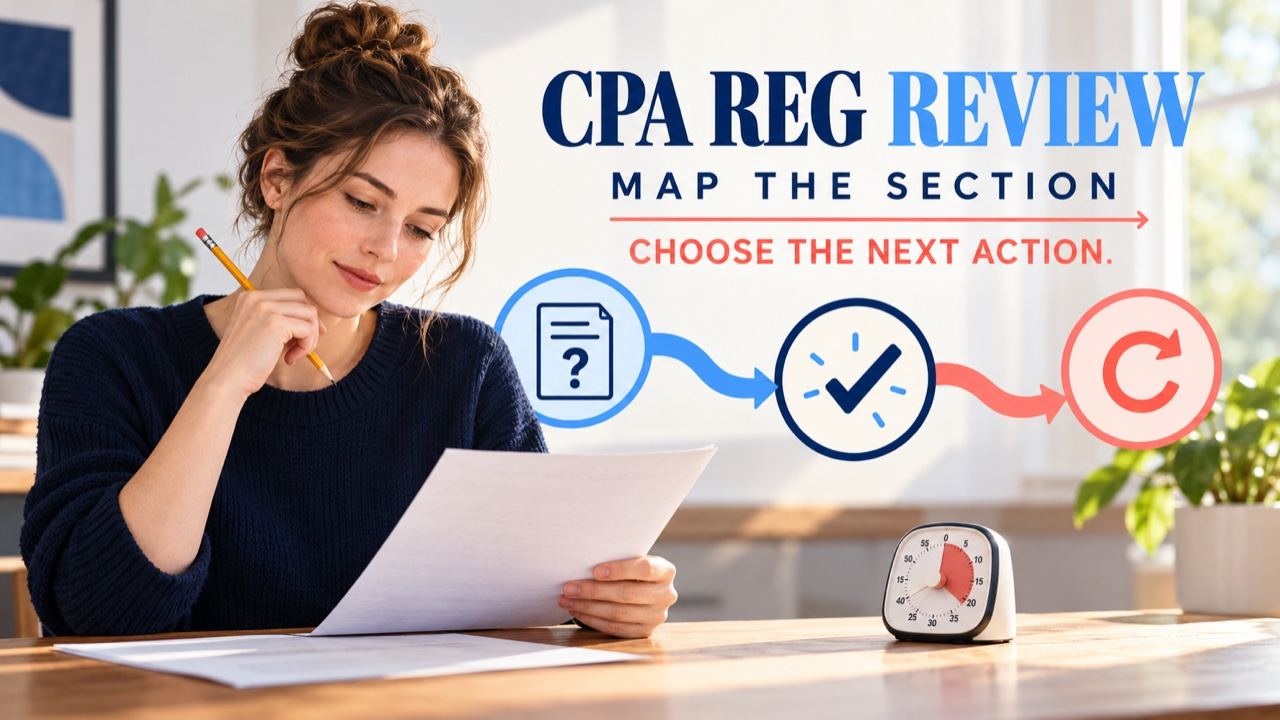

Direct answer: Use free cpa reg practice questions to test one REG decision at a time. Select a current Blueprint row, write the result the question must elicit, identify the fact that would change it, and require an explanation beside the answer. Then run one changed-fact retry. A free question set becomes useful when it reveals a missing proof point; a high hit rate by itself is only a local observation.
Scope and freshness note: This is original editorial study guidance for the U.S. CPA audience. It does not reproduce official questions, predict a score, set a tax position, give legal advice, or make a licensing decision. Reopen the AICPA CPA Exam Blueprints, IRS tax resources, and NASBA CPA Exam FAQ before relying on a live boundary or administration detail.
Use the REG review hub to choose a lane. Consult the Blueprint format guide when a task statement is unclear, the topic MCQ page when you need rule discrimination, or the TBS practice guide when a response must assemble exhibits or calculations.
For a broader preparation path, continue with our related CPA study resources.
free cpa reg practice questions: decide what a question must prove
A practice question should have a job before it has an answer. First state the job in a short phrase: classify, calculate, evaluate, identify, or recommend. Next, specify the evidence that would make the response convincing. For a classification, that may be a category plus a reason; for a calculation, it may be inputs, transformation, and result.
That distinction keeps a question from testing vocabulary alone. The prompt can be original and still teach a reliable reading move: the candidate sees the task, isolates a hinge fact, and explains why the strongest alternative fails. This is the central use of free cpa reg practice questions in a section review workflow.
free cpa reg practice questions: make the set answer one row
Choose one row from the active Blueprint and keep neighboring rows out of the first set. Record the Area or group, topic, task statement, skill level, reference, and item type. Then rewrite the row in plain language and set a stopping rule: the set ends when the first missing proof field is identified.
- Target: state the smallest topic the question can actually test.
- Verb: preserve the row’s requested action rather than turning it into “know this.”
- Hinge: name the role, date, amount, ownership, notice, condition, or classification that can flip the response.
- Checkpoint: save the official or technical source that gives the hinge its meaning.
- Proof: decide what must appear beside the answer: reason, number, exhibit trail, or response fields.
Afterward, write one changed fact that the next question will use. If the expected response does not move, explain why; if it does move, name the trigger. That one line makes a question set diagnostic instead of merely repetitive.
free cpa reg practice questions: sort the REG evidence
Sort the question by the evidence it asks you to assemble. The lanes below help you choose facts; they do not replace the current task statement.
- Federal taxation: identify taxpayer and transaction, then test timing, basis, income, deduction, credit, or limitation.
- Business law: connect party, authority, agreement or default, filing or priority, and requested remedy.
- Ethics and professional responsibility: connect the duty to reliance, disclosure, record, or procedural deadline.
- Tax procedure and application: connect notice, authority, trigger date, and requested response before choosing a deadline.
For example, a deadline alone is not a procedure answer if the notice that starts the clock is missing. Likewise, an entity label is not enough for a law question if authority or remedy is still unknown. Keep the evidence field beside the question so you can tell whether the miss was scope, rule, or assembly.
Use the REG topic-to-action route
Once the row and evidence field are fixed, move through five handoffs. Each handoff should leave a small record that can be checked after the attempt.
- Frame the row. Keep the current Blueprint line visible and set aside adjacent topics.
- Name the response. Turn the task verb into a visible deliverable: reasoned choice, calculation, exhibit trail, or fields.
- Mark the hinge. Underline the one fact or input that could change the outcome.
- Read the checkpoint. Reopen the source or exhibit and paraphrase the boundary before writing the question.
- Test the transfer. Use MCQ for recognition or distractor logic; use TBS-style work for calculations, exhibits, reconciliations, or multi-field assembly.

The route graphic shows why the answer is only one stop. The last stop is the next question with one material fact changed, which tests whether the rule survived a new fact.
Run the REG review route checklist
Use the checklist after one bounded set. Mark a line only when you can explain it from the current row, question, and checkpoint. The first unchecked line chooses the next action; it is not an official score or readiness test.
Then follow that first blank. Tighten the target, restate the verb, isolate the hinge, reopen the source, switch proof format, explain the distractor, or run a changed-fact item.
free cpa reg practice questions: review lucky guesses
A correct answer can still be a repair item. Write the strongest wrong option and the fact that would make it reasonable. If you cannot do that, the response was recognition without a boundary. Keep the question in the ledger and choose a narrower source checkpoint.
MCQ or TBS after the diagnosis?
For instance, use MCQ when the problem is rule discrimination, exceptions, or distractor logic. Use a TBS-style workpaper when the requested result depends on exhibits, a reconciliation, visible inputs, or several response fields. Use a source reread when you cannot state the controlling boundary in your own words.
free cpa reg practice questions: change one fact before you close
Run a five-line review record: task verb, hinge fact, source or exhibit, strongest wrong turn, and next action. Keep timing separate from certainty. If the clock expires while the boundary is unclear, save the ticket and reduce the scope for the next block instead of adding a longer mixed set.
When the source is current-sensitive, record the date you checked it and the question that still needs verification. Editorial prompts can teach a reading move; live authority controls the technical boundary. Therefore, refresh the checkpoint while the route stays stable.
Finally, change one material fact. Keep the task verb fixed and decide whether the answer, calculation, or next destination changes. Explain the trigger either way. That explanation is the durable value of free cpa reg practice questions.
free cpa reg practice questions: choose the next source
Let the first unchecked field select one destination. Use the section hub when the map is missing; use the Blueprint guide when row language is missing; use the MCQ page when discrimination is missing; and use the TBS guide when evidence assembly is missing. Opening every page at once hides the defect.
- REG review hub — find the lane and bound the next question.
- CPA Exam Blueprint format guide — translate the row into task, skill, source, and item type.
- CPA MCQ by topic — test recognition, limits, and distractor reasoning.
- CPA TBS practice — assemble exhibits, calculations, reconciliations, and multi-field responses.
Before ending the session, schedule the next question with its row, proof format, changed fact, evidence to save, and retry time. Then close the research tabs.
Build a diagnostic queue before the first item
Build the free set as a diagnostic queue. Do not treat it as a pile of anonymous questions. At the start of each block, write the REG lane, task verb, and proof to save. During practice, label the first miss: scope, controlling fact, source, arithmetic, or response format. These labels make the next action visible. An easy question can still expose a missing boundary. A slow item can still be correct. Record both observations.
Create a clean handoff record. Use one line for the item, one for the hinge, and one for the next retry. If a source uses a term differently, quote the phrase in your notes. Verify the current authority before you build a rule. If one changed fact alters the answer, explain the trigger. That explanation keeps the practice loop useful across a new topic, item type, or study date.
Finally, save the first unchecked field instead of opening another tab. Reopen one checkpoint, choose MCQ or TBS evidence, and set a retry time. This keeps a small session focused and makes free cpa reg practice questions produce an actionable next step.
free cpa reg practice questions FAQ
Should I study every REG topic in the same order?
No. Let the current row and the first missing proof field choose the order. Keep nearby topics visible for context, but repair one decision before mixing lanes.
Is a high practice percentage proof that I am ready?
No. A local percentage describes one observation; it is not an official CPA score or readiness determination. Keep the reason, failed distractor, and changed-fact result beside it.
When should I use MCQ versus TBS practice?
Use MCQ for recognition and rule discrimination. Use TBS-style work for exhibits, calculations, reconciliations, or several response fields. Reopen the current Blueprint if the item type is unclear.
What should I do after a miss?
Save the earliest missing field, reopen one relevant checkpoint, explain the hinge in your own words, and retry one new item after changing one material fact.
Sources
- AICPA CPA Exam Blueprints
- IRS tax resources
- NASBA CPA Exam FAQ
- REG review hub