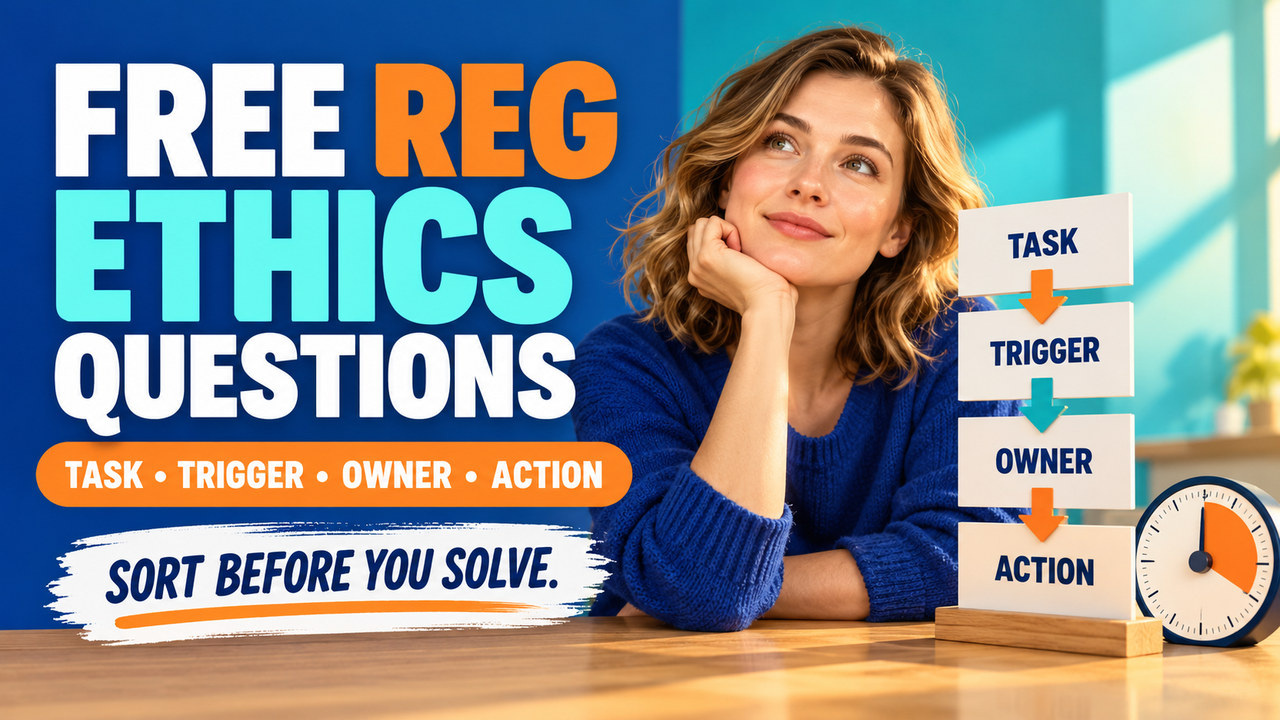

Direct answer: The best way to use free reg ethics questions is to sort the decision before you solve it. Name the task, trigger, owner, authority, and next action. Then read the rationale, mark the first missing rung, and retry after changing one material fact.
Scope and freshness note: This is original editorial study material, not an exam-authority publication. Reopen the AICPA CPA Exam Blueprints for current task statements and tested scope. Use the NASBA CPA Exam FAQ for eligibility, scheduling, jurisdiction, and score questions. Apply current professional guidance to any live engagement or tax conclusion.
For orientation, visit the REG review hub. Use the CPA study guide for planning, the Blueprint format guide for task wording, and the topic MCQ page or TBS practice guide when you need a different retrieval mode.
For a broader preparation path, continue with our related CPA study resources.
Free reg ethics questions: use a decision ladder
However, a multiple-choice stem can contain several true statements. The answer still depends on the task verb and the fact that activates it. The decision ladder keeps those layers separate. It asks what the prompt wants, what event matters, who owns the output, which source controls, and what action follows.
Meanwhile, these are original, simplified practice questions. They are not recalled or official exam items. The Blueprint defines tested scope, while current guidance controls any live conclusion.
Set the task before the facts
Circle the verb first: identify, evaluate, explain, or recommend. Next, underline the fact that could move the answer to another lane. Finally, write the output in one short sentence before you compare options.
Keep the ladder narrow
Similarly, use one question at a time. A narrow ladder makes the changed fact visible. It also prevents a familiar ethics word from hiding a missing owner or trigger.
Sort the question before reading choices
Before you look for a familiar phrase, write five labels in order:
- Task: What must the response do?
- Trigger: Which event, request, notice, or missing record activates the issue?
- Owner: Who owns the judgment, approval, support, or filing action?
- Authority: Which current source or exhibit supports the boundary?
- Action: What is the next permitted step and what record would show it?
Consequently, a choice that skips one label may sound efficient while remaining incomplete. Write the missing label beside the distractor rather than simply marking it wrong.
Build a free reg ethics questions ladder
Next, a paper ladder works best when each rung has one job. Put the task at the top, the trigger beneath it, and the owner, authority, and action below. Leave a blank line for a changed fact.
- Task: name the response verb.
- Trigger: name the event, not just the date.
- Owner: separate support from judgment.
- Authority: identify the source or exhibit to reopen.
- Action: state the step and the record it creates.

The decision-ladder visual is a study tool. Read from top to bottom once. Then cover the last two rungs and rebuild the action from the task, trigger, and owner.
Use one checkpoint per rung
For example, for a task problem, reopen the Blueprint wording. When a trigger is unclear, label the event behind a notice or request. If the owner is unclear, write the responsibility boundary. For an authority gap, reopen the source. In an action gap, name the record you would preserve.
Run original free reg ethics questions
Beforehand, attempt each case before reading the explanation. Write your five-rung ladder, the strongest rejected shortcut, and one checkpoint. These questions are editorial practice for learning, not authority statements.
Reveal the decision ladder
Try the original question first. Name the task, trigger, owner, authority, and next action before opening the rationale.
Reveal the answer
Answer: Compare your ladder with the rationale, mark the first missing rung, and change one fact before retrying.
Compare your process with the reasoning shown above.
Question 1: the request with no owner
Fact pattern: A client asks for a quick response to a tax position. The supporting schedule is incomplete, and the file does not name who owns the final judgment.
Question: Which first move creates a usable ladder?
- Copy the requested result because the due date is close.
- Identify the decision owner, list the missing support, and locate the current procedure.
- Refuse all assistance without checking the scope.
- Choose the shortest option and add a record later.
Answer and rationale: Choice 2 is strongest because it supplies the owner and support rungs before action. Choice 1 treats preference as authority. Choice 3 overstates the refusal. The fourth choice delays the record. Checkpoint: owner, missing schedule, procedure source, and next record.
Question 2: two dates, one event
Fact pattern: A notice shows an issue date and a later delivery event. A changed version uses another notice category while keeping the dates visible.
Question: What should the learner write before choosing a response?
- Use the first date because it appears first.
- Use the later date because it seems more generous.
- Name the event behind each date, verify the category rule, and choose the activating event.
- Repeat the first wording until it feels automatic.
Answer and rationale: Choice 3 preserves the trigger rung. A date without its event cannot select the procedure, and repetition cannot test the changed category. Checkpoint: category, event, authority, action, and changed-fact result.
Question 3: support is not judgment
Fact pattern: A reviewer can organize records, but a client asks the reviewer to make the business judgment because the client file is incomplete.
Question: Which response keeps the ladder honest?
- Accept the judgment so the file can close.
- Refuse every discussion without analyzing the record.
- Separate evidence support from the decision owner, state the missing record, and verify the boundary.
- Save only the final answer and omit the uncertainty.
Answer and rationale: Choice 3 keeps owner, authority, action, and record distinct. Choice 1 transfers judgment, choice 2 ignores scoped support, and choice 4 deletes the learning trail. Checkpoint: owner, missing record, authority, permitted support, and next action.
Compare the strongest distractors
Afterward, write why the tempting answer fails after every question. Does it use the wrong task verb? Does the date act as a false trigger? Who owns the judgment? Where is the authority or record? That sentence is more useful than a letter alone.
Use the same rejection test
First, name the shortcut. Next, name the missing rung. Then, state the fact that would make the shortcut look plausible. Finally, explain why the current fact still blocks it.
Use a changed-fact checkpoint
As a check, a correct answer should survive a controlled variation for the right reason. Change only one detail: notice category, owner, support record, response verb, or delivery event. Keep the other facts stable and write whether the action changes.
Meanwhile, reopen the same checkpoint after the change. If the answer changes, write the new trigger or owner. If it does not, explain why the changed detail is immaterial. This is transfer, not another memory test.
Choose the next free reg ethics questions repair
Therefore, repair the first missing rung instead of adding a larger set. Classify the gap as task, trigger, owner, authority, action, or transfer.
Then choose one bounded move: rewrite the task in your own words, label the event behind the date, name the owner, reopen one source, record the permitted action, or retry one changed-fact question.

The repair route shows the sequence from a distractor to a missing rung, a source check, one changed fact, and a retry. Keep the reason beside the answer so the next session begins with evidence.
Keep a free reg ethics questions ledger
For each miss, give one row:
- Task: the response verb.
- Trigger: the event that activated the issue.
- Owner: the responsibility holder.
- Authority: the source or exhibit checked.
- Action: the permitted next step and record.
- Transfer: the one fact changed in the retry.
As a result, repeated blank task lines call for better stem reading. Repeated trigger lines call for event labeling. Repeated owner lines call for a responsibility pass. A repeated authority line calls for a source block.
Apply the ladder across ethics and procedure lanes
Across topics, keep the ladder stable. Ethics cases may turn on owner and boundary. Tax procedures may turn on trigger and notice category. Disclosure cases may turn on authority and record.
In addition, use the ledger to choose the next resource. Open the Blueprint page for scope, the MCQ guide for retrieval volume, the TBS guide for exhibits, and the REG hub for lane orientation.
free reg ethics questions checklist
- Circle the task verb.
- Name the trigger event behind any date.
- Identify the decision owner.
- Reopen one current authority or exhibit.
- State the action and record.
- Reject the strongest distractor by naming its missing rung.
- Change one material fact and retry.
- Save the first missing rung as the next study action.
Ultimately, strong free reg ethics questions practice turns each stem into a ladder: task, trigger, owner, authority, action, and one transfer check.
free reg ethics questions FAQ
Are these authoritative exam questions?
No. They are original editorial practice. Use current AICPA material for authoritative scope.
What should I write before reading the options?
Write the task, trigger, owner, authority, and next action so the options have a defined frame.
How do I use a changed fact?
Change one material detail, hold the other facts steady, and explain whether the action changes.
Does free practice promise a score?
No. It creates a visible reasoning record and a focused next action; current preparation and performance determine results.
Sources
- AICPA CPA Exam Blueprints
- NASBA CPA Exam FAQ
- REG review hub
- CPA study guide