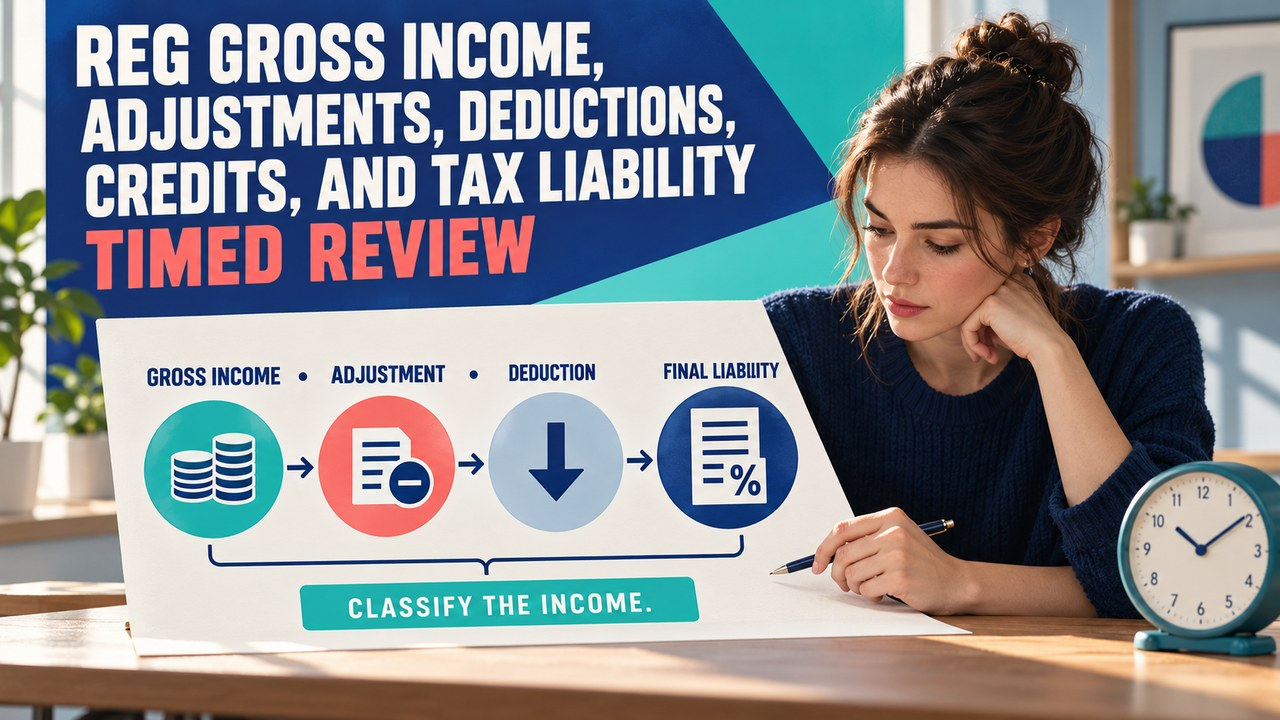

Direct answer: Treat this gross income deductions practice mock exam as a four-stop tax ladder. Put every receipt in the right bucket, build the adjusted base, choose the deduction lane, and reduce tentative tax only by the credit amount the facts permit. A timer makes the order visible; a short error card tells you where the next review belongs.
Scope note: These are original editorial study questions. They do not reproduce live exam content or provide tax advice. Recheck the current AICPA CPA Exam Blueprints for tested tasks, the AICPA CPA Exam resources for subject boundaries, and the NASBA CPA Exam FAQ for scheduling or jurisdiction questions. Use the REG review hub for orientation, then switch to the linked MCQ or TBS pages when you want a different response format.
For a broader preparation path, continue with our related CPA study resources.
REG Gross Income Deductions Practice Mock Exam: timed checkpoints
REG questions often place several familiar labels in one paragraph. Wages, a gift, an adjustment, an itemized amount, and a credit can all appear together while the stem asks for only one line. The trap is usually sequence. This timed circuit makes you pause at the requested output instead of subtracting every attractive number.
Give each scenario six minutes. Spend the first minute circling the requested line, the next two minutes tagging facts, two minutes calculating, and the final minute writing a repair note. Do not open the rationale until your option and reason are on paper. For example, a score without a reason hides the exact boundary that needs work.
Build a gross income deductions practice checkpoint card
Draw four boxes: receipt, base, tax reduction, and liability. Beside each box, write one decision verb. Use classify for the first, adjust for the second, select for the deduction route, and cap for the credit. Therefore, the verbs keep a late-stage number from jumping into an early-stage answer.
Keep a gross income deductions practice time split
At the top of the page write 0:00, 1:00, 3:00, 5:00, and 6:00. If a fact remains uncertain at 3:00, mark the uncertainty and finish the route with the stated assumption. A clean record of the uncertainty is more useful than a rushed guess that looks precise.
Set the gross income deductions practice assumptions
Before the timer starts, copy four lines from the case into your workpaper:
- Person and period: who earned or paid the amount, and which tax period the exercise uses.
- Requested line: gross income, adjusted income, taxable income, usable credit, or final liability.
- Stated simplification: an exclusion, route comparison, eligibility statement, or dollar cap that controls this drill.
- Repair variable: one fact you will change after the first attempt.
Those four lines are the guardrails for a gross income deductions practice session. They prevent you from importing a rule that the exercise never asked you to apply. The retry also becomes measurable: you know which input changed and which output should move.
When you read a receipt, ask what it represents before asking whether it is taxable. Next, ask whether an adjustment changes the base before the deduction choice. Also, ask whether the question wants the nominal amount or the permitted credit. As a result, classification, computation, and limitation stay in separate lanes.

Write the gross income deductions practice evidence line
Use one compact line for every stop: output → controlling fact → boundary → option. For example, “gross-income line → wage amount → supplied exclusion for the reimbursement → choice 2.” In practice, the line should let another reader reconstruct your decision without rereading the entire stem.
Predict the gross income deductions practice changed fact
Choose a single switch before you look at the answer. A receipt can lose its supplied exclusion, an adjustment can stay fixed while the deduction route changes, or a credit cap can fall to zero. The switch tells you whether you understood the rule or only recognized the original numbers.
Run the original practice test
Work all three cases first. Select one option for each, write the checkpoint card, and note the distractor that felt most tempting. The scenarios and explanations are original editorial practice; they are not recalled or official exam questions.
Reveal the timed reasoning
Attempt the original item first. Write the controlling fact, the boundary or evidence check, and the reason you would save before opening the explanation.
Reveal the answer
Answer: Compare your note with the rationale, mark the first missing proof point, and change one fact before retrying. Do not use a raw answer letter as the study record.
Compare your process with the reasoning shown above.
Scenario 1: route the receipt
Facts: For this simplified exercise, Jordan receives $24,000 of wages, a $5,000 personal gift, and $1,500 that the case labels as an employer reimbursement meeting its stated exclusion condition. The question asks what belongs on the gross-income line before any later adjustment.
Question: Which move keeps the first checkpoint intact?
- Put all three cash amounts on the line because cash always enters gross income.
- Begin with the $24,000 wage figure, then test the gift and the reimbursement against their separate facts.
- Apply a tax credit to the $30,500 total before deciding which receipts count.
- Subtract a deduction from wages before classifying the receipts.
Answer: Choice 2. Wages provide the starting line. The gift and reimbursement need their own classification under the supplied facts. Choice 1 treats unlike receipts as identical, choice 3 uses a later tax reduction too early, and choice 4 moves a deduction into the gross-income checkpoint.
Changed-fact retry: Remove the reimbursement condition but keep the dollar amount. Write the new gross-income line and name the fact that moved it.
Scenario 2: build the adjusted base
Facts: The exercise gives $96,000 of gross income, a $6,000 above-the-line adjustment, and an $8,000 itemized amount. It says the taxpayer may use the itemized route only when that route beats the stated alternative. The question asks which value should be established first.
Question: Which sequence protects the base calculation?
- Take the $8,000 amount from each receipt before considering the adjustment.
- Apply the $6,000 adjustment to form the next base, then compare the deduction route under the case assumption.
- Use a credit first because a credit reduces taxable income.
- Choose the larger dollar figure without checking the route condition.
Answer: In contrast, choice 2 creates the next base with the adjustment, then follows the case condition for the deduction comparison. Choice 1 skips the base step, choice 3 belongs to a later tax stage, and choice 4 lets arithmetic replace the stated decision rule.
Changed-fact retry: Keep the $6,000 adjustment and replace the itemized amount with $3,000. State which route wins and why the comparison, rather than the label, decides it.
Scenario 3: cap the usable credit
Facts: A simplified computation produces $65,000 of taxable income and $9,400 of tentative tax. The taxpayer qualifies for a $2,400 nonrefundable credit, but this exercise limits the usable amount to $1,600. No carryforward or second credit appears.
Question: What liability belongs in the answer record?
- $7,000, using the full nominal credit.
- $7,800, with $9,400 minus the $1,600 permitted amount.
- $9,000, applying the credit before tentative tax exists.
- $9,400, treating the credit as irrelevant to liability.
Answer: Choice 2. The stated limit controls: $9,400 − $1,600 = $7,800. Choice 1 ignores the cap, choice 3 reverses the tax sequence, and choice 4 drops a permitted reduction.
Changed-fact retry: Set the usable limit to $0 while leaving the nominal credit at $2,400. The liability returns to $9,400; the broken link is the limitation, not the arithmetic.
Read the gross income deductions practice rationale
Review each answer with the same four questions: What line did the stem request? Which fact controls that line? What condition gives the fact its meaning? Which number confirms the route? This order keeps a correct number at the wrong stage from receiving credit.
Separate rule from arithmetic
In Scenario 1, the wage amount starts the classification work; the other receipts wait for their own boundaries. In Scenario 2, the adjustment shapes the base before the route comparison. The third case applies the cap after tentative tax, so the credit stays in its proper lane. The numbers are short because the test is the handoff between stages.
Label the gross income deductions practice first broken link
Use one tag only: scope when you answered a different question, fact when you missed an input, rule when you used the wrong boundary, limit when you ignored a cap or condition, or transfer when the changed-fact retry failed. The tag selects the next review block.
Choose the next practice test repair
Repair the earliest missing proof point before adding another mixed set. A receipt mistake needs a fresh classification with a new label. For a base mistake, write one calculation that separates the adjustment from the deduction. For a credit mistake, use a two-line check showing tentative tax and the permitted reduction.

Use a narrow gross income deductions practice repair loop
Set a ten-minute block. Spend three minutes restating the boundary, four minutes on a new amount, two minutes explaining the nearest distractor, and one minute recording the changed-fact result. Finally, stop when the repaired link is visible; do not turn a focused fix into an unfocused reread.
Make the timed review repeatable
Keep the same record on every attempt: topic row, requested output, decision verb, controlling fact, boundary, selected option, rejected distractor, first broken link, and changed-fact result. A short record lets you compare attempts without relying on a vague feeling of improvement.
Keep authority and practice separate. The AICPA pages control current scope and terminology. Meanwhile, the dollar amounts, options, labels, and visuals on this page are editorial training devices. When a live tax-year detail or jurisdiction question appears, reopen the authoritative material before treating a study shortcut as a rule.
gross income deductions practice checklist
- Circle the requested output before doing arithmetic.
- Classify each receipt on its own facts.
- Form the adjusted base before choosing a deduction route.
- Check credit eligibility and the usable ceiling after tentative tax.
- Write why the strongest distractor fails at its checkpoint.
- Tag the earliest broken link with one repair label.
- Change one material fact and predict the result.
- Schedule the next ten-minute block before leaving the page.
A good gross income deductions practice record ends with a next action, not just a percentage. You should know whether to revisit classification, rebuild the base, verify a limitation, or run another transfer.
gross income deductions practice FAQ
Are these official exam questions?
No. The three scenarios, options, and rationales are original editorial practice. Use current AICPA material for the official scope.
Should every cash receipt enter gross income?
No. Classify each receipt under the facts and any explicit simplification in the case. A cash label alone does not settle the checkpoint.
Does a deduction always come before a credit?
Follow the requested output and the sequence stated in the exercise. In Scenario 3, tentative tax comes first, then the usable credit limit.
Will this timed review predict a passing score?
No. It creates observable evidence and a focused repair. The exercise cannot predict an exam result.
Sources
- AICPA CPA Exam Blueprints
- AICPA CPA Exam resources
- NASBA CPA Exam FAQ
- REG review hub