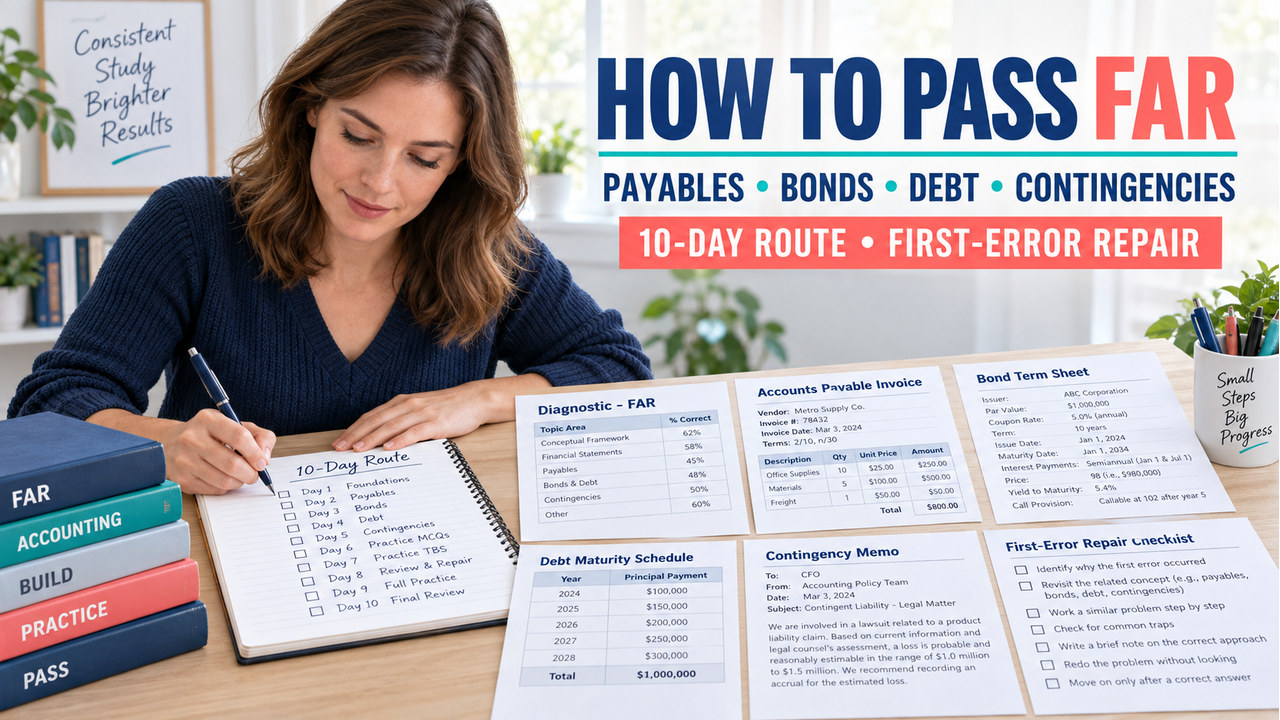

Direct answer: To pass payables bonds debt and contingencies on CPA FAR, use a ten-day evidence route rather than a chapter-count promise: confirm the current scope, run a baseline, drill the first weak field, test a changed fact under time, repair the first broken step, and stop only after you can explain one mixed case without notes. A pass cannot be guaranteed by a study article, but the route below makes your next decision specific.
Editorial review: The CPA Exam Prep editorial team checked the topic boundary against the current AICPA Blueprint and saved the accounting research checkpoint on September 24, 2026. The route, examples, cases, visuals, and repair actions are original simplified study material. Therefore, use the current official sources again when the Blueprint, guidance, or your jurisdiction-specific process changes.
For scope, reopen the AICPA CPA Exam Blueprint. For technical conclusions, research the current FASB Accounting Standards Codification. Meanwhile, the NASBA CPA Exam FAQ covers administration separately, and the AICPA sample test is a format tool rather than a readiness forecast.
What a pass-focused study route can and cannot prove
A useful route can prove that you followed a scope boundary, reproduced a rule, labeled the controlling fact, explained a distractor, and transferred the logic after one fact changed. It cannot prove a future score or promise a pass. For that reason, a high percentage from familiar questions may reflect recognition instead of independent reasoning.
Use five evidence fields in every block: source, date, measurement, classification or judgment, and requested unit. For example, a payable may turn on the receiving report and cutoff date, while a bond expense may turn on carrying amount, effective yield, and elapsed period. Therefore, log the field you used before logging whether the answer was right.
- Keep: the fact, rule, formula, or split that controlled the answer.
- Repair: the first field that broke, not every topic in the chapter.
- Retry: one changed-fact case without notes.
- Stop: only when you can explain the result and the nearest distractor.
Pass payables bonds debt: run the ten-day route
Use the route as a sequence of evidence, not as a promise that ten calendar days is enough for every candidate. However, extend a phase when the proof is missing, and shorten a phase only when the evidence is stable. Accordingly, the visual route board below shows what each phase should leave behind.
Scope and baseline: five lanes, one mixed set, first error.
Drill the broken field and keep labeled work.
Transfer one changed fact under a time limit.
Repair the first error and explain the distractor.
Use the stop rule and schedule only the next gap.

Pass payables bonds debt: scope and baseline
First, reopen the current Blueprint and write the four liability lanes on one sheet. Next, attempt one original case from each lane without notes. After that, record the requested output, the fact you used, the nearest distractor, and the first broken field. A baseline is useful only when it tells you what to do next; therefore, it is not a score forecast.
Pass payables bonds debt: drill one broken field at a time
In practice, choose the earliest broken field from the baseline. When the issue is cutoff, use three receipt-and-payment timelines. When measuring a bond, label face amount, carrying amount, coupon, yield, and period before calculating. Meanwhile, for debt classification, split current and later principal at the reporting date. When reviewing a contingency, separate probability from estimability. As a result, each drill should produce a page you can inspect, not just more answer letters.
Pass payables bonds debt: transfer under time
Keep the rule and change one fact. For example, change the carrying amount while keeping the yield, change the elapsed days while keeping the principal, or change whether an estimate is available. Then solve without notes and explain why the nearest distractor fails. In contrast, a familiar repeat can hide a setup error; therefore, a changed fact exposes whether the rule transferred.
Pass payables bonds debt: repair and mixed review
Instead, return to the first broken field, not the most interesting topic. Next, run one narrow repair, one changed-fact retry, and one mixed case that includes a neighboring lane. When the mixed case fails, label whether the failure came from evidence selection, date, measurement, classification, judgment, or requested unit. Consequently, the mixed set becomes a diagnostic queue instead of a confidence ritual.
Pass payables bonds debt: use a stop rule
Stop a study block when you can reproduce the rule, name the controlling fact, calculate or classify the requested output, and explain the nearest distractor on one changed-fact case. If one of those proofs is missing, do not add a broad new chapter; instead, book the narrow repair. As a result, a stop rule protects the final days from endless rereading.
Build a pass evidence contract
Before each question, write five labels: source, date, measurement, classification or judgment, and requested unit. Afterward, add the answer, the nearest distractor, and one next action. In practice, this contract makes a correct guess visibly different from a supported solve.
Attempt six original pass payables bonds debt checkpoints
These cases are original simplified practice, not live exam questions. First, read the tested skill, assumptions, and difficulty. Then commit to an answer and reason before opening the reveal. Finally, record the first broken field and use the repair rule below.
1. Payable cutoff
Tested skill: identify the period of an accepted payable. Assumptions: goods were accepted before year-end and no return is stated. Difficulty: foundational. A company received and accepted $72,000 of inventory on December 29. The invoice arrived January 4 and cash was paid January 20.
Question: What simplified payable belongs at December 31?
- A. $0 because the invoice arrived later
- B. $72,000 because accepted goods were received before year-end
- C. $20,000 because that is the payment date
- D. $92,000 because invoice and payment are combined
Reveal Checkpoint 1
Answer: B. Thus, the receiving evidence and cutoff date control this simplified case. Option A follows invoice entry, C follows cash, and D invents an addition. Next action: draw the three dates before reviewing another cutoff question.
2. Bond expense
Tested skill: apply an effective yield to carrying amount for elapsed time. Assumptions: the rate is annual and the period is three months. Difficulty: measurement. A bond has a $640,000 carrying amount and a 9% annual effective yield.
Question: What simplified three-month expense should be calculated?
- A. $14,400
- B. $16,000
- C. $57,600
- D. Face amount multiplied by an unstated coupon
Reveal Checkpoint 2
Answer: A. Therefore, use $640,000 × 9% × 3/12 = $14,400. Option B uses a different rate or period, C uses a full year, and D answers an unavailable input. Next action: write carrying amount, rate, and fraction before entering numbers.
3. Current debt
Tested skill: classify principal at the reporting date. Assumptions: only principal is requested and no refinancing exception is stated. Difficulty: classification. A note has $185,000 due within the next twelve months and $615,000 due later.
Question: What current portion belongs in the simplified presentation?
- A. $0
- B. $185,000
- C. $615,000
- D. $800,000
Reveal Checkpoint 3
Answer: B. As a result, current principal is the amount due within the next twelve months. Option C selects later principal, and D fails to split the note. Next action: mark the reporting date before considering interest.
4. Contingency estimate
Tested skill: separate probability from estimability. Assumptions: a loss is probable, but counsel cannot make a reasonable estimate; no reimbursement is stated. Difficulty: judgment.
Question: Which simplified response fits the facts?
- A. Recognize the claimant’s requested amount
- B. Disclose the contingency without inventing a recognized amount
- C. Ignore it because cash has not been paid
- D. Record zero and stop reviewing
Reveal Checkpoint 4
Answer: B. However, probability alone does not provide a reliable measured amount in this simplified case. Option A substitutes a demand for an estimate, C confuses cash with reporting, and D treats zero as a conclusion. Next action: write probability and estimate on separate lines.
5. Accrued interest
Tested skill: accrue interest for a stated time fraction. Assumptions: use a 360-day year and simple daily accrual. Difficulty: time-apportioned calculation. A $420,000 note carries a 5% annual rate, and 90 days have elapsed.
Question: What simplified accrued interest should be recorded?
- A. $1,750
- B. $5,250
- C. $21,000
- D. $37,800
Reveal Checkpoint 5
Answer: B. Thus, $420,000 × 5% × 90/360 = $5,250. Option A uses one month, C uses a full year, and D uses too many days. Next action: write the annual amount, elapsed days, and denominator before calculating.
6. Cash versus expense
Tested skill: return the requested cash-interest output. Assumptions: interest is paid semiannually. Difficulty: requested-unit control. A $700,000 bond has a 6% annual coupon.
Question: What six-month cash interest is paid?
- A. $10,500
- B. $21,000
- C. $42,000
- D. Carrying amount multiplied by effective yield
Reveal Checkpoint 6
Answer: B. In this case, cash interest uses face amount and coupon: $700,000 × 6% × 6/12 = $21,000. Option A uses one quarter, C uses a full year, and D answers expense. Next action: write “cash” or “expense” above the formula.
Repair the first broken field
Next, classify the first error. Source errors mean the invoice, receipt, term sheet, maturity schedule, or memo was not used. Similarly, date errors lose the reporting or elapsed period. Meanwhile, measurement errors mix face, carrying amount, coupon, or yield. In turn, classification errors leave current and later principal unsplit. Likewise, judgment errors combine probability and estimation. Finally, a requested-unit error answers cash when the prompt asks for expense, or expense when it asks for cash.
For Checkpoint 1, rebuild a dated cutoff timeline. Next, label the carrying amount, rate, and fraction for Checkpoint 2. Then, split the maturity schedule for Checkpoint 3. Meanwhile, for Checkpoint 4, separate probability from estimate. Similarly, after Checkpoint 5, rewrite the time fraction. Finally, label the output unit for Checkpoint 6. In contrast, rereading all four topics hides the field that actually failed.

Use a pass-evidence board and stop rule
Keep one row for each lane: controlling source, date, measurement, classification or judgment, requested unit, first error, and next block. In practice, a good row is not a trophy; it is a decision aid. When the row lacks a proof, schedule the same lane. When the row has a proof and a changed-fact retry, move to mixed transfer. Therefore, the board should always point to one next action.
| Evidence field | Keep | If missing |
|---|---|---|
| Source and date | Dated evidence trail | Three cutoff variations |
| Measurement | Labeled formula and unit | Two changed-rate cases |
| Classification | Current/later split | Two maturity schedules |
| Judgment | Probability and estimate note | One changed-estimate case |
Use the stop rule only after one changed-fact case is solved without notes and the nearest distractor is explained. If the evidence is mixed, the correct response is a narrower route, not a pass promise. In addition, refresh the Blueprint and technical source before reusing any simplified case as a reporting conclusion.
Refresh the pass route before reuse
For current scope, reopen the AICPA CPA Exam Blueprints. For technical accounting, research the current FASB Codification. Meanwhile, use the AICPA sample test for software familiarity and the NASBA FAQ for administration; none of those links turns this page into an official score or readiness test.
Finally, check the Blueprint effective date, update changed assumptions, and keep the first-error log. Semrush US volume and KD remain a row-level refresh task because the workbook does not supply them here. A bounded plan stays useful when it is current, specific, and honest about what its evidence can prove.
Pass payables bonds debt contingencies FAQ
Can ten days prove readiness?
No. The route organizes evidence and next actions; it does not predict a score or promise an outcome.
What should I do after a mixed-set miss?
Tag the first broken field, change one fact, solve again, and explain the nearest distractor before adding breadth.
Which bond amount should I use?
Label the requested output first, then choose face amount, carrying amount, coupon, yield, and period from the facts.
When should I stop a study block?
Stop when you can reproduce the rule, use the controlling fact, answer the requested unit, and explain one changed-fact distractor.