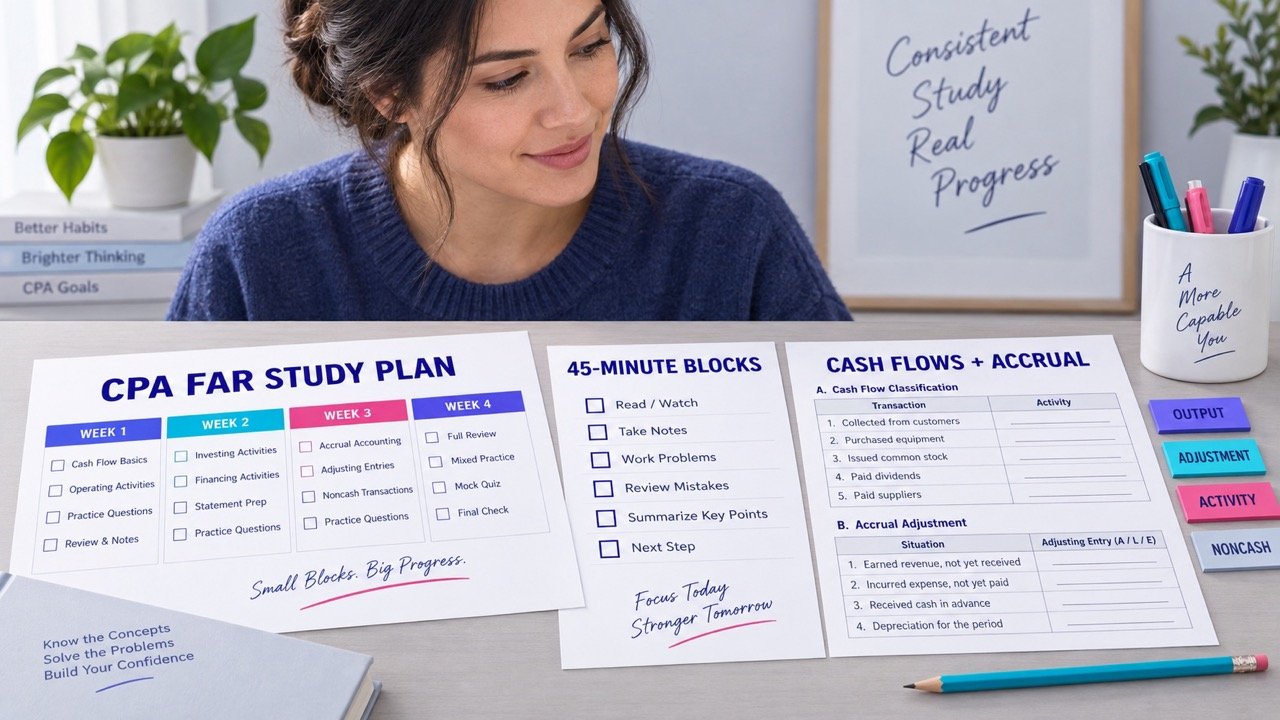

how to study cash flows and accrual accounting for cpa far becomes manageable when the study plan follows the learner’s first error. If you are deciding how to study cash flows, let the first broken field choose the next bounded drill. Start by naming the requested output, then label the accrual facts, build the bridge, place the cash movement, and record the next retry. This page turns that route into a four-week calendar, a repeatable 45-minute block, and four original practice prompts. It is original editorial study content, not provider-owned question material and not a readiness score.
Quick answer: First, use Week 1 to separate profit, cash, balance, adjustment, and noncash facts; Week 2 to sort operating, investing, and financing lanes; Week 3 to mix fact patterns; and Week 4 to transfer the method under time pressure. That sequence is a practical way to study cash flows without rereading the whole chapter after every miss. Then, in every session, spend the final minutes tagging the first broken reason. For broader FAR context, use the CPA FAR review hub.
How to study cash flows: start with the output
Tested skill: move from an accrual fact pattern to the specific cash-flow output the prompt requests. For example, that output might be cash from operations, cash paid for equipment, net financing cash, or the treatment of a noncash exchange. The main trap is calculating a correct number for the wrong question.
Assumptions: the examples use simplified calendar-year nongovernmental entities, short calculations, and no unusual tax, industry, method, presentation, or effective-date exception. Therefore, when a real fact pattern changes those assumptions, reopen current guidance instead of extending a classroom shortcut. The current AICPA CPA Exam Blueprint resource controls scope language; the AICPA sample test helps with format rehearsal, not readiness scoring.
Difficulty and study rhythm: moderate. Plan three short sessions each week if possible: one for the bridge, one for lane and noncash classification, and one for mixed transfer. Also, if your schedule is tighter, keep the same order and compress the minutes rather than skipping the error log.
How to study cash flows: build a four-week plan around the weak area
Then, use the calendar as a progression, not a promise that every learner needs four full weeks. Each week has a goal, a drill, proof that the skill moved, and a next action. The proof should be an explanation or a corrected route, not a percentage that pretends to be an official score.
How to study cash flows: separate output from measurement
Begin with the words in the prompt. For example, “Cash provided” asks for a cash bridge. “Cash paid” asks for the payment. “Net financing cash” asks you to split borrowing and repayment. “Treatment” may signal that no cash moved. During each session, write four labels beside the numbers: profit or loss, cash, balance, and noncash or adjustment. End by explaining why one tempting number does not answer the question.
How to study cash flows: place the lane
Similarly, sort each movement into operating, investing, financing, or noncash under the stated exercise. Working-capital changes and the operating bridge belong together. Cash paid for long-lived assets is an investing fact in these exercises. Borrowing, principal repayment, equity cash, and distributions are financing candidates. An exchange of an asset for shares without cash belongs in a noncash review. If you miss a lane, do a short sort before returning to mixed arithmetic.
How to study cash flows: mix one changed fact at a time
Keep the same route while changing one fact. Turn an accounts-receivable increase into a decrease, change a borrowing amount, add a small cash payment to an exchange, or replace an equipment payment with a later depreciation fact. The purpose is transfer: you should be able to say which line changed and why the output moved. Do not change five facts at once because that hides the original error.
How to study cash flows: transfer the method under a clock
Use a short mixed set, but keep the time limit secondary to the explanation. Next, name the output, then build the route, then check the lane and noncash treatment. After each item, record the first broken step. A timed block that produces a clear repair plan is more useful than a fast block that leaves you unsure why the answer was wrong.

Progress check: the plan is working when you can read a new fact pattern and immediately write “output, controlling fact, lane, next proof.” If you still reread the whole chapter after every miss, the schedule is too broad. Narrow tomorrow’s task to the first broken field.
Use one repeatable 45-minute study block
A fixed block makes the method easier to repeat. First, spend five minutes reading the prompt verbs and predicting the requested output. Then, spend twelve minutes labeling facts. Next, use fifteen minutes for one bridge or lane sort. Reserve eight minutes for a changed-fact retry. Finally, finish with five minutes to write the first error and the next session’s proof. If you only have 20 minutes, use 3, 6, 7, 3, and 1 minute in the same order.
Worked example: Harbor Services
Harbor Services reports net income of $82,000, depreciation of $11,000, an accounts-receivable increase of $7,000, an inventory decrease of $3,000, and an accounts-payable increase of $4,000. For example, under a simplified indirect-method exercise, cash from operations is $93,000: $82,000 + $11,000 – $7,000 + $3,000 + $4,000. The important study move is not memorizing the total. It is identifying why depreciation is a noncash add-back, why the receivable increase uses cash, why the inventory decrease releases cash, and why the payable increase supplies cash.
Now change one fact: make accounts payable decrease by $4,000 instead of increase. The total falls to $85,000 because the payable line changes from plus $4,000 to minus $4,000. That single change is a proof of transfer. If you changed the sign correctly but still placed the result in investing, your next block should be a lane sort, not another indirect-method calculation.
Editorial review note: this schedule and worked example were prepared for CPA Exam Prep editorial use and checked against the current AICPA Blueprint boundary and the FASB Codification entry point on September 22, 2026. The exercise is simplified and is not an official question or readiness measure.
Four original practice prompts: schedule the attempt
Use one 20-minute practice block. Before opening the answer, write the requested output, controlling fact, lane, and nearest distractor for each prompt. These are original editorial exercises, not provider-owned question material.
Prompt 1: operating bridge
Redwood Media reports net income of $51,000. Depreciation is $8,000, accounts receivable decreases by $5,000, and accounts payable decreases by $2,000. Under a simplified indirect-method presentation, what is cash provided by operating activities?
Prompt 2: equipment payment
Lumen Labs pays $27,000 cash for testing equipment. Which amount and lane describe the purchase-date cash effect? Ignore later depreciation.
Prompt 3: debt movement
Orion Foods borrows $42,000 in cash and repays $17,000 of principal during the same period. Ignore interest. What is the net financing cash flow?
Prompt 4: share-for-land exchange
Pine Ridge acquires land with a fair value of $24,000 by issuing shares directly to the seller. No cash is paid at signing. What treatment fits the stated facts?
Reveal the original practice routes
Complete all four prompts before opening the answer. Record the requested output, controlling fact, lane, and one distractor.
Reveal the answer
Answer: Redwood CFO is $62,000; Lumen is a $27,000 investing outflow; Orion is a $25,000 financing inflow; Pine is a noncash share-for-land exchange.
Compare your process with the reasoning shown above.
Let the first error choose tomorrow’s study block
After the reveal, review the four routes. Redwood is $62,000 of operating cash: $51,000 + $8,000 + $5,000 – $2,000. Lumen is a $27,000 investing outflow because the question asks for cash paid for a long-lived asset. Orion is a $25,000 financing inflow because $42,000 borrowed less $17,000 repaid equals $25,000. Pine is a noncash share-for-land exchange at the acquisition date because no cash moved.
Use four error tags. Tag output when you answered a different question than the prompt asked. For an adjustment error, note that you reversed a receivable, inventory, payable, prepaid, or noncash sign. Mark activity when an asset or debt movement landed in the wrong statement lane. Finally, tag disclosure when an exchange without cash was reported as if cash moved.

Repair rule: output errors get a five-minute prompt scan; adjustment errors get a 10-minute sign drill; activity errors get a 10-minute lane sort; disclosure errors get a 10-minute cash-versus-noncash rewrite. Then, finish the repair by changing one fact and explaining what moved. Do not start another mixed set until you can state the controlling fact in one sentence.
How to study cash flows: match the plan to your available time
For a 20-minute block, protect the output scan, one bridge or lane sort, and a one-line error log. Alternatively, at 45 minutes, use the full block above and complete one changed-fact retry. Finally, with 90 minutes, run two different fact patterns, take a short break, and spend the last 15 minutes explaining the two first errors. In every version, keep the order stable. More minutes should add a second useful fact pattern, not a longer introduction.
Meanwhile, when your exam date is close, compress the calendar but preserve the progression: output and bridge first, lane and noncash next, mixed transfer after that, and timed practice last. When the date is farther away, use the four-week version and revisit the same weak area after 48 hours. A good next action is concrete: “tomorrow at 7 p.m., run three receivable/payable sign drills and change one payable fact,” not “study FAR more.”
Finally, use the current FASB Accounting Standards Codification when entity type, reporting date, cash-flow method, disclosure scope, or effective date changes. The FASB Codification overview is a research entry point, not a replacement for the specific current Topic. Keep the practice prompts separate from official source material.
How to study cash flows and accrual accounting for CPA FAR FAQ
Should I study formulas before fact patterns?
Learn the direction of common adjustments, but put the prompt output first. A formula without an output and controlling fact can produce a polished answer to the wrong question.
How often should I change the practice facts?
Change one fact after each miss. Once you can explain the changed result, move to a genuinely different pattern. Changing everything at once makes the repair impossible to audit.
Should I use a percentage to judge my readiness?
Use a local result as a diagnostic only. The useful evidence is the first broken field and the next repair block, not a number presented as an official score.
When should I check the official sources again?
Check the current Blueprint when scope or skill language changes. Check current FASB guidance when entity, reporting date, method, disclosure scope, or effective-date facts change.