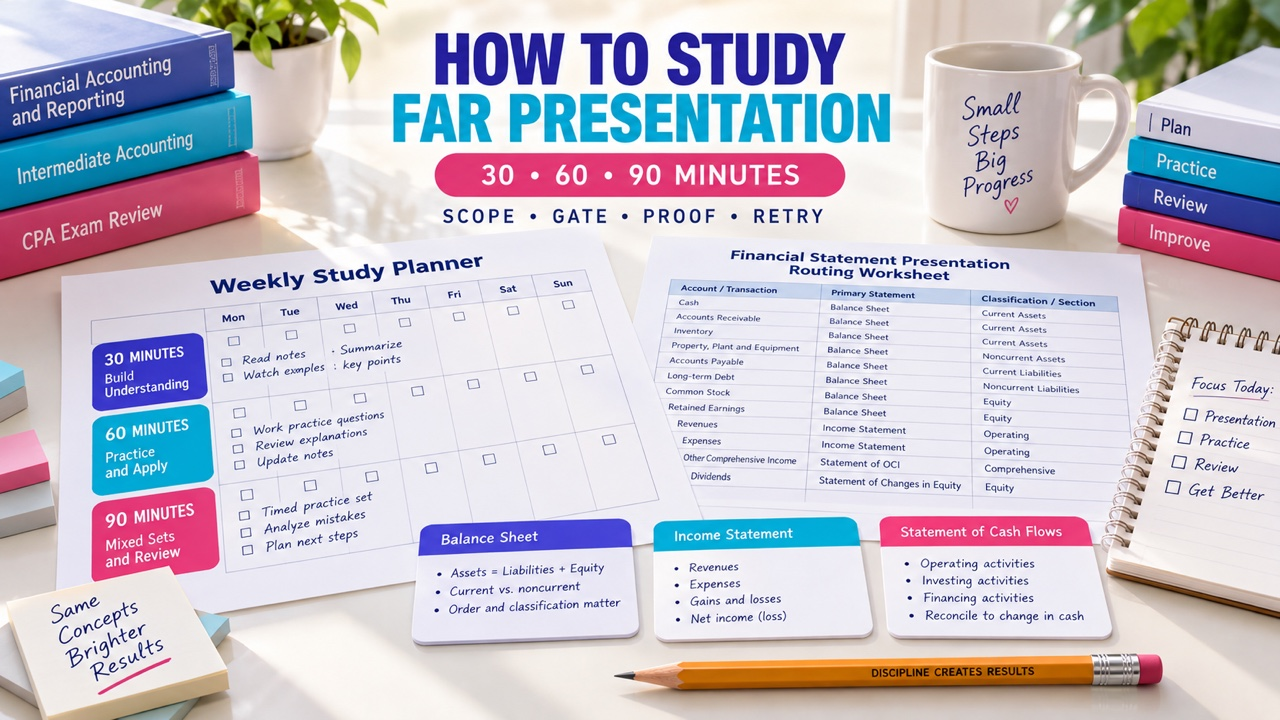

Learning how to study financial statement presentation for CPA FAR is easier when each session ends with a defensible destination. Do not begin with a large bank of mixed questions. Begin with one task verb, one controlling fact, one statement or note, and one reason the nearest distractor fails. This page uses the loop SCOPE → GATE → PROOF → RETRY.
Quick answer: choose a study block that matches your available time, run every fact through recognition, measurement, presentation, and disclosure, then change one fact and repeat the first weak path. This financial statement presentation study plan keeps the next action narrow. The three practice checks below are original editorial questions, not provider-issued exam items.
Assumptions: examples use simplified U.S. GAAP facts and no unusual tax effects unless stated. Refresh the applicable current Codification topic when a question adds scope, materiality, tax, effective-date, industry, or alternative-presentation complications. Difficulty is moderate because each check isolates one presentation handoff.
For a broader preparation path, continue with our CPA Exam Study Guide.
Start your financial statement presentation study session
Financial statement presentation study goal
The financial statement presentation study goal is to defend both the amount and its destination. Name the reporting event first, then preserve the fact that supports the statement, cash-flow category, or note.
The AICPA Blueprints give you a current boundary for Areas, Groups, Topics, task statements, skill levels, references, item types, and weighting. Use that boundary to name the skill before you open a question bank. A useful session starts with a sentence such as, “I am practicing how a cash or noncash event reaches the statement, cash-flow section, or note.”
- Scope: write the FAR topic and the task verb: classify, present, calculate, correct, or disclose.
- Gate: decide whether the first risk is recognition, measurement, presentation, or disclosure.
- Proof: record the fact, source topic to reopen, destination, and closest distractor.
- Retry: change one controlling fact and explain whether the destination moves.
This sequence prevents a common study failure. A learner can know a rule and still place the result in the wrong statement. The evidence card forces the answer to carry its destination and reasoning.
Choose a CPA FAR study block by time and weak lane
Use the smallest block that can produce proof. The goal is not to fill every available minute with more questions. The goal is to leave with a source-backed decision and a next repetition.
- 30 minutes — repair one gate: spend five minutes naming the task and fact, fifteen minutes on one example, and ten minutes changing one fact. Choose this block when you already know the topic but keep missing the same destination.
- 60 minutes — build and test: spend ten minutes on the current Blueprint boundary, twenty minutes on a worked example, twenty minutes on three original checks, and ten minutes on an error card. Choose this block for a new or unstable subtopic.
- 90 minutes — map and transfer: spend fifteen minutes on scope, thirty minutes on two examples, thirty minutes on a focused set, and fifteen minutes on a changed-fact retry plus source note. Choose this block when recognition is sound but presentation and disclosure still blur together.
At the end of the block, write one sentence: “My next study action is ___ because the first unsupported gate was ___.” That sentence is more useful than an unqualified feeling that the chapter was hard.
Build the four-gate presentation map
Run the same four questions in the same order. Stop at the first unsupported handoff instead of jumping to a later display rule.

- Recognize: what asset, liability, equity change, income item, or cash event enters the reporting model?
- Measure: what amount, date, basis, period, or assumption controls the number?
- Present: which statement, line, subtotal, section, or cash-flow category carries the result?
- Disclose: which policy, detail, noncash explanation, or supporting note lets the reader understand it?
A clear amount without a destination is not a finished answer. A clear statement line without an identified event can also be a guess. Use the current Codification to verify the gate that failed, then preserve the source cue on your evidence card.
Work an original mixed cash-and-noncash example
Practice fact pattern: On January 1, Northline Services acquires equipment for $100,000. It pays $25,000 in cash and issues a $75,000 three-year note. During the year, it records $10,000 of depreciation. Assume simplified U.S. GAAP, no tax effects, and no other facts.
Recognition: record equipment and the note payable. Measurement: start with the $100,000 equipment cost and the $10,000 depreciation charge; the simplified carrying amount before other adjustments is $90,000. Presentation: place the equipment with the applicable long-lived-asset line and the note with the applicable liability classification. Disclosure: show the $25,000 cash payment in the appropriate investing cash-flow section and identify the $75,000 noncash portion in the supplemental noncash explanation. Do not report a $100,000 cash outflow when only $25,000 of cash moved.
Now make one change: suppose the full $100,000 is paid in cash and no note is issued. Recognition and measurement still begin with equipment cost, but the cash-flow destination changes because the noncash financing portion disappears. This is the value of a one-fact retry: it tests whether you can transfer the rule instead of repeating a memorized answer.
Practice check 1: customer cash received before the work
Original practice item: A company receives $24,000 on December 1 for a twelve-month service arrangement. At December 31, eleven months of service remain. Under the stated simplified facts, which presentation should you test first?
- Recognize all $24,000 as revenue because cash was received.
- Recognize a contract liability for the unearned portion and recognize only the earned amount as revenue.
- Record the cash as an investing inflow because it funds future work.
- Record the cash directly in retained earnings.
Reveal the answer, distractor, and next action
Answer: B. The controlling fact is the timing of the service, not the receipt of cash. Under the simplified facts, one month is earned by December 31 and the remaining obligation is presented as a contract liability under the applicable classification. Cash receipt does not by itself complete the revenue handoff.
Nearest distractor: A confuses cash movement with earned revenue. Next action: change the fact so six months of service have been provided, then update the earned amount and remaining liability without changing the cash received.
Practice check 2: split cash and noncash equipment consideration
Original practice item: A company acquires equipment for $80,000 by paying $20,000 at closing and signing a $60,000 note. Which cash-flow starting point best matches the stated facts?
- Show an $80,000 investing cash outflow because the equipment cost is $80,000.
- Show a $20,000 investing cash outflow and explain the $60,000 noncash portion separately.
- Show a $60,000 financing cash outflow because the note is a financing instrument.
- Show no cash-flow effect because equipment purchases are balance-sheet events.
Reveal the answer, distractor, and next action
Answer: B. The fact that controls cash-flow presentation is the amount of cash that actually moved. The $20,000 payment is the cash investing component. The $60,000 note is a noncash portion that belongs in the appropriate supplemental explanation rather than in the cash total.
Nearest distractor: A uses the asset cost as if it were the cash movement. Next action: change the consideration to $80,000 cash and no note, then state which disclosure line disappears and which cash total changes.
Practice check 3: a foreign-currency translation adjustment
Original practice item: A foreign subsidiary’s translated net assets create a $12,000 translation adjustment during the year. Assume the adjustment is not a transaction gain, no tax effect is modeled, and no disposal occurs. Where should you trace the adjustment first?
- Revenue on the income statement.
- Other comprehensive income and the related accumulated comprehensive-income component, subject to the applicable current guidance.
- Operating cash inflow because the translated amount increased.
- Accounts receivable.
Reveal the answer, distractor, and next action
Answer: B. The fact pattern describes a translation adjustment rather than a customer transaction or cash event. Under the stated simplified facts, trace it through the other-comprehensive-income path and verify the applicable accumulated component in the current literature.
Nearest distractor: A treats a translation movement as earned operating performance. Next action: change the fact to a disposal of the foreign operation and reopen the current guidance to identify the reclassification question.
Set a weekly rhythm that responds to errors
A simple seven-day rhythm keeps the method practical. On day one, set the Blueprint boundary and write the four-gate map. On day two, work the mixed cash-and-noncash example. On day three, complete the three original checks without opening the reveals. On day four, review only the first weak gate. On day five, change one fact and retry. On day six, explain the destination aloud or in writing. On day seven, decide whether the next block should stay narrow or expand to a mixed FAR set.
For financial statement presentation, let the first unsupported gate choose the next source and drill instead of adding unrelated question volume.
Use your available time honestly. A 30-minute repair completed with a clear source cue is better than a 90-minute block filled with unreviewed questions. If the first weak lane is presentation, name the line or cash-flow category. If it is disclosure, name the note or supplemental explanation. The lane decides the next source.
Convert the first miss into a repair
Do not record only “wrong.” Record the earliest unsupported decision. If you misread what the question asked, repair recognition. If you had the event but not the amount or date, repair measurement. If you knew the amount but chose the wrong statement or cash category, repair presentation. If the statements looked right but the reader still needed context, repair disclosure.

Keep every unchanged fact visible during the retry. Change one fact, recompute only the linked conclusion, and compare the old and new destinations. If several lines move, write which change caused each movement. That record becomes the first card in the next study block.
Common traps when studying financial statement presentation
- Cash equals revenue: cash receipt can precede earned performance and create a liability.
- Asset cost equals cash flow: a mixed cash/noncash purchase must be split by actual cash movement.
- Amount equals answer: a correct number still needs a statement, line, category, or note.
- Translation equals income: a translation adjustment can follow an OCI path rather than an operating-revenue path.
- More questions equals progress: unreviewed volume can hide the first broken gate.
- Old summary equals current rule: reopen the live Blueprint and current Codification when scope or effective dates matter.
Use one repair sentence for every trap: “The controlling fact is ___; the destination is ___; the closest distractor fails because ___.” If you cannot complete the sentence, keep the topic in the next block.
Refresh the Blueprint and Codification before you expand
The AICPA CPA Exam Blueprints page is the scope source for current task statements and exam-format context. The FASB Accounting Standards Codification is the technical source to reopen for the applicable U.S. GAAP topic. The AICPA sample-test resource can help you rehearse the testing interface, while the NASBA CPA Exam FAQ is a separate exam-process reference.
This page’s method and examples are original editorial study content. They do not replace current source literature, a full FAR study plan, or jurisdiction-specific advice. Before you move on, save the current scope cue, controlling fact, destination, distractor, and one changed-fact retry. That is the practical finish line for this study block.