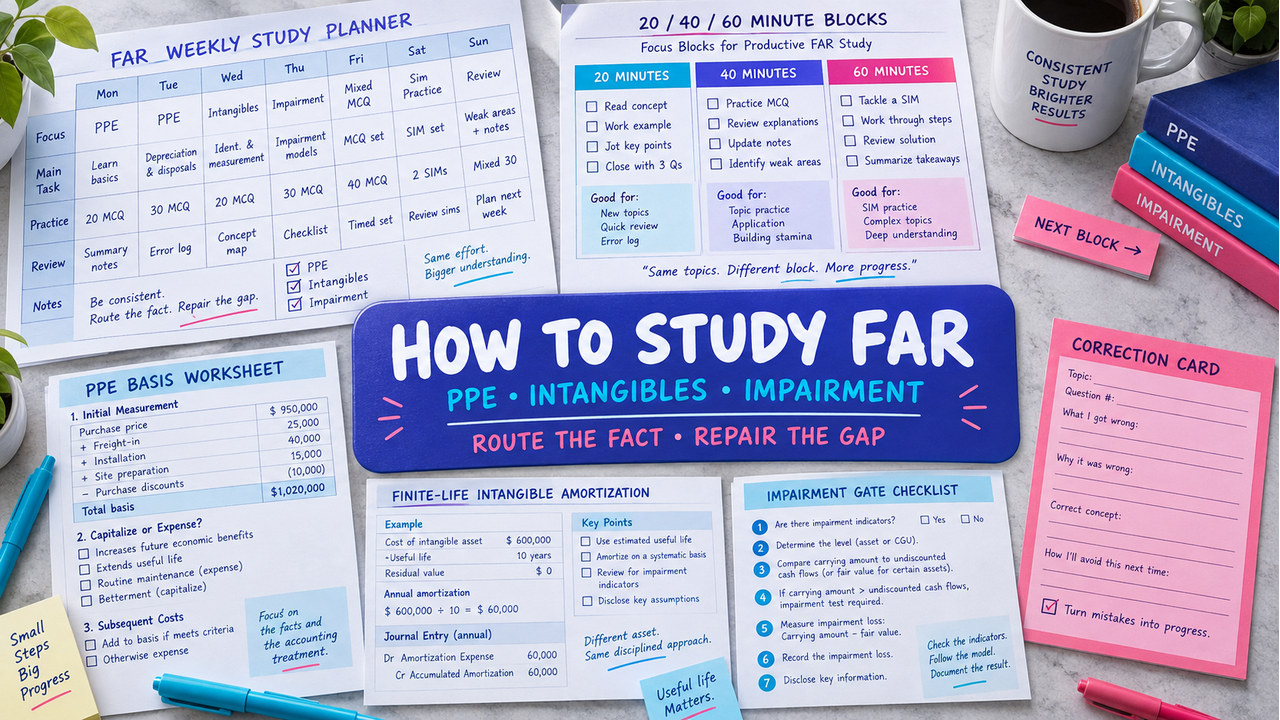

Quick answer: To study PPE depreciation, intangibles, and impairment for CPA FAR, use a fact-first loop rather than rereading every formula. Route the asset, write the controlling fact, show one number flow, explain the nearest distractor, and change one fact before you stop. A 20-minute block can repair one weak lane; a 40- or 60-minute block can compare lanes and schedule the next retry.
Editorial review: Written by the CPA Exam Prep editorial team and technically checked against the current AICPA Blueprint and linked FASB boundaries on September 24, 2026. This page is original educational study material, not official exam content, a licensed accounting opinion, or a score prediction.
For scope, reopen the AICPA CPA Exam Blueprint. For live US GAAP conclusions, reopen the FASB Accounting Standards Codification. The FAR review hub is the broader navigation route; the NASBA CPA Exam FAQ is the separate checkpoint for administration questions.
How to study PPE depreciation in a FAR session
Start each block by naming the output before calculating. In practice, PPE questions usually turn on basis and the ready-for-use clock. Meanwhile, finite-lived intangible questions add an available-for-use date and an amortization life. By contrast, indefinite-lived and held-and-used questions require a different impairment lane. Therefore, when you study PPE depreciation, do not let one familiar formula erase those classifications.
| Block | What you do | Evidence to write | Stop when |
|---|---|---|---|
| 1. Route | Name the asset lane and requested output | PPE / finite / indefinite / gate | The first controlling fact is visible |
| 2. Work | Show basis, date, life, or comparison before choices | One number flow, not a guessed answer | The calculation can be checked |
| 3. Explain | Name the nearest distractor and why it fails | Broken fact + wrong shortcut | The error has a label |
| 4. Repair | Change one fact and solve again | Changed fact + new result | The next block is specific |
Assumptions: For clarity, the worked cases below use simplified straight-line depreciation or amortization, no tax effects, and clear fact patterns. The method is designed to help you recognize the decision order. However, for a live accounting conclusion, reopen the current Codification instead of treating a study shortcut as a universal rule.
Study PPE depreciation with a fact-first map
First, classify the lane. Next, mark the controlling date. Then, name the requested output. After that, identify the nearest distractor and finish by retrying one changed fact. This five-step study PPE depreciation sequence transfers across the cluster because it makes the error visible before the answer letter feels persuasive.

- Route the lane. Write PPE, finite-lived intangible, indefinite-lived intangible, or held-and-used group.
- Circle the fact. Mark included cost, salvage, ready-for-use date, available-for-use date, useful life, cash-flow screen, or fair value.
- Show the number flow. Put the comparison or formula on paper before reading the options a second time.
- Explain the miss. Name the shortcut behind the nearest distractor: omitted cost, wrong clock, wrong lane, or wrong sequence.
- Repair one fact. Change one input and solve again. The changed fact, not a broad feeling, chooses tomorrow’s review.
Choose a 20-, 40-, or 60-minute study PPE depreciation block
Time is a routing constraint. First, a short block should not pretend to be a full mixed review. Next, a longer block should not become unstructured rereading. Use the following schedule as a boundary, then plug in one of the five original cases below.
| Available time | Study route | Output |
|---|---|---|
| 20 minutes | Route one case, show the controlling fact, then retry one changed fact | One corrected calculation + one repair note |
| 40 minutes | Work two cases from different lanes and compare their first decisions | Two answer explanations + one weak-lane choice |
| 60 minutes | Work three cases, review the nearest distractors, and log tomorrow’s retry | Three answer explanations + a named next block |
For a 20-minute block, reserve the first five minutes for routing, ten for the calculation, and five for the changed-fact retry. Next, for a 40-minute block, compare two lanes so that classification, not speed, becomes the contrast. Finally, for a 60-minute block, work three cases but protect the final ten minutes for the next-block note. As a result, that last note keeps a study PPE depreciation plan from becoming a collection of disconnected answers.
Work five original FAR cases, then reveal the reasoning
These are original practice cases for method training. Pause at each prompt, write your route and number flow, and only then open the reveal. Do not treat the examples as provider-issued questions.
Original practice 1: PPE basis and the ready-for-use clock
Pause before the reveal: A machine costs $420,000. Freight is $9,000, installation is $21,000, and expected salvage is $10,000. It is ready for use on July 1 and has a five-year straight-line life. Under these simplified facts, what are the depreciable basis and first-year depreciation?
Choices: A. $420,000 and $42,000. B. $440,000 and $44,000. C. $450,000 and $45,000. D. $460,000 and $46,000.
Reveal answer and reasoning
Answer: B. First, build cost: $420,000 + $9,000 + $21,000 = $450,000. Then, subtract $10,000 salvage to reach a $440,000 depreciable basis. Finally, annual depreciation is $88,000, and six months in service produces $44,000.
Nearest distractor: By contrast, C forgets salvage; moreover, a full-year amount forgets the July 1 ready-for-use date.
Changed-fact retry: Next, move the ready-for-use date to October 1. Keep the basis and life fixed; therefore, recompute only the time fraction.
Original practice 2: Prospective estimate change
Pause before the reveal: An asset costs $300,000, has a $30,000 residual value, and a six-year life. After two full years, the residual value changes to $18,000 and four years remain. What is the new annual depreciation under the simplified facts?
Choices: A. $45,000. B. $48,000. C. $50,000. D. $70,500.
Reveal answer and reasoning
Answer: B. First, the old annual amount was ($300,000 − $30,000) ÷ 6 = $45,000. After two years, the carrying amount is $210,000. Therefore, the prospective amount is ($210,000 − $18,000) ÷ 4 = $48,000.
Nearest distractor: By contrast, A keeps the old estimate; meanwhile, D restates the past instead of using the carrying amount at the change date.
Changed-fact retry: Next, keep carrying amount at $210,000 but change the remaining life to three years. Then, recompute prospectively.
Original practice 3: Finite-lived intangible timing
Pause before the reveal: A patent costs $144,000 and direct registration costs are $6,000. The right becomes available for use on October 1 and has a five-year life with no residual value. What is first-year amortization under the simplified facts?
Choices: A. $7,500. B. $30,000. C. $37,500. D. $150,000.
Reveal answer and reasoning
Answer: A. First, the amortizable amount is $150,000. Meanwhile, annual amortization is $30,000; therefore, three months available for use produces $7,500.
Nearest distractor: By contrast, B uses a full year; moreover, C uses the wrong fraction; instead, D states the asset amount instead of the period expense.
Changed-fact retry: Finally, change availability to January 1. As a result, the annual amount becomes the first-year amount, while basis and useful life stay fixed.
Original practice 4: Indefinite-lived impairment lane
Pause before the reveal: A brand is classified as indefinite-lived under the simplified facts. Its carrying amount is $260,000 and the comparison produces fair value of $240,000. What shortfall should the study note record?
Choices: A. $0. B. $20,000. C. $240,000. D. $500,000.
Reveal answer and reasoning
Answer: B. Here, the indicated shortfall is $260,000 − $240,000 = $20,000. Therefore, the study decision is classification: do not move an indefinite-lived asset into a routine finite-life amortization schedule.
Nearest distractor: By contrast, A imports a no-loss assumption; meanwhile, C treats fair value itself as the loss; finally, D adds the two amounts.
Changed-fact retry: Next, raise fair value to $275,000. Then, decide whether a shortfall remains before writing an amount.
Original practice 5: Held-and-used recoverability gate
Pause before the reveal: A held-and-used asset group has a carrying amount of $500,000, undiscounted cash flows of $480,000, and fair value of $450,000. Under the simplified study example, what loss is indicated after the screen?
Choices: A. $0. B. $20,000. C. $50,000. D. $930,000.
Reveal answer and reasoning
Answer: C. First, the $480,000 cash-flow estimate is below the $500,000 carrying amount, so the gate fails. Consequently, the simplified loss is $500,000 − $450,000 = $50,000. Finally, record the gate result before the measured loss.
Nearest distractor: By contrast, B confuses the gate comparison with the measured loss; moreover, A ignores the failed gate; therefore, D has no meaning for the requested output.
Changed-fact retry: Finally, change undiscounted cash flows to $520,000 while keeping fair value at $450,000. As a result, the gate passes under the simplified facts, so the loss becomes $0.
Study PPE depreciation, intangibles, and impairment by weak area
After the five cases, classify the first broken fact rather than averaging the result. In other words, a correct answer reached by the wrong lane is still a review signal. Basis and clock errors belong together; meanwhile, estimate changes require prospective thinking. Finite-life errors usually live in the availability date; likewise, indefinite-life errors are classification errors, and recoverability errors are sequencing errors.

Use the router in this order: write the first broken fact, retry the same case with one changed input, and book a narrow next block. If the retry works, add one contrasting case tomorrow. Conversely, if it fails again, stay in the same lane and reduce the numbers until the decision order is explainable without notes.
What to study next after this study PPE depreciation method
If basis or timing broke first, schedule a 20-minute PPE block with one included-cost variation and one date variation. Likewise, if the estimate changed, schedule a 20-minute prospective-change block and keep prior periods untouched in the explanation. If finite and indefinite were mixed, compare one patent case with one brand case. Finally, if the recoverability gate broke, repeat the $480,000-to-$520,000 retry and explain why fair value comes later under these simplified facts.
Finally, return to the current Blueprint and Codification before turning this page into a live study plan or accounting conclusion. The useful result of a study PPE depreciation session is not a broad confidence score; it is one named lane, one corrected number flow, and one scheduled retry.
How to study PPE depreciation questions
What should I study first in a PPE depreciation block?
Start with the controlling fact: what belongs in basis and when the asset was ready for use. Then show the requested amount before checking the choices. In addition, write the nearest distractor in one sentence.
How long should one FAR study block be?
Use 20 minutes for one route-and-retry case, 40 minutes for two contrasting lanes, or 60 minutes for three cases plus a next-day repair note. For example, a shorter block can target only the first broken fact.
Why separate finite and indefinite-lived intangibles?
Finite-lived rights use an amortization clock; however, indefinite-lived assets use an impairment-focused lane rather than routine amortization in this simplified method.
Is this an official CPA FAR practice set?
No. It is original editorial study material. Therefore, use the current AICPA Blueprint for scope and the current FASB Codification for live technical conclusions.