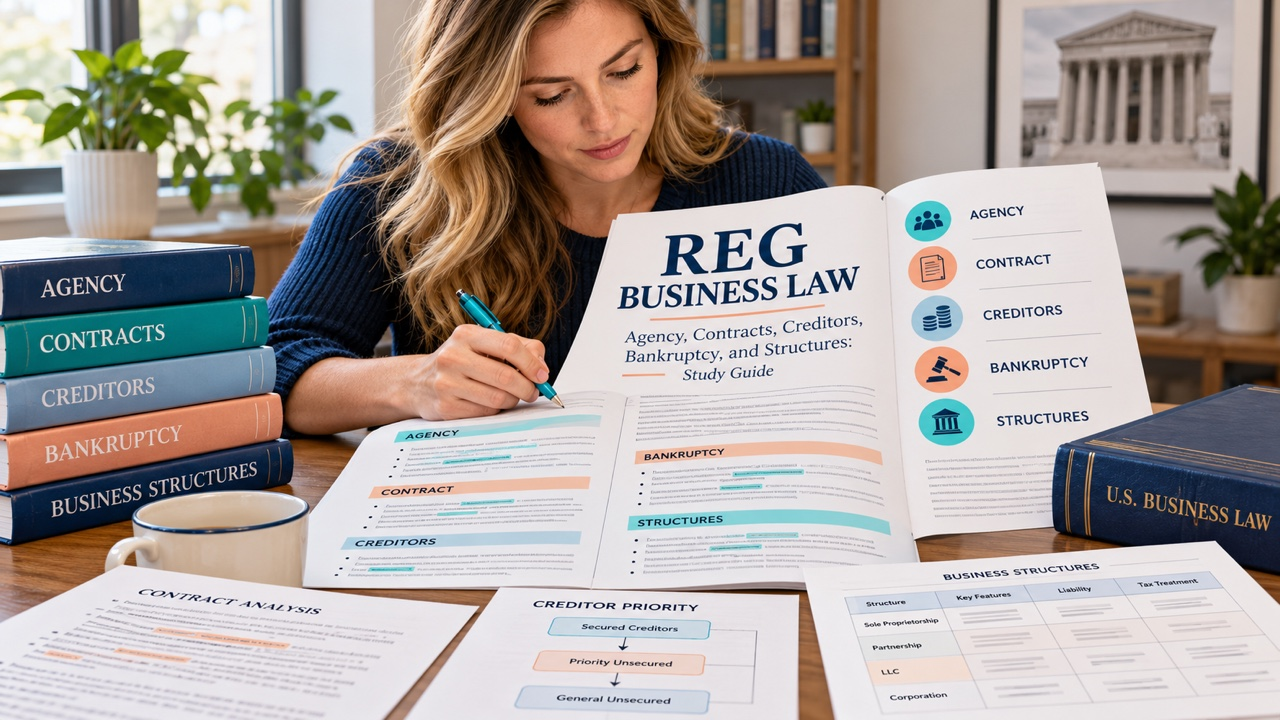

Use this method: For that reason, a useful reg business law contracts cheat sheet is a routing tool. Start with the event the question asks you to judge, trace the party and authority behind it, verify the document or filing that gives it meaning, and then write the result in the question’s own terms. The TRACE route below turns a mixed REG fact pattern into one evidence trail, three original practice prompts, and a specific repair for the next study block.
Scope note: This is original editorial practice, not an exam-authority publication and not legal advice. Reopen the AICPA CPA Exam Blueprints for current task statements and tested scope. Use the NASBA CPA Exam FAQ for eligibility, scheduling, jurisdiction, or score questions.
Meanwhile, when you need broader orientation, begin with the REG review hub. The CPA study guide can frame a weekly block, while the Blueprint format guide clarifies the task statement. Use the topic MCQ resource for quick retrieval and the TBS practice guide when an exhibit or filing must be interpreted.
For a broader preparation path, continue with our related CPA study resources.
REG business law: the TRACE route for a mixed fact pattern
First, TRACE stands for Trigger, Relationship, Authority, Consequence, Evidence. The letters are a memory aid; the work happens in the order. First, circle the trigger: a signature, acceptance message, filing, petition, default, or formation event. Next, name the relationship that the trigger might change. Then, identify who had authority to act and who bears responsibility for the decision. After that, state the consequence the prompt asks about, such as contract binding, claim priority, stay, distribution, or personal exposure. Finally, open the evidence that proves or limits that consequence.
As a result, that order keeps a vivid noun from hijacking the analysis. A “bankruptcy” label does not answer whether a claim is secured. A signed contract does not prove that an agent had authority. An LLC name does not create an owner’s personal obligation. The trigger points to the relationship; the relationship points to the authority; the authority and evidence determine the consequence.
Timing and difficulty
Initially, use a moderate item for the first pass. Give yourself two minutes to mark the trigger and relationship, three minutes to identify authority and evidence, and two minutes to explain the consequence. If a source or exhibit is missing, write open beside the gap. Guessing can be fast, but it leaves no trace that a later session can repair.
Sort the five REG business-law lanes
However, a mixed stem can touch several doctrines while testing only one. Put the question into a lane before you copy a rule:
- Agency: Which act did the principal authorize, and what did the third party know?
- Contract: Which offer term or performance event made the promise operative?
- Creditor: Which claim, collateral description, notice, or filing establishes the competing position?
- Bankruptcy: Which petition, stay, claim status, or distribution posture frames the result?
- Structure: Which formation document, signer role, guaranty, or veil fact connects a person to the obligation?
Next, once the lane is named, cross out facts that cannot answer the requested result. That small edit prevents a familiar term from doing work it cannot support. A filing date can decide priority, yet it cannot by itself establish authority. A guaranty can create personal exposure, yet it does not rewrite the debtor’s filing history.
REG business law: write a TRACE review record
Next, use one page for one item. Write the prompt’s decision verb at the top, then complete these fields in plain language:
- Trigger: What event changed the legal or procedural position?
- Relationship: Who is connected to whom, and which lane is being tested?
- Authority: What appointment, contract term, filing, formation record, or responsibility boundary matters?
- Consequence: What result must the answer select or reject?
- Evidence: Which exhibit or current source would let you defend the result?
- Transfer: Which single fact will you change on the retry?
Meanwhile, keep the last line even when the answer is correct. A correct answer without a transfer test can be recognition; a changed fact shows whether the route survives. Label the result known when the evidence and the conclusion agree, open when a source still needs checking, or wrong when the record was complete but the consequence was selected incorrectly.

Try three original TRACE prompts
Before reading its rationale, attempt each prompt. These are original practice scenarios written for this guide. They are not official, recalled, leaked, or exam-memory questions.
Prompt 1: an agent crosses a purchasing limit
Facts: Harbor Lab Supply appoints Nia to order routine equipment for the company. A private instruction limits her to $12,000 without written approval. The company website lists Nia as “purchasing lead,” and a vendor accepts her $18,500 order without seeing the private instruction. The company refuses delivery after the invoice arrives.
Question: Which TRACE line should be completed before deciding who is bound?
- Use the invoice total as the entire authority analysis.
- Treat the private instruction as conclusive because every vendor is charged with finding it.
- Trace the appointment, private limit, public website, vendor knowledge, and requested binding result.
- Discard the item because a website label can never matter.
Rationale: Choice 3 keeps actual authority and apparent authority in separate evidence fields. The private limit describes an internal boundary; the website and vendor knowledge speak to the outside-facing signal. The repair is to mark which authority theory the prompt is asking you to evaluate.
Prompt 2: two creditors, one filing sequence
Facts: Maple Ridge Foods grants First Bank a security interest in inventory. First Bank files a financing statement on May 4. A second lender files on June 1 after the debtor has already entered a Chapter 7 case. The question asks which claim should be reviewed first, but the stem also mentions the larger dollar amount owed to the second lender.
Question: Which fact deserves the first underline?
- Compare the filing dates and collateral description before comparing the dollar amounts.
- Choose the second lender because the later claim is larger.
- Begin with the bankruptcy label and ignore the perfection record.
- Assume every lender shares the same priority once the petition is filed.
Rationale: Choice 1 isolates the priority signal. The petition changes the procedural posture, but it does not erase the sequence or the collateral terms that establish a secured position. The next action is to reopen the current source on perfection and test the result after changing only the filing date.
Prompt 3: an entity record meets a guaranty
Facts: Cedar Street Studios, an LLC, signs a lease through its managing member. The lease names the LLC as tenant. The member separately signs a personal guaranty for the first year’s rent. After a default, a question asks whether the member is exposed personally.
Question: Which evidence path is most complete?
- Use the LLC name alone because the entity signed the lease.
- Follow the formation and signing records, then read the guaranty and the requested remedy.
- Use the member’s job title as proof that every debt is personal.
- Skip the lease and focus only on the amount of rent.
Rationale: Choice 2 separates entity liability from the separate promise in the guaranty. The formation record and lease identify the first relationship; the guaranty may create a second route to exposure. Change the guaranty term on the retry and record whether the requested remedy changes.
Reveal the TRACE rationale
Attempt the original item first. Write the controlling fact, the boundary or evidence check, and the reason you would save before opening the explanation.
Reveal the answer
Answer: Compare your note with the rationale, mark the first missing proof point, and change one fact before retrying. Do not use a raw answer letter as the study record.
Compare your process with the reasoning shown above.
REG business law distractors as routing signals
For example, when an option answers a neighboring question, treat that distractor as useful evidence. If an option talks only about the filing date while the prompt asks personal exposure, tag it priority and explain the mismatch. An option that cites an entity name while the prompt asks whether a guaranty creates a second obligation belongs in the structure lane. A different option that repeats a contract rule without identifying the operative term belongs in the event lane.
Therefore, write one complete sentence for the rejection: “This choice proves ___, but the prompt asks ___.” That sentence makes the boundary visible. It also gives you a new retrieval cue for the next session instead of an answer letter that will disappear when the facts change.
Repair the first open TRACE line
If a field is open, stop at the earliest one. Reopen one authoritative source or exhibit, restate the boundary in your own words, and change one material fact. Change the public communication or the vendor’s knowledge for an agency retry. A contract retry can change the operative acceptance or performance event. Creditors and bankruptcy require a changed filing sequence or proceeding posture. Structures call for adding or removing the guaranty or changing the signer’s role.
Finally, when the retry works, keep the same lane and add a neighboring lane only on the next block. When it fails, narrow the question before adding more volume. The objective is a defensible evidence path, not a larger pile of timed items.

REG business law: schedule the next review block
Finally, at the end of a session, save a short ledger: Blueprint row and checkpoint date, decision verb, trigger, relationship, authority, consequence, evidence checked, distractor rejected, and changed-fact result. A ledger entry should tell you what to reopen in under a minute. If it cannot, the note is still too broad.
Also, use official scope pages for current boundaries and keep the practice cases separate from a live legal conclusion. AICPA material can frame tested content; NASBA material can answer administration questions; neither source turns these editorial scenarios into official exam items. For an exhibit-heavy retry, move to the TBS practice guide. For rapid retrieval, use the topic MCQ resource.
REG business law contracts cheat sheet checklist
- Circle the trigger before copying a rule.
- Name the lane: agency, contract, creditor, bankruptcy, or structure.
- Write the relationship in one sentence.
- Identify the authority, term, filing, formation record, or guaranty that matters.
- State the consequence the prompt actually requests.
- Point to the exhibit or current source you would reopen.
- Reject the strongest distractor by naming its neighboring question.
- Change one fact and record whether the result moves.
- Schedule the next review block from the first open TRACE line.
A strong reg business law contracts cheat sheet does more than collect rules. It preserves the path from trigger to evidence to consequence, so the next attempt can test transfer instead of repeating recognition.
REG business law contracts cheat sheet FAQ
Are these official exam questions?
No. The prompts and rationales are original editorial practice. Use current AICPA resources for authoritative scope and terminology.
What is the first note line when I am unsure?
Write the trigger and the relationship, then name the authority or evidence that is missing. That line tells you what to reopen.
Should I keep adding timed items after a miss?
Repair the first open TRACE line first. More items help after the changed-fact retry shows that the route transfers.
Does this method promise a passing result?
No. It creates observable study evidence and a focused next action; current rules, preparation, and performance determine the actual result.
Sources
- AICPA CPA Exam Blueprints and tested content resources
- NASBA CPA Exam FAQ
- REG review hub
- TRACE evidence route: original editorial method for this page