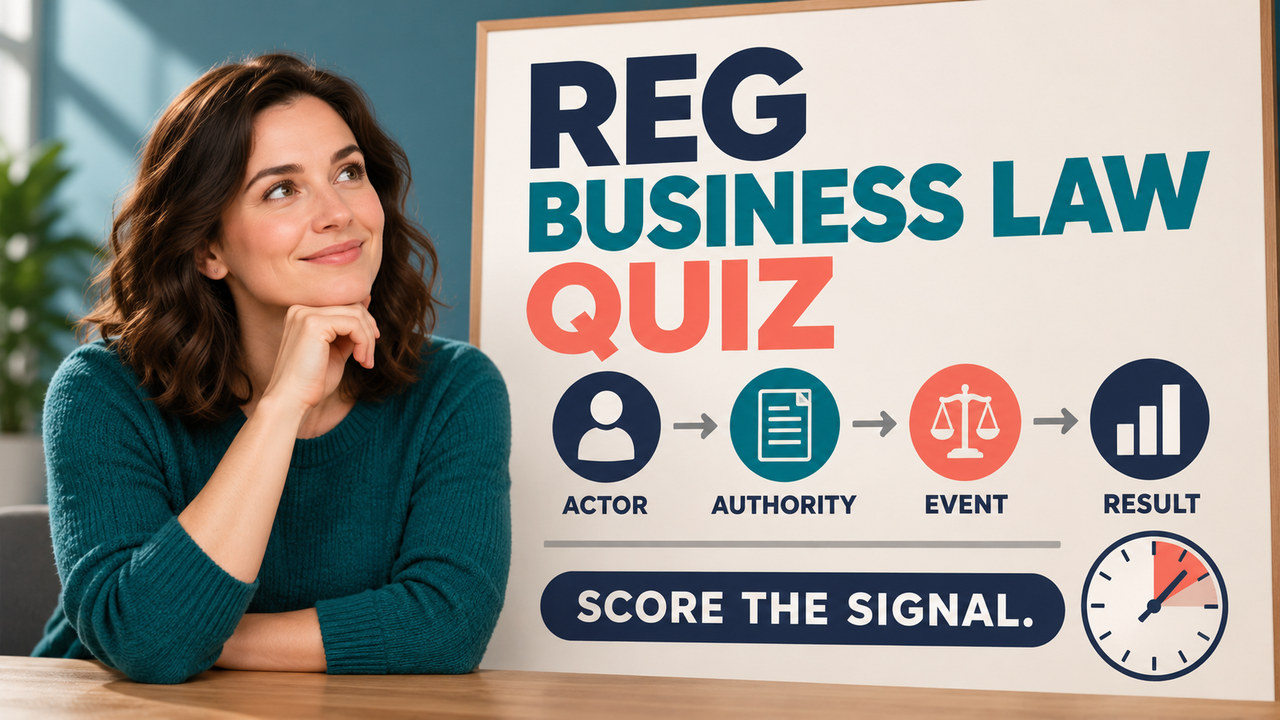

Direct answer: A productive reg business law quiz uses the score to identify a legal signal that needs repair. For every item, record the actor, authority, event, posture, and result. Then change one fact and retry the smallest missed signal.
Scope and freshness note: This is original editorial study material, not an exam-authority publication. Reopen the AICPA CPA Exam Blueprints for current task statements and tested scope. Use the NASBA CPA Exam FAQ for eligibility, scheduling, jurisdiction, and score questions. Apply current professional guidance to any live legal or tax conclusion.
For orientation, visit the REG review hub. Use the CPA study guide for planning, the Blueprint format guide for task wording, and the topic MCQ page or TBS practice guide when the quiz exposes an exhibit or retrieval gap.
For a broader preparation path, continue with our related CPA study resources.
REG Business Law Quiz: score the legal signal
However, a business-law quiz can feel broad because agency, contracts, debtor-creditor issues, bankruptcy, and structures use different vocabulary. In practice, the underlying study move is stable: identify the relationship, locate the authority, name the event, state the posture, and choose the result the task requests.
In this article, these are original, simplified practice questions. Moreover, they are not recalled or official exam items. The Blueprint defines tested scope, while current law and professional guidance control any live conclusion.
Timing and difficulty assumptions
First, use moderate difficulty. Then, set a short reading period, a decision period, and a review period. If the answer depends on a missing document or event, record that gap instead of spending the remaining time on a guess.
Define reg business law quiz lanes
Next, before the timer starts, list five lanes: agency, contract, creditor, bankruptcy, and entity structure. Next, each lane gets a one-line signal:
- Agency: who acted and what authority reached the third party?
- Contract: what offer, acceptance, performance, or breach event controls?
- Creditor: what claim or security document is being evaluated?
- Bankruptcy: what proceeding posture or filing event frames the question?
- Structure: what formation record and owner role affect exposure?
Consequently, a familiar word does not decide the lane by itself. For example, a “notice” may be an event in a procedure question, while a “signature” may be evidence of authority or contract formation. Read for the relationship before the label.
Build reg business law quiz cards
Then, use five small evidence cards in your notes, one for each signal. Put the task verb at the top and leave a final line for the changed fact. As a result, this creates a repeatable record without turning the quiz into a decorative score widget.
- Actor: list each party, role, and signer.
- Authority: name the agreement, appointment, notice, filing, or formation record.
- Event: describe what happened, not just the date shown.
- Posture: mark formation, performance, breach, collection, filing, or distribution.
- Result: restate the outcome the question asks you to select.

Use the reg business law quiz score as a routing signal
Afterward, score the item only after you write the missing signal. For example, an agency miss routes to authority and third-party information. Meanwhile, for contracts, route a miss to the event that completed or defeated formation. Likewise, a creditor or bankruptcy miss routes to claim type and posture. For structures, route a miss to the formation record and owner role.
Also, keep “unknown” separate from “wrong.” In other words, unknown means the record or source was not checked. By contrast, wrong means the map was complete but the result was selected incorrectly. Those two errors need different next actions.
Run the reg business law quiz
First, attempt each case without opening the rationale. Next, write the five signals and the strongest distractor. Therefore, the quiz measures the quality of the legal map, not only the answer letter.
Reveal the quiz reasoning
Try the original question first. Write lane, actor, authority, event, posture, and result before opening the rationale.
Reveal the answer
Answer: Compare your card with the rationale, mark the first missing signal, and change one fact before retrying.
Compare your process with the reasoning shown above.
Scenario 1: a principal and an apparent authority signal
Fact pattern: A supplier receives a purchase request from a worker who has handled orders before. The company never gave the supplier the worker’s internal spending limit, but, in addition, a company directory lists the worker as the purchasing contact.
Question: Which note should come first?
- The worker’s job title proves unlimited authority.
- The internal limit always defeats any outside reliance.
- Separate actual authority, apparent authority, the company communication, and the contract result requested.
- Ignore the supplier’s information because only the employee’s intent matters.
Answer and rationale: Choice 3 is strongest because the authority source and the third party’s information are different signals. However, one shortcut assumes a title answers the scope question. Another ignores what the principal communicated. The fourth choice removes the outside relationship. Review note: record appointment, limit, communication, reliance, and result.
Scenario 2: a contract event and a changed delivery fact
Fact pattern: An offer states that acceptance must be sent by a stated date. The response is drafted on time but, however, reaches the offeror later. Meanwhile, a changed version says the offeror must receive acceptance by that date.
Question: What should the learner test before choosing?
- Use the drafting date because it is the earliest date.
- Use the delivery date without reading the acceptance instruction.
- Identify the acceptance method, the event that completes it, and the changed instruction’s effect.
- Choose the rule remembered from the last question.
Answer and rationale: Choice 3 preserves the contract event. For example, a dispatch rule and a receipt rule can ask for different events. One shortcut treats drafting as acceptance. Another skips the offer language. The fourth choice repeats a label without checking the changed fact. Review note: record offer term, acceptance event, timing, and outcome.
Scenario 3: a claim, filing posture, and structure
Fact pattern: A limited liability company owns equipment subject to a recorded lien. Meanwhile, a creditor files a claim after an insolvency petition. Therefore, the prompt asks what should be checked before discussing the owner’s personal exposure.
Question: Which first move keeps the quiz lane clear?
- Assume the owner is personally liable because the company has debt.
- Assume the lien answers every priority and exposure question.
- Identify the entity record, the signer or guarantor, the claim and lien documents, and the proceeding posture.
- Use the company name as the only structure evidence.
Answer and rationale: Choice 3 is strongest because exposure, priority, and filing posture are separate questions. One shortcut collapses the entity boundary. Another skips the person and claim facts. The fourth choice treats a name as a formation record. Review note: record entity document, owner role, guaranty or signature, lien status, filing posture, and requested result.
Read the reg business law quiz results
After the attempt, compare your five-signal card with the rationale. First, find the controlling event. Next, confirm the authority or document. Finally, state why the strongest distractor answers a different question.
Classify the first error
Then, use one category: lane when the topic was misidentified; record when a document or party was missed; event when a date replaced the underlying act; posture when the procedural stage was missed; or transfer when the map failed after one changed fact.
Change one reg business law quiz fact
As a check, change one material detail and hold the rest steady. Next, change the principal’s communication, the acceptance instruction, the lien filing, the guaranty, the entity record, or the petition posture. Then write whether the result changes and which signal caused the change.
For example, a new written limitation can change an apparent-authority analysis. A receipt requirement can change a contract event. A perfected filing or a guaranty can change the next creditor or exposure question. Do not change several facts at once; the point is to isolate the controlling signal.
Repair the next reg business law quiz move
Therefore, repair the earliest missing signal before adding another mixed set. Classify it as lane, record, authority, event, posture, result, or transfer.
Then choose one bounded action: rewrite the parties, reopen one document, name the event behind the date, mark the proceeding stage, or retry one changed-fact item. If the retry works, move to a neighboring lane. Otherwise, if it fails, narrow the scope and repeat the same signal.

The repair route turns a score into a next step. Therefore, keep the failed signal and the new evidence together so the next quiz begins with a hypothesis instead of a blank page.
Keep a quiz log
For each missed question, save one row:
- Lane: agency, contract, creditor, bankruptcy, or structure.
- Actor: party, owner, signer, or agent.
- Authority: agreement, filing, notice, or formation record.
- Event: the act that activated the issue.
- Posture: the stage of the dispute or transaction.
- Transfer: the one fact changed in the retry.
As a result, repeated lane errors call for better stem classification. A recurring record error calls for source retrieval. Event errors call for timeline labeling. When posture errors repeat, use a procedure pass.
Connect the reg business law quiz lanes
Across the set, use the same map. For example, agency asks who can bind whom. Contract asks what event created or defeated the agreement. Creditor and bankruptcy questions ask what claim and posture control the next step. Structure asks which document and role define exposure.
In addition, route the next resource from the log. Use the Blueprint page for scope, the MCQ guide for retrieval volume, the TBS guide for exhibits, and the REG hub for lane orientation.
reg business law quiz checklist
- Circle the task verb.
- List the parties and roles.
- Name the authority document.
- Describe the event behind any date.
- Mark the procedural posture.
- Reject the strongest distractor by naming its different lane.
- Change one material fact and retry.
- Save the first missing signal as the next study action.
Ultimately, a strong reg business law quiz turns every result into routing data: lane, actor, authority, event, posture, result, and one transfer check.
reg business law quiz FAQ
Are these authoritative exam questions?
No. They are original editorial practice. Instead, use current AICPA material for authoritative scope.
What should I do with a missed quiz item?
Record the first missing signal, check one supporting document or source, and retry after changing one material fact.
Should I chase a higher raw score?
Finally, use the score only when it routes a specific repair. More items without a repair can preserve the same mistake.
Does this quiz promise a score?
No. It creates a visible reasoning record and a focused next action; current preparation and performance determine results.
Sources
- AICPA CPA Exam Blueprints
- NASBA CPA Exam FAQ
- REG review hub
- CPA study guide