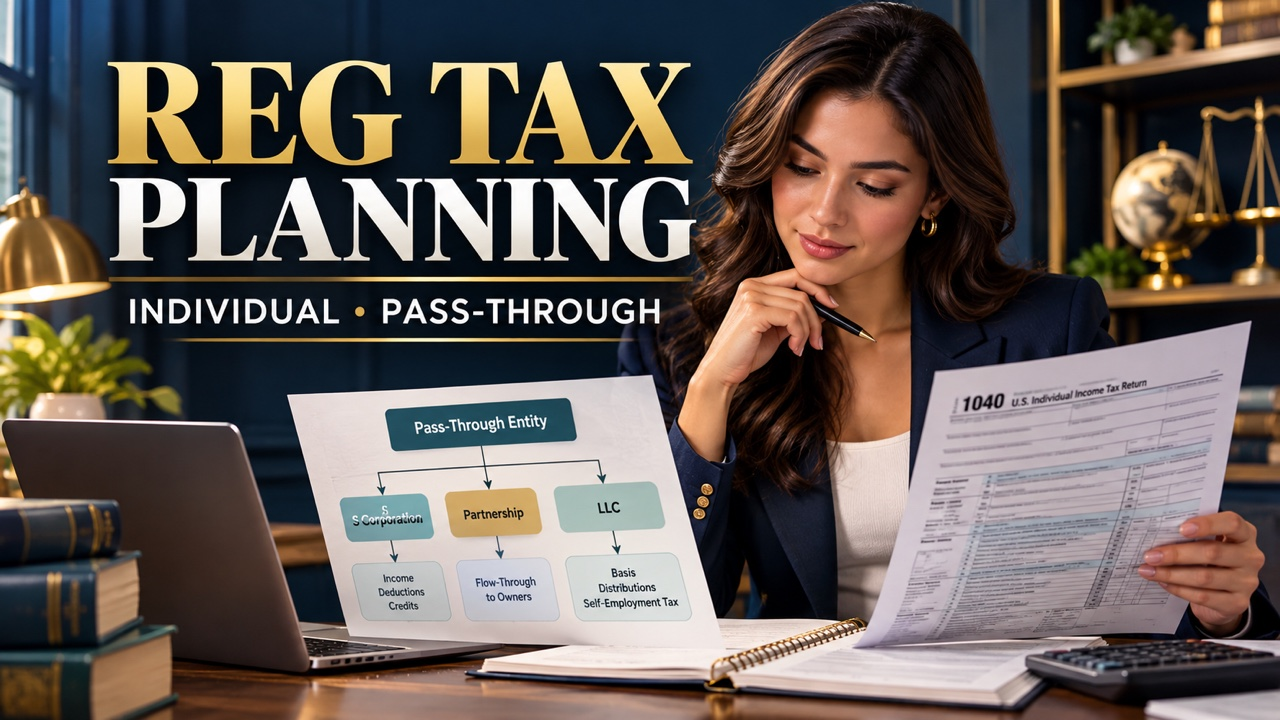

Direct answer: Use a tax planning exam review as a review ledger, not a score chase. Name the individual taxpayer, classify the pass-through item, mark the first owner-level gate, and write the evidence that would change the answer. Then retry one original scenario after changing one fact. This method keeps a study-guide review narrow enough to inspect and useful enough to repeat.
Scope and freshness note: This is original US CPA REG study material, not an AICPA question, a recalled item, tax advice, or a score promise. Reopen the current AICPA CPA Exam Blueprints for testing-window scope, the AICPA CPA Exam resources for current terminology, and the NASBA FAQ for eligibility, scheduling, jurisdiction, or score questions.
Start with the REG review hub for section orientation. Use the CPA study guide for sequence, the Blueprint format guide for task boundaries, and the topic MCQ page or TBS practice guide when your next repair needs a different retrieval mode.
REG individual and pass-through tax planning exam review: build a review ledger
First, convert the search phrase into four ledger lines: recipient, item character, first gate, and evidence to reopen. In addition, the recipient tells you whose return or decision is in view. Next, item character keeps ordinary, separately stated, capital, and loss items from blending together. The first gate prevents a usable amount from being assumed before basis or another stated limit is checked. The last line keeps current-sensitive questions tied to a source.
Start the tax planning exam review with the decision verb
For example, circle the verb in the task statement: classify, determine, evaluate, or plan. For a classification prompt, identify the item category. Similarly, a determination prompt needs the controlling fact and calculation boundary. Likewise, an evaluation prompt needs a comparison. Finally, a planning prompt needs a bounded next move tied to the facts supplied. Writing the verb first makes the review less vulnerable to a familiar-looking distractor.
Difficulty and timing assumptions
Next, use a four-minute cycle for each original case. Then, spend one minute locating the task verb and recipient, two minutes selecting a response, and one minute writing the proof point that would reverse your choice. Meanwhile, the cycle is a review control rather than an exam prediction. When a case needs a current rule, pause the clock, note the official source to reopen, and return to the scenario only after the boundary is clear.
Set the study-guide review assumptions
Before starting, copy one current Blueprint task statement and define the expected output in a single sentence. For clarity, the three cases below are complete only for the facts they state. They provide no hidden filing status, extra debt basis, at-risk amount, passive-activity exception, carryforward, withholding adjustment, or current rate. Therefore, where a fact is missing, write source check in the ledger and keep the conclusion limited.
Build the tax planning exam review ledger
In practice, draw four fields: recipient, character, first gate, and reopen evidence. Also, add one short phrase to each field. For example, “owner; separately stated interest; no loss gate supplied; verify current placement guidance.” The point is to leave a trace that another study session can inspect without rereading the entire case.

Run the original study-guide review
Then, attempt each case cold before opening any explanation. Write the recipient, the controlling fact, the first gate, and the evidence you would keep. After you choose, change one input and predict the first owner-level line that should move. The exercise is successful when the changed fact changes your reasoning in a traceable way.
Reveal the reasoning
Attempt the original item first. Write the controlling fact, the boundary or evidence check, and the reason you would save before opening the explanation.
Reveal the answer
Answer: Compare your note with the rationale, mark the first missing proof point, and change one fact before retrying. Do not use a raw answer letter as the study record.
Compare your process with the reasoning shown above.
Scenario 1: tax planning exam review item character
Case file: An individual owner receives a Schedule K-1 with $24,000 of ordinary business income and $3,600 of separately stated interest income. The prompt asks where the $3,600 belongs on the owner return. No loss, basis shortage, or special limitation is supplied.
Question: Which review note follows the stated facts?
- Combine both amounts as ordinary income because the same entity issued the K-1.
- Keep the $24,000 ordinary item and the $3,600 interest item in their supplied categories before applying any individual-level rule.
- Report the interest as a deduction because it is separately stated.
- Ignore the interest until the owner reports a loss.
Rationale: Therefore, Choice 2 preserves the item character supplied by the case. Choice 1 lets the entity label erase a separate category. Choice 3 changes income into a deduction, while choice 4 delays the item that controls the first report line. On retry, replace interest with a capital item and record the category change.
Scenario 2: tax planning exam review basis boundary
Case file: A partner is allocated a $16,800 pass-through loss. The file states that $10,500 of outside basis is available at year-end and gives no additional basis, at-risk, or passive-activity exception. The question asks for the first defensible conclusion.
Question: What belongs in the ledger?
- Deduct the full $16,800 because the entity incurred the loss.
- Use $10,500 as the first owner-level gate and flag $6,300 for the limitation review.
- Convert the loss into ordinary income for the partner.
- Use the loss as a credit against the next estimated payment.
Rationale: As a result, Choice 2 uses the only owner-level ceiling supplied. However, an entity loss does not prove that the owner can use every dollar. Meanwhile, the other choices skip the basis checkpoint, change the item, or move it to a payment line. On retry, add $7,000 of basis and state which checkpoint changes first.
Scenario 3: tax planning exam review payment boundary
Case file: An owner projects $12,400 of additional pass-through income for the following quarter. The prompt asks for a bounded response to an estimated-payment concern. It gives no withholding change, safe-harbor conclusion, or current-rate assumption.
Question: Which action stays inside the file?
- Promise that the owner will owe exactly $2,900 more.
- Update the projection, reopen current payment guidance, and compare the next estimate with the owner’s actual withholding facts.
- Turn the projected income into a deductible expense.
- Ignore the estimate because pass-through income is never paid by the owner.
Rationale: Similarly, Choice 2 limits the action to a projection, a current source, and facts the owner must supply. Choice 1 invents a result, choice 3 changes income into expense, and choice 4 removes the taxpayer from the payment question. On retry, add a withholding amount and write the new comparison without promising a final tax.
Read the rationale and distractor
Afterward, review the answer in five passes: recipient, character, first gate, timing, and proof. A merged ordinary and separately stated item is a character miss. A loss used before basis is a gate miss. An exact payment promise without current facts is a timing miss. The rationale should identify the first broken line and explain why the nearest distractor fails.
Read the tax planning exam review rationale
For clarity, write one sentence beginning “I chose this because…” and one sentence beginning “The distractor fails because…”. If both sentences repeat the option letter, the review has not reached the controlling fact. Replace the letter with a category, a gate, a comparison, or a source boundary that another reader could check.
Choose the next study-guide review repair
Finally, choose the earliest missing proof point and make one bounded repair. A character miss calls for a placement drill. A basis miss calls for a ceiling calculation that names the next limitation. For timing, use a current source and a fact comparison. Retry one new item after the repair; do not add a mixed set until the ledger line is complete.

Use the second visual as a worked example record: identify the owner line, mark the boundary, show the evidence to reopen, and write the next action. It is a decision aid for the review, not a decorative scorecard.
Make the study-guide review repeatable
Keep the tax planning exam review ledger
Finally, at the end of a session, save the Blueprint task statement, decision verb, recipient, controlling fact, first gate, rejected distractor, source or evidence check, and changed-fact result. Consequently, the next session can then begin at the first incomplete field instead of repeating every question. A short ledger also exposes when a familiar phrase is masking an unverified assumption.
tax planning exam review checklist
- Copy one current Blueprint task statement and its decision verb.
- Name the individual taxpayer or owner receiving the item.
- Preserve ordinary, separately stated, capital, or loss character.
- Write outside basis before deciding whether a loss is usable.
- Check any stated at-risk, passive, or other limitation before the final amount.
- Separate projected income from the estimated-payment comparison.
- Write the nearest distractor and the first fact that defeats it.
- Record the source or evidence that must be reopened.
- Change one fact and predict the first owner-level line that moves.
As a result, a useful tax planning exam review ledger shows the recipient, character, first gate, timing fact, evidence, and repair. Therefore, use current authoritative sources for scope, then use these original cases to make the reasoning observable.
tax planning exam review FAQ
Are these official exam questions?
No. The scenarios, options, and rationales are original editorial practice. Use current AICPA materials for authoritative scope and terminology.
What should I record when I miss an item?
Record the controlling fact, the first gate or boundary, the rejected distractor, the source check, and one changed-fact retry.
Should I keep adding more timed items?
Only after the first missing proof point is repaired. More volume without a repair can preserve the same character, gate, or timing error.
Does this method promise a passing result?
No. It creates observable study evidence and a focused next action; preparation, current rules, and performance determine the result.