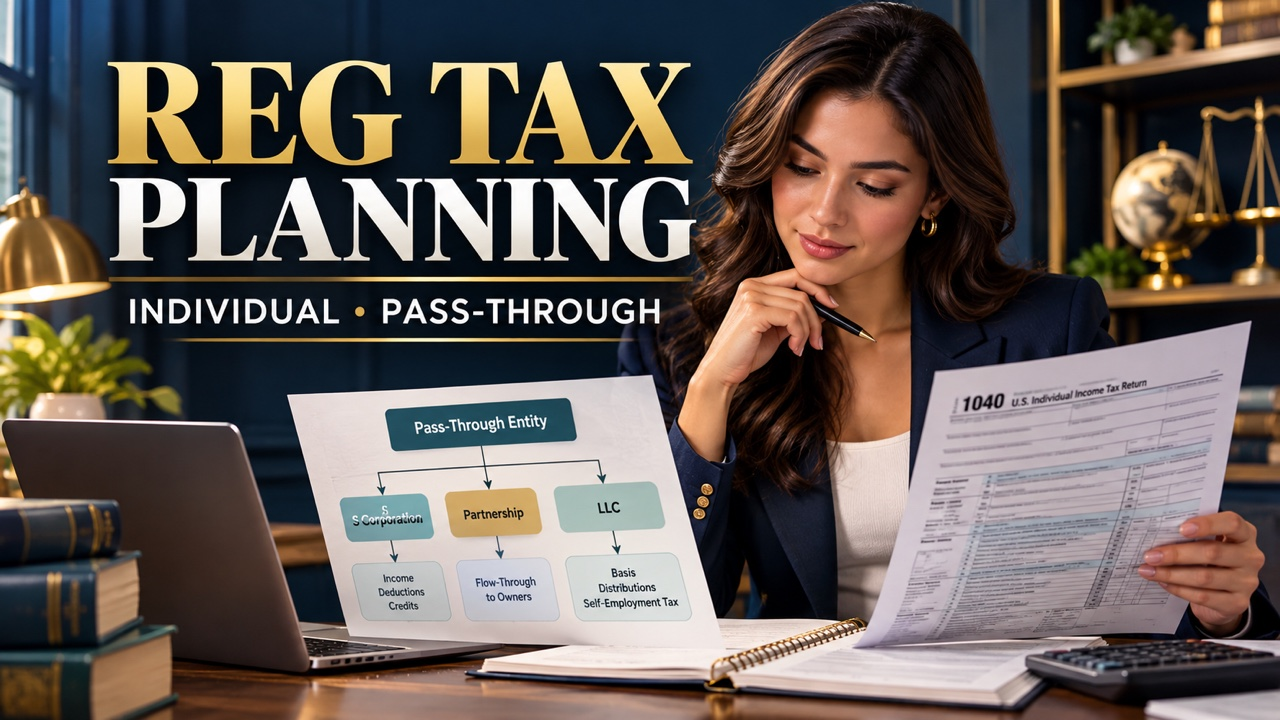

Direct answer: Build tax planning flashcards around decisions, not definitions. Put the taxpayer and item on the front, hide the first restriction on the back, and add one trigger that would change the answer. After a recall pass, write the evidence you would reopen. That deck turns a REG study session into a sequence of observable choices.
Scope and freshness note: This is original US CPA REG study material, not an AICPA question, a recalled item, tax advice, or a score promise. Reopen the current AICPA CPA Exam Blueprints for the testing-window map, the AICPA CPA Exam resources for current terminology, and the NASBA FAQ for eligibility, scheduling, jurisdiction, and score questions.
Start with the REG review hub for section orientation. Then use the CPA study guide for sequencing, the Blueprint format guide for task boundaries, and the topic MCQ page or TBS practice guide when a card exposes an exhibit or retrieval gap.
Tax planning flashcards: design a retrieval deck
A useful card has four fields. On the front, name the taxpayer, item, and task verb. On the back, state the first restriction and the action that follows. Next, add one trigger that would change the back. Finally, use the evidence tag to name the source or exhibit you would reopen. A card becomes complete only when those four fields can be read without guessing what the writer meant.
Keep the front narrow
Instead, do not put an entire chapter on one card. “Owner receives a K-1” is a setting, not a task. For example, a better front says who receives which item, what the question asks, and which fact is missing. As a result, that wording forces the learner to retrieve a decision instead of repeating a slogan.
Meanwhile, keep the back conditional. Then, state what follows from the facts supplied, and state what is still unknown. Therefore, a conditional back is safer for current-sensitive tax topics because it shows where a source check belongs.
Tax planning flashcards: difficulty and timing
Use three passes. Start pass one by answering the front in twenty seconds without opening the back. Continue pass two by spending forty seconds naming the restriction and evidence tag. On pass three, change one fact and say whether the back changes. The clock only measures retrieval quality; it does not predict an official exam result.
If the card depends on a current rate, filing rule, or administrative boundary, pause the timer. Write “source check” on the evidence tag and continue only after the authoritative page is reopened. Later, compare the first answer with the source-supported answer. That comparison shows whether the problem was recall, classification, or scope.
Tax planning flashcards: set the assumptions
First, before making a deck, copy one current Blueprint task statement and choose a single output: classify an item, locate a limitation, or frame a payment action. Meanwhile, the cards below use bounded facts. They do not imply a filing status, debt basis, at-risk exception, passive-activity result, withholding history, or current rate that is not written.
Next, for each card, write four labels in the margin: person, item, gate, and evidence. Then add a one-line trigger. This small layout keeps a flashcard from becoming an untestable paragraph.

Use a two-sided card log
Also, record the date, the card version, the first answer, the changed fact, and the evidence page you checked. When the answer changes, keep both versions and write the reason. As a result, the deck becomes a history of decisions rather than a stack of memory prompts.
Also, separate a slow first pass from a fast maintenance pass. Initially, explain the handoff from an entity to an individual. Later, say the handoff aloud and move to the trigger. If a card still feels vague, rewrite its front before adding another card.
Tax planning flashcards: run the review
To begin, answer each front before looking at the back. Then, mark the gate that controls the result. Then, change one input and predict which field must be rewritten. For that reason, the point is to make an error visible while the decision is still small.
Reveal the reasoning
Attempt the original item first. Write the controlling fact, the boundary or evidence check, and the reason you would save before opening the explanation.
Reveal the answer
Answer: Compare your note with the rationale, mark the first missing proof point, and change one fact before retrying. Do not use a raw answer letter as the study record.
Compare your process with the reasoning shown above.
Card 1: character before limitation
Front: An individual partner receives a K-1 with $21,000 of ordinary business income and $2,800 of separately stated interest income. The task asks where the interest belongs before any owner-level limitation is considered. No loss or basis shortfall is supplied.
Choices:
- Merge both amounts because they came from the partnership.
- Keep the ordinary and separately stated amounts in their supplied categories, then examine the individual rule that applies.
- Move the interest to a deduction because it is separately stated.
- Leave the interest off the card until a loss appears.
Back and trigger: Choice 2 preserves character before a later gate. Meanwhile, choice 1 loses the category, choice 3 changes income into expense, and choice 4 ignores a supplied item. Trigger: replace the interest with a separately stated capital item and rewrite the item field.
Card 2: basis is the first gate
Front: A partner is allocated a $12,400 loss. Outside basis is $8,900 at year-end. The card gives no debt basis, at-risk exception, or passive-activity conclusion. The task asks for the first usable amount to record.
Choices:
- Use all $12,400 because the partnership reported the loss.
- Record $8,900 as the first basis ceiling and flag $3,500 for the next limitation check.
- Convert the loss to ordinary income for the partner.
- Apply the loss against the next estimated payment.
Back and trigger: Choice 2 starts with the only owner-level ceiling in the card. Meanwhile, the other choices skip the gate, change the item, or move it to a payment field. Trigger: add $4,000 of debt basis and state which evidence must be checked after basis.
Card 3: payment timing needs taxpayer facts
Front: An owner projects $18,600 of additional pass-through income for the next quarter and asks whether to change an estimated payment. The card has no withholding total, safe-harbor result, prior-payment history, or current rate.
Choices:
- State the exact extra payment the owner will owe.
- Update the projection, reopen current payment guidance, and compare it with the owner’s actual withholding and payment facts.
- Turn the projection into a deductible expense.
- Ignore the card because pass-through income cannot affect an individual payment decision.
Back and trigger: Choice 2 keeps the response bounded to a projection and a source check. In contrast, choice 1 invents certainty, choice 3 changes income into expense, and choice 4 removes the owner from the payment question. Trigger: add a withholding amount and rewrite only the comparison field.
Tax planning flashcards: read the rationale
After each reveal, read the back in a fixed order. First, identify the taxpayer. Next, name the item. Afterward, point to the gate. Finally, say which evidence would reopen the card. This order prevents a correct answer from hiding a wrong reason.
For individual and pass-through topics, the entity label is often the distractor. The card should show the handoff from allocation to owner return, preserve the supplied character, and separate a projection from a final payment. Finally, when the rule is current-sensitive, record the source date beside the evidence tag.
Use a one-sentence error label
Write: “My card failed at ___ because ___; the trigger is ___; I will reopen ___.” Fill the first blank with person, item, gate, evidence, or transfer. If the label only says “wrong,” the card has not taught the next decision.
Tax planning flashcards: choose the next repair
Therefore, repair the earliest broken field. Reopen one source, rewrite one line in your own words, and retry one card with one changed detail. Afterward, if the retry succeeds, test another trigger. If it fails, narrow the front instead of adding more cards.

Use the second visual as a worked-card record: show the front, mark the gate, point to the evidence tag, and write the changed field. It is a decision aid for retrieval, not a decorative score panel.
Tax planning flashcards: make the deck repeatable
At the end of a session, save the Blueprint task, card version, taxpayer, item character, first gate, rejected distractor, source or exhibit, and trigger result. As a result, the next session can begin with the card whose evidence tag is still empty. Consequently, the deck tells you where to work instead of merely showing what you already saw.
Additionally, keep official scope separate from original practice. AICPA pages define the tested map. Meanwhile, the cards, backs, triggers, visual boards, and repair choices here are independently written. When an exhibit is the bottleneck, switch to the TBS practice guide; when recall is the bottleneck, use the topic MCQ page.
Tax planning flashcards checklist
- Copy one current Blueprint task statement.
- Name the individual taxpayer or owner on the card front.
- Classify the ordinary, separately stated, capital, contribution, or loss item.
- Write the first owner-level gate on the card back.
- Add one fact that would change the back.
- Attach the source or exhibit to reopen.
- Explain why the strongest distractor fails.
- Separate projected income from an estimated-payment conclusion.
- Save the first broken field as the next card repair.
A strong tax planning flashcards deck makes the reasoning visible: person, item, gate, evidence, and trigger. Finally, reopen current sources for scope, then use the original cards to make transfer observable.
Tax planning flashcards FAQ
Are these official exam questions?
No. The cards, choices, and rationales are original editorial practice. Use current AICPA materials for authoritative scope.
What belongs on the back of a card?
Write the first restriction, the action supported by the stated facts, the trigger that would change it, and the evidence to reopen.
Should I keep adding cards when recall is weak?
Repair the earliest broken field first. More cards without a changed-fact retry can repeat the same error.
Does this method promise a passing result?
No. It creates observable study evidence and a focused next action; current rules, preparation, and performance determine the result.