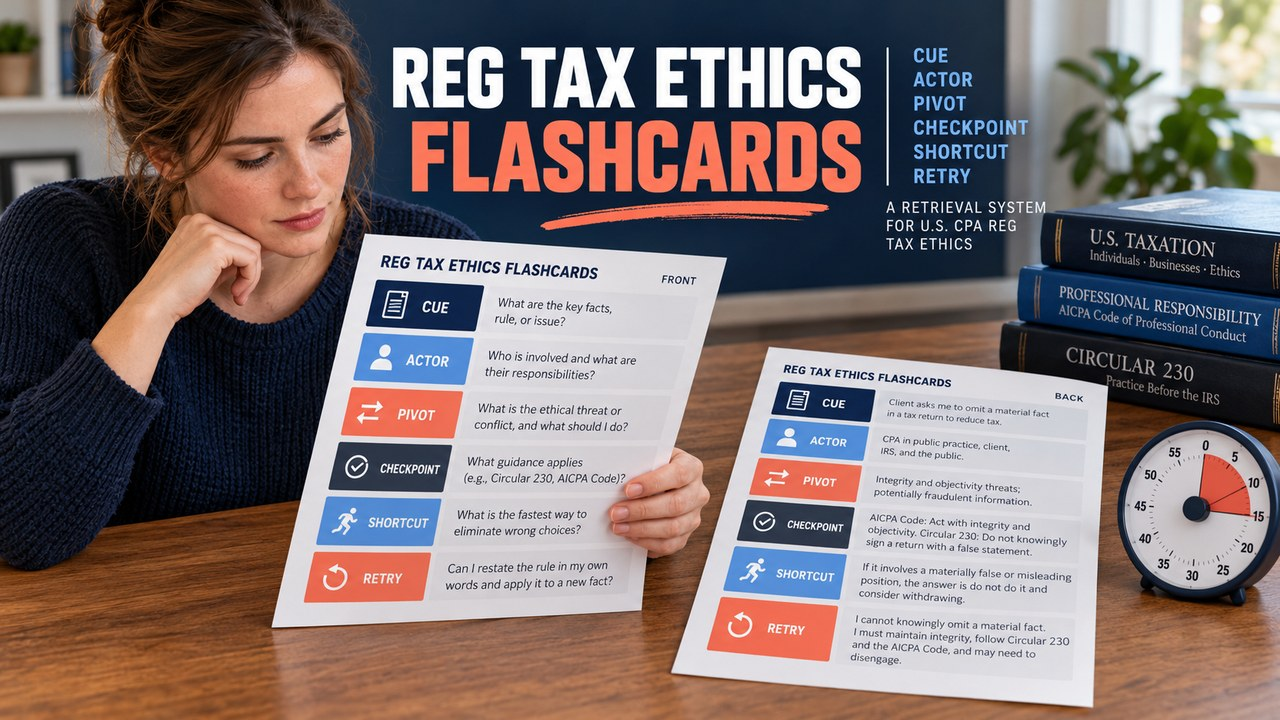

Direct answer: Good reg tax ethics flashcards practice has a front and a back. The front gives one cue and a response verb. The back names the actor, pivot fact, current checkpoint, and reason the shortcut fails. Try an original prompt before flipping to the back, then change one material detail and answer again. That loop tests judgment instead of recognition alone.
Scope and freshness note: This is original editorial study material, not an exam-authority publication. Reopen the AICPA CPA Exam Blueprints for current task statements and tested scope. Use the NASBA CPA Exam FAQ for eligibility, scheduling, jurisdiction, and score questions. Apply current professional guidance to any live engagement or tax conclusion.
For orientation, visit the REG review hub. Use the CPA study guide for the wider plan, the Blueprint format guide for task wording, the topic MCQ page for retrieval volume, and the TBS practice guide when exhibits carry the decision.
For a broader preparation path, continue with our related CPA study resources.
Reg tax ethics flashcards: turn recognition into a decision
A flashcard can test a label, but a REG decision requires a boundary. You need to know who owns the output, what the task asks for, which fact changes the answer, and which current source confirms the response. Accordingly, the useful unit is a cue followed by a defensible explanation.
This review uses original prompts for ethics, professional responsibility, and tax procedures. Facts are simplified for study. The Blueprint controls scope, while current guidance controls any live conclusion. Our goal is a repeatable retrieval method, not a promise about a result.
Define the front of the prompt
Write one short cue before you read the options. A good cue names the lane and the action: “Who owns the judgment?” “Which event starts the response?” or “What support must be documented?” Keep the cue narrow enough that the answer has a clear shape.
Use a four-pass retrieval rhythm
First, read the cue and say the response verb. Next, retrieve the actor and pivot fact from memory. Then, state the checkpoint you would open. Finally, explain the tempting shortcut. This rhythm keeps a flashcard from becoming a vocabulary contest.
Build a reg tax ethics flashcards study strip
A paper strip can hold the front and back without turning the session into a wall of disconnected cards. Put the cue on the left and reserve the right side for five checks:
- Actor: Who owns the judgment, approval, support, or response?
- Output: What must the response produce: a conclusion, document, procedure, or recommendation?
- Pivot: Which fact would send the answer somewhere else?
- Checkpoint: Which current authority, notice, exhibit, or procedure should be reopened?
- Shortcut: What attractive assumption should the explanation reject?
Also, add a transfer line at the bottom. Write one detail you could change without changing the lane. That line makes the prompt reusable after the back has been read.

The retrieval-strip visual shows one cue moving through actor, output, pivot, checkpoint, shortcut, and action. Read it left to right once, then cover the right side and rebuild the explanation from the cue.
Run original reg tax ethics flashcards prompts
Next, work the prompts without looking at the explanations. Write the answer in your own words, name the pivot, and identify the source you would reopen. Only then flip to the back. These are original editorial prompts, not authority questions.
Reveal the back of the prompt
Attempt each original prompt from the cue alone. Write the actor, response verb, pivot fact, and checkpoint before revealing the explanation.
Reveal the answer
Answer: Compare the response with the back-of-card rationale, classify the first missed line, and change one fact before the second attempt.
Compare your process with the reasoning shown above.
Prompt 1: the missing support owner
Front: A reviewer receives incomplete client schedules shortly before a response is due. The client wants a quick conclusion, but the file does not name the person who owns the unresolved judgment. Which first action belongs on the back?
- Choose the fastest conclusion because the filing label is familiar.
- Let the reviewer absorb every business judgment.
- Identify the approval owner, list the missing schedule, and find the procedure that governs the response.
- Skip the prompt until a mixed review.
Back: Choice 3 is strongest because it separates preparation from judgment. Choice one treats speed as evidence. The second assigns an owner by convenience. The last option leaves the gap untouched. Write: missing schedule, approval owner, and checkpoint.
Prompt 2: the requested result without a trail
Front: A client asks a team to support a tax position and says disclosure can wait. The working file shows the desired result but does not show the authority, procedural step, or final decision owner. What should the back explain?
- Accept the result because the client supplied it.
- Record the authority, identify the owner, and set the support and disclosure boundary.
- Refuse every kind of scoped assistance.
- Draft first and attach support later.
Back: Choice 2 keeps the review within a defined boundary. Preference does not replace authority, a total refusal exceeds the facts, and delayed support misses the control. Write: the support trail and the sentence that separates assistance from responsibility.
Prompt 3: the event behind two dates
Front: A notice shows a printed date and a later delivery event. A changed version uses another notice category while keeping the dates visible. Which back-of-card action tests transfer?
- Select the first date because it appears first.
- Select the later date because it appears more generous.
- Name the event behind each date, check the rule that selects the trigger, and reassess the changed category.
- Repeat the first wording until the option feels automatic.
Back: Choice 3 makes the event and source do the work. A date without an event cannot select a procedure, and repeated wording cannot test a changed category. Write: category, trigger event, checkpoint, and changed-fact result.
Review the reg tax ethics flashcards back
After each reveal, run a short audit. Did the response match the verb on the front? Next, did it assign the output to the right actor? Finally, did it use the pivot fact and point to a checkpoint? A back that repeats a definition without those links is too thin for transfer.
Replace labels with owner-plus-action language
The term “ethics” can describe a conduct duty, a disclosure boundary, a conflict, or a split between advice and management judgment. Therefore, rewrite the label as one owner-plus-action sentence. If the sentence is unclear, schedule a terminology pass instead of adding more prompts.
Attach an event to every date
Meanwhile, a notice date, delivery date, filing date, and response date can serve different steps. Put the event beside each date. Then reopen the source that selects the trigger. The number becomes useful only after the event is named.
Make support visible
In addition, pair each pivot fact with an authority or exhibit. Mark a missing source as an open checkpoint. Mark a missing record as evidence absent. This habit keeps the back of the prompt honest when the session is over.
Choose a reg tax ethics flashcards repair
As a result, the first missed line chooses the repair. When the cue is weak, write a narrower front. A missing actor needs an owner sentence. For a missing pivot, write a counterfactual. An absent checkpoint needs one source reopen. A transfer miss needs a new prompt with one deliberate change. Complete one repair before increasing the stack.

The repair route shows the move from an error log to a checkpoint, changed detail, second attempt, and saved reason. Keep it beside the strip while you retry so the improvement is visible in the next answer.
Keep a reg tax ethics flashcards ledger
Afterward, give each miss one row. Use the same six labels every time:
- Lane: ownership, support, disclosure, notice, or timing.
- Cue: the short question on the front.
- Pivot: the detail that could change the result.
- Checkpoint: the page, rule, notice, or exhibit to reopen.
- Shortcut: the attractive assumption and why it fails.
- Retry: the changed detail and the new response.
Consequently, group rows by the first blank label. Repeated blank cue lines call for better prompt writing. Several blank checkpoint lines call for a source block. Several failed retries call for controlled variation. The ledger then chooses the next session instead of becoming a score diary.
Schedule a reg tax ethics flashcards retrieval circuit
Finally, run three short circuits with different facts. Start with an ownership cue, follow with a support or disclosure cue, and finish with a notice cue whose event changes. Keep the strip format stable while the facts move. That contrast reveals whether the method travels beyond one sentence.
Meanwhile, let the ledger select the next resource. Use the Blueprint page when scope is unclear, the MCQ guide when retrieval is slow, the TBS guide when exhibits are dense, and the REG hub when the lane itself is uncertain. Do not add volume until a row identifies the missing proof.
reg tax ethics flashcards checklist
- Choose one lane and save the current Blueprint checkpoint.
- Write a narrow cue and the response verb.
- Name the actor, pivot fact, and event behind any important date.
- Attempt the original prompt before reading the back.
- Explain why the strongest shortcut fails.
- Record the authority or exhibit you would reopen.
- Change one material detail and answer again.
- Classify the first blank line and select one bounded repair.
- Return to mixed retrieval after the repair is visible.
A strong reg tax ethics flashcards routine is active: cue the lane, retrieve the actor, test the pivot, verify the checkpoint, and show transfer before adding volume.
reg tax ethics flashcards FAQ
Are these official exam flashcards?
No. The prompts and explanations are original editorial practice. Use current AICPA material for authoritative scope.
What should the back of a study prompt contain?
Name the actor, response verb, pivot fact, checkpoint, shortcut, and one transfer change.
How many prompts should I review at once?
Use a short circuit and repair the first missing line before increasing the number.
Does this method promise a passing result?
No. It produces observable retrieval evidence and a next action; current preparation and performance determine the result.
Sources
- AICPA CPA Exam Blueprints
- NASBA CPA Exam FAQ
- REG review hub
- CPA study guide