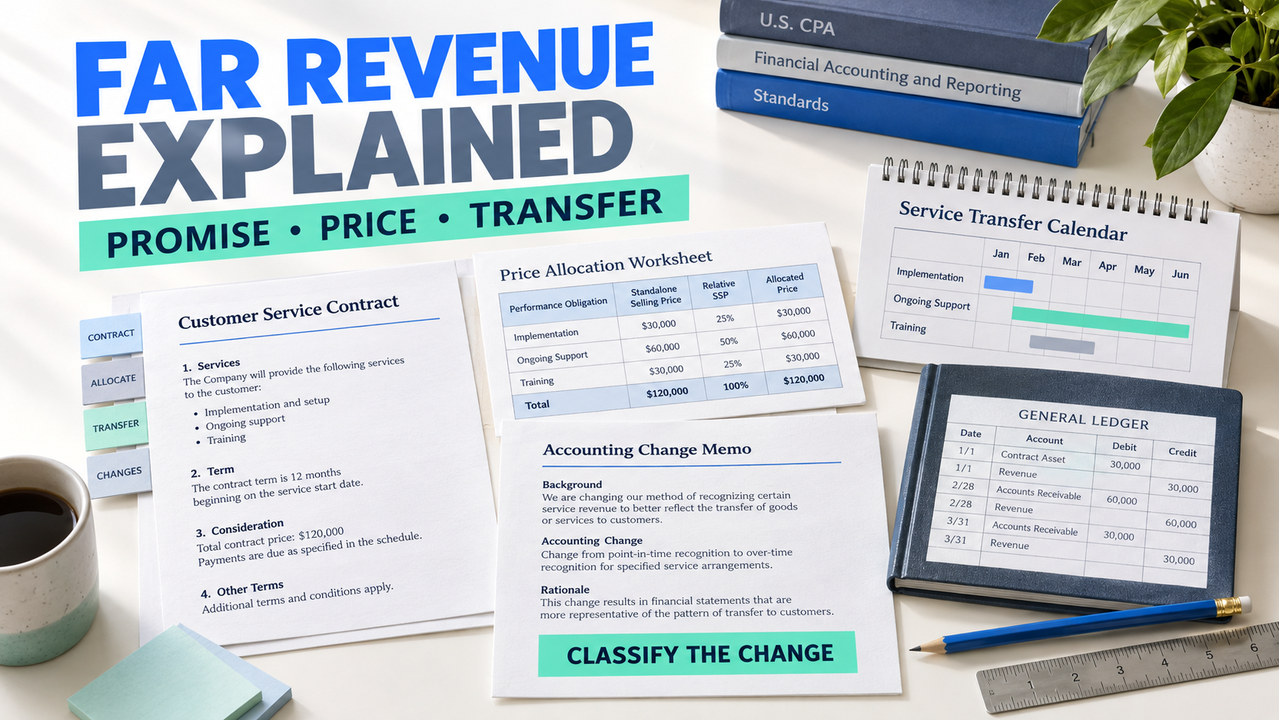

Direct answer: Revenue recognition explained starts with the promised transfer, not the invoice date. Identify the contract, identify what the customer receives, determine the transaction price, allocate that price when needed, and recognize revenue when the entity satisfies the obligation. Accounting changes are a separate question: decide whether the new fact is an estimate, a change in principle, or an error before choosing the treatment.
Editorial review note: Written by the CPA Exam Prep study-content team and reviewed for terminology, arithmetic, internal consistency, and learner usefulness. The examples, amounts, prompts, answers, distractors, and retry are original editorial practice, not official exam content.
This FAR explainer uses simplified facts so the reasoning stays visible. The current AICPA Blueprint and authoritative FASB guidance define the live boundary; this page gives you a reusable map and original cases. When the entity, contract, transition rule, or reporting date changes, reopen the current source. For wider study routing, visit the FAR review hub.
Revenue recognition explained in one five-field map
Write the five fields before you calculate. This simple order prevents three common substitutions: cash for revenue, a total invoice for an allocated price, and a billing event for a transfer event. It also gives you a clean place to stop when a fact is missing.
- Promise: What distinct good or service will the customer receive? A stand-ready service may satisfy the obligation over time, while a delivered good may transfer at a point in time under the stated facts.
- Price: What consideration belongs in the transaction price? Separate fixed consideration from any variable amount or financing feature given in the question. Do not invent a bonus, refund, or constraint.
- Allocate: Does the arrangement contain more than one performance obligation? When the question supplies standalone selling prices, add them first and allocate the transaction price by the relative ratio.
- Transfer: What evidence shows that the customer received the promised value? A service calendar, delivery record, acceptance term, or other stated fact can control the timing.
- Check: Does the answer explain both the amount and the reason? Reconcile earned revenue, cash collected, and any remaining contract liability before you move on.
The map is a study routine, not a replacement for the current Codification. It is useful because it forces you to name the controlling fact. If the question gives a twelve-month stand-ready service and a reporting date after four months, the service calendar is more important than the date of the invoice. If it gives a bundle, the standalone prices matter before the service calendar does.

Revenue recognition explained: start with the promised good or service
A customer can pay before receiving the promised service. In that situation, the entity may record cash and a contract liability on receipt. As the entity provides the service, the entity can release part of that liability to revenue. The same cash balance can therefore coexist with earned revenue and a remaining liability that change over time. When the prompt asks for revenue at a reporting date, begin with what the customer has received by that date.
Use a three-line scratchpad: cash collected, service transferred, and liability remaining. Add a fourth line whenever a bundle requires an allocation ratio. A short “because the customer received…” sentence is a useful check against treating an invoice label as the answer.
Revenue recognition explained: keep price allocation before timing
Suppose a machine and maintenance are sold together. First total the standalone selling prices. Next, divide each standalone price by that total and multiply by the transaction price. Only then ask when the machine and maintenance transfer. Recognition timing cannot repair a wrong allocation. Conversely, a correct allocation does not tell you that the customer received every obligation on the invoice date.
Revenue recognition explained: use the source boundary
These examples are intentionally narrow. They do not decide variable consideration, significant financing components, contract modifications, unusual licenses, tax effects, or an entity-specific transition issue. When one of those facts appears, mark the question “source boundary” and consult current authoritative guidance. That habit is part of revenue recognition explained: a good answer states what the simplified facts do and do not establish.
FAR revenue recognition and accounting changes explained: the distinction
Revenue recognition asks when did the customer receive the promised value? Accounting-change analysis asks why did the reported amount or method change? Those questions can share a study session, but they use different controlling facts.
Revenue recognition is a transfer question
For a service, divide the stated transaction price by the stated service period when the facts support a straight-line pattern, then multiply by the months or units delivered. For a point-in-time good, use the transfer evidence the prompt supplies. A prepayment is not automatically revenue, and a completed service is not made unearned merely because the customer paid earlier.
Accounting changes are a reason-for-change question
New information about an amount or timing generally points to an estimate lane under the stated facts. A move from one acceptable accounting principle to another belongs in a principle-change lane and may have a prescribed transition or retrospective requirement. Information that was available but omitted or misapplied belongs in an error lane; materiality and correction effects then require the applicable current guidance. The classification is not decided by whether the number got bigger or smaller.
Run the three-word lane test
Write one of three labels beside the fact: new information, new principle, or missed information. “New information” is the estimate signal. “New principle” means read the applicable transition instruction. “Missed information” means analyze error correction. If the prompt is unclear, do not hide the uncertainty behind a confident journal entry; state the missing fact and the source you would reopen.
Original revenue recognition and accounting-change practice set
Try each case before opening the reveal. Read the fact pattern once, underline the date or reason that controls the answer, and write the equation or classification in your own words. We include the nearest distractor because it shows which shortcut the case is designed to expose.
Case 1 — Harborline support timing
Original practice prompt: Harborline Support collects $48,000 on January 1 for twelve months of stand-ready support. The service pattern is even, and the reporting date is April 30 after four months of service. How much revenue has Harborline earned, and what remains before considering other facts?
Reveal Case 1 answer and reasoning
Answer: Earned revenue is $16,000 ($48,000 ÷ 12 × 4). The remaining contract liability is $32,000 under the simplified facts. The controlling fact is four months of support delivered, not the January cash receipt. The nearest distractor is $48,000 because it treats collection as completion. Repair verb: separate.
Case 2 — Summit bundled allocation
Original practice prompt: Summit sells equipment and six months of service for a combined invoice of $150,000. The standalone selling prices are equipment $120,000 and service $60,000. Three months of service have elapsed, and the equipment transferred at the start. Allocate the transaction price and identify the service amount earned so far.
Reveal Case 2 answer and reasoning
Answer: Total standalone selling price is $180,000. Equipment receives 120/180 of the transaction price, or $100,000. Service receives 60/180, or $50,000. Three of six service months earns $25,000, leaving $25,000 for the remaining service period. The nearest distractor uses the invoice label or records all $150,000 as equipment revenue. Repair verb: allocate, then apply the transfer schedule.
Case 3 — Oakridge revised estimate
Original practice prompt: Oakridge has an asset with a $90,000 carrying amount at the start of Year 4. New production evidence indicates that the remaining useful life is five years. Ignore residual value and other complications. What is the current-year depreciation under the simplified facts, and should the learner rewrite earlier periods just because the estimate changed?
Reveal Case 3 answer and reasoning
Answer: Current-year depreciation is $18,000 ($90,000 ÷ 5). The stated trigger is new information about the remaining life, so do not restate earlier periods merely because the estimate changed; apply the current and future effect under the applicable guidance. The nearest distractor keeps the old life or treats every changed number as an error. Repair verb: classify.
Case 4 — Willow principle or error
Original practice prompt: Willow Retail moves from one acceptable inventory-costing principle to another. In a separate fact, the team had a prior-year invoice before the financial statements were issued but omitted it from the records. What lane should each fact enter before the entity researches the transition or correction details?
Reveal Case 4 answer and reasoning
Answer: The move between acceptable principles is a change in accounting principle; follow the applicable transition and disclosure guidance. The omitted available invoice is a prior-period error; if material, analyze correction and comparative-period effects under current guidance. Neither fact is automatically an estimate just because a reported amount changes. Repair verb: classify, then reopen the relevant source.
Case 5 — Keep a local practice result bounded
Original practice prompt: A learner gets four of five original cases correct after one review session and asks whether the result proves readiness for the live CPA Exam. What can the result support, and what can it not support?
Reveal Case 5 answer and reasoning
Answer: The result supports a local study signal: the learner should inspect the one missed decision and choose the next review block. It does not predict a live score, establish official readiness, or replace the current Blueprint and broader practice. The nearest distractor converts a tiny editorial sample into a promise. Repair verb: bound.

Review revenue recognition explained by the first broken lane
Do not turn the five-case set into a single pass-or-fail label. Find the first broken decision. Case 1 usually means the learner merged cash and transfer. For Case 2, the learner usually skipped the allocation ratio. In Case 3, the learner usually mislabeled new information as an error. With Case 4, the learner usually failed to separate the reason for change. When Case 5 is missed, the conclusion usually outruns the evidence.
Record the case, confidence before the reveal, controlling fact, first broken field, repair verb, and next ten-minute review block. This is a local study aid, not an official score or readiness prediction.
Retry revenue recognition explained after one changed transfer fact
Now change only one Harborline fact: by September 30, the entity has delivered nine months of the twelve-month support service instead of four months by April 30. Keep the $48,000 payment, even service pattern, and all other assumptions fixed. Which amounts change, and which boundary remains the same?
Earned revenue becomes $36,000 ($48,000 ÷ 12 × 9), and the remaining contract liability becomes $12,000. The unchanged conclusion is that cash collected before the entity provides the service is not automatically revenue. A controlled retry changes the transfer fact, recalculates the result, and leaves the classification logic intact.
Revenue recognition explained: FAQ
When do I allocate the transaction price?
Allocate before applying the recognition timing for each performance obligation when the facts give multiple obligations and standalone selling prices. The ratio answers “how much belongs to each obligation”; the transfer evidence answers “when is that amount recognized?”
How do I separate an estimate, a principle change, and an error?
Start with the reason, not the size of the number. New information points toward estimate analysis. A switch between acceptable principles points toward principle-change guidance. Information that was available but omitted or misapplied points toward error analysis. Then read the current transition, materiality, and correction requirements.
What should I do when the prompt crosses the source boundary?
Write down the missing fact, preserve the simplified calculation separately, and reopen current authoritative guidance. Contract modifications, variable consideration, unusual transfer terms, and entity-specific transition rules deserve that pause.
What does a practice result prove?
It can show which decision needs another review block. It cannot prove a live exam outcome or official readiness. Use the result to improve the next action, then test the same skill with a changed fact.
Revenue recognition explained: sources and refresh note
Current tested-content boundary: AICPA CPA Exam Blueprints. Format boundary: AICPA sample tests. Revenue framework background: FASB Revenue Recognition project summary. Technical refresh: FASB Accounting Standards Codification. Candidate-process routing: NASBA CPA Exam FAQ. The team checked these pages September 23, 2026. Reopen current guidance when a contract, entity, transition method, reporting date, or reason for change differs. The cases, formulas, answers, distractors, visuals, and retry are original editorial study content.