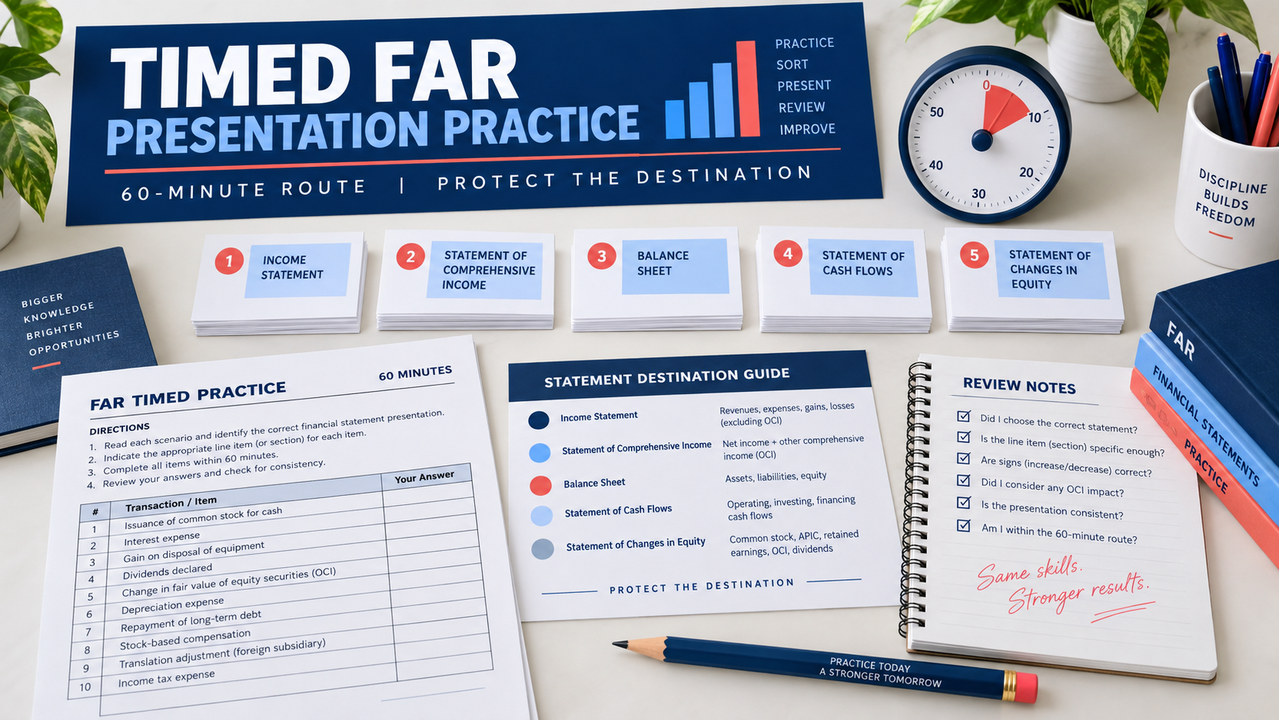

Timed FAR financial statement presentation practice works best when the clock measures a decision path, not just the number of questions you touched. Use a 60-minute block to name the task verb, protect the controlling fact, route the result to the right statement destination, reject the nearest distractor, and retry one changed fact.
Quick answer: reserve five minutes for scope and setup, fifteen minutes for a focused presentation lane, twenty minutes for original checks, ten minutes for distractor review, and ten minutes for a changed-fact retry. Stop the timer after each lane and record where the route slowed. This page uses original editorial practice items, not released or provider-owned CPA Exam questions.
Assumptions and difficulty: the examples use simplified U.S. GAAP facts, no unusual tax effects, and no hidden scope exceptions. Difficulty is moderate: the arithmetic is light, but each question changes the destination, disclosure path, or evidence you must defend. When a fact adds materiality, tax, effective-date, industry, or alternative-presentation complications, reopen the applicable current Codification topic.
For broader preparation context, continue with our CPA Exam FAR review hub. Use this page when you want a bounded practice block with a clear repair action.
What timed FAR financial statement presentation practice is testing
This drill tests whether you can preserve a presentation route while the clock is running. You are not trying to recite every rule in the FAR section. You are showing that you can move from a prompt to a defensible destination:
- Read: restate the requested action: classify, present, calculate, correct, or disclose.
- Anchor: mark the date, amount, status, cash movement, obligation, or disposal fact that controls the result.
- Route: name the statement, line, subtotal, cash-flow category, component presentation, or note.
- Check: write why the closest answer fails because it ignores or changes the controlling fact.
The current AICPA Blueprint is the boundary for task statements and test format, not a promise that a particular item will appear. The official sample test is useful for software familiarity, but it is not a scored readiness determination. The timed block below gives you a repeatable topic-level measurement.
Run a 60-minute timed FAR presentation block
Use one timer and one sheet. Do not pause the clock to look up every uncertainty. Write a question mark beside the fact you need to verify, finish the route, and use the review lane to reopen the source. That keeps the timing evidence honest.
- Minutes 0–5 — scope: write the exact task verb and the presentation skill you are testing. List the current source topic you will reopen if a simplified fact no longer applies.
- Minutes 5–20 — first-pass route: work one short presentation fact pattern. Mark the controlling fact before you choose a statement destination. If the route is unclear after two minutes, flag it and continue.
- Minutes 20–40 — original checks: attempt the three questions below without opening the answer reveal. Record the destination and the nearest distractor for each one.
- Minutes 40–50 — distractor review: compare your choice with the controlling fact. Label the miss as read, anchor, route, or check; do not only write “wrong.”
- Minutes 50–60 — changed-fact retry: change one fact in the slowest question. Recompute only the linked conclusion and state whether the destination moved.
If you finish early, do not fill the remaining minutes with random volume. Use them to write one proof sentence: “Because ___, the result belongs in ___ rather than ___.” A short explanation exposes a destination error faster than another answer letter.
Build a timing card before the first question
Put the five lanes where you can see them. The card is a pacing guardrail, not a promise that every question deserves the same number of seconds.

- Scope: write the task verb and the source boundary.
- Route: protect one controlling fact and name the destination.
- Attempt: answer the original check before reading its rationale.
- Review: identify the nearest distractor and the fact it ignored.
- Retry: change one fact and compare the old and new destination.
At the 30-minute checkpoint, ask only one question: “Do I know what fact controls this route?” If the answer is no, do not spend the rest of the block chasing speed. Keep the next lane narrow enough to repair the anchor.
Attempt three original presentation checks before revealing answers
These are original editorial practice items. Use a two-pass rule: choose an answer and write the destination on the first pass; on the second pass, test whether the choice preserves the fact the prompt emphasized.
Check 1: debt due shortly after the reporting date
Original practice item: A company reports a $240,000 note payable due in eight months after year-end. Under the simplified facts, it has no unconditional right to defer settlement beyond twelve months, and no refinancing fact is supplied. What should you test first?
- Use the original five-year issuance term and present the full note as long-term.
- Start with the applicable current-liability guidance because the reporting-date rights and settlement horizon control the route.
- Present the note in revenue because the borrowing supported operations.
- Ignore the note because the payment occurs after year-end.
Reveal the answer, distractor, and next action
Answer: B. The controlling facts are the reporting-date settlement horizon and the rights available at that date. Under the simplified facts, the current-versus-noncurrent route must be tested through the applicable current guidance.
Nearest distractor: A preserves the original issuance label while skipping the reporting-date facts. Next action: change the fact so an enforceable right to defer settlement exists, then reopen current literature before deciding whether the destination changes.
Check 2: noncash asset and liability recognition
Original practice item: A company records a right-of-use asset and lease liability when a lease begins. No cash is paid at commencement, and no business combination is involved. Which presentation question should you ask first?
- Report the full asset and liability as an operating cash outflow because the lease has a cost.
- Trace the noncash recognition and required supplemental cash-flow disclosure before classifying later cash payments.
- Record the right-of-use asset as revenue because it creates an economic resource.
- Ignore the event because no cash moved at commencement.
Reveal the answer, distractor, and next action
Answer: B. The anchor is the absence of cash at commencement alongside recognition of the asset and liability. The route begins with the noncash event and its applicable supplemental disclosure; later cash payments require their own analysis.
Nearest distractor: A converts a noncash recognition into a cash event that did not occur. Next action: add a commencement payment as the changed fact and separate the cash piece from the noncash piece.
Check 3: a component disposal and presentation path
Original practice item: A company sells a component that satisfies the simplified criteria stated in the prompt for separate disposal presentation. What should you protect before analyzing the gain?
- Put every historical amount into ordinary operating revenue because cash was received.
- Establish the applicable discontinued-operation presentation and disclosure path before analyzing the gain.
- Classify the proceeds as a financing inflow because the component was funded with debt.
- Move the component directly to retained earnings without statement presentation.
Reveal the answer, distractor, and next action
Answer: B. The stated disposal criterion is the controlling fact. Set the presentation and disclosure scope before routing the gain or proceeds. The current literature must be reopened for the exact definition, measurement, and disclosure details.
Nearest distractor: A treats proceeds as ordinary revenue and skips the component-level presentation decision. Next action: remove the stated criterion and compare the remaining presentation path.
Use a two-pass rule when the clock is tight
On the first pass, write only four fields: task verb, controlling fact, destination, and nearest distractor. Do not draft a full rationale while the timer is moving. On the second pass, complete the proof sentence and cite the current topic you need to reopen.
- Read problem: you cannot restate what the question asks in plain language. Slow the first 30 seconds and underline the verb.
- Anchor problem: you know the verb but keep returning to a familiar number. Circle the date, status, cash movement, or obligation that changed the route.
- Route problem: you identified the fact but named the wrong statement or category. Write the destination before you read the options again.
- Check problem: your conclusion is plausible but you cannot reject the nearest distractor. Write the fact the distractor ignores.
This classification prevents a slow explanation from being mistaken for a knowledge gap. A route that is correct but poorly timed may need a shorter explanation drill; a route that changes when one fact changes needs technical source review.
Score timed FAR financial statement presentation practice without guessing
Do not turn the block into a percentage that pretends to predict an official result. Record three pieces of evidence: attempted items, correct without notes, and minutes spent in the slowest lane. The next block should respond to the slowest lane, not simply add more questions.
Example: if you attempted three checks, answered two without notes, and spent eight of the ten review minutes on destination confusion, your next block is not “do ten more.” It is a 20-minute route drill with two changed-fact comparisons focused on the destination.
Repair the slowest step in timed financial statement presentation practice
Keep every unchanged fact visible during the retry. Change one fact, recompute only the linked conclusion, and compare the old and new destinations. If the destination does not move, explain why; if it moves, name the fact that caused the movement.

Use the retry to choose the next block:
- Read broke: take a 10-minute verb-and-destination drill.
- Anchor broke: take a 20-minute fact-change drill and mark the controlling date or status.
- Route broke: reopen the current topic and work two destination comparisons.
- Check broke: write three distractor rejections without increasing question volume.
Use timed FAR financial statement presentation practice to choose the next block
Repeat the 20-minute version when the same step breaks twice. Move to a 40-minute version when you can state the route but need more varied facts. Use the full 60-minute block when you can finish the route, explain the distractor, and make a one-fact prediction without notes.
- I can restate the task verb before reading the answer choices.
- I can point to the fact that controls timing, amount, classification, or disclosure.
- I can name the statement, line, category, section, or note before writing the rationale.
- I can reject the nearest distractor in one sentence.
- I can change one fact and predict whether the destination moves.
- I know which current source topic I must reopen when the simplified facts no longer apply.
When one statement is false, keep the next block narrow. Timing improves when every minute has a diagnostic purpose.
Refresh official sources before you expand
The AICPA CPA Exam Blueprints page is the current scope source for task statements, testlet context, item types, and weighting. The AICPA sample-test resource is for software and format rehearsal; it is not a scored readiness measure. The FASB Accounting Standards Codification is the technical source to reopen for the applicable presentation and disclosure topic. The NASBA CPA Exam FAQ is a separate exam-process reference.
This timed route and all practice items are original editorial study content. They do not replace current source literature or promise an official score. Before you expand the question set, save the slowest lane, the controlling fact, the destination, the rejected distractor, and the changed-fact retry.