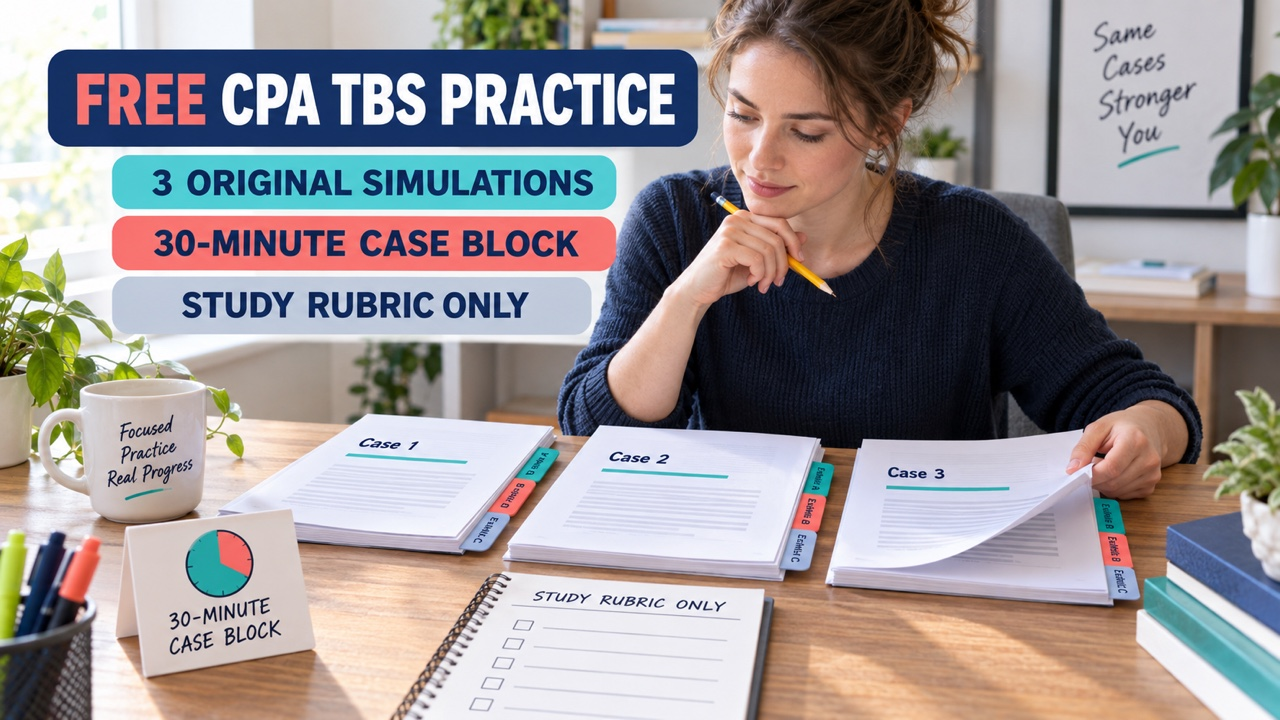

Quick answer: in practice, this free cpa tbs practice page gives you three original task-based simulation cases with compact exhibits, a response instruction, delayed rationales, and a review action. It is editorial practice, not official AICPA content, an official score, or a readiness prediction.
First, keep the source boundary clear. The current AICPA Blueprints organize each section by Area, Group, and Topic, describe sample task statements and skills, and place task-based simulations in the third through fifth testlets. In contrast, the cases below are a small study block that teaches how to read a requirement and use evidence.
Therefore, plan for about 30 minutes: ten minutes per case, with the answer reveal closed until you have written a response. Checked September 16, 2026. Reopen the live AICPA Blueprint before relying on current section names or dates.
Free CPA TBS Practice: What You Get
In short, you get three original TBS-style cases for AUD, FAR, and REG. Each case states the skill, assumptions, difficulty, exhibits, and the requested response. Then, the rationale shows which exhibit matters, what the key logic is, why a tempting path fails, and what to do next.
Just as important, this is not an answer-only worksheet. For this reason, a useful task-based simulation practice session asks you to build a response from the requirement and the evidence. You may need to classify, calculate, reconcile, or explain. Record what you used so that a wrong answer becomes a diagnosis rather than a score you forget.
- Three original cases: one short fact pattern each for AUD, FAR, and REG.
- Exhibit-first practice: identify the requirement and use only the facts that support it.
- Delayed feedback: attempt the response before opening the rationale.
- Next-action review: repair the first weak step and retry with changed facts.
How to Use This Free CPA TBS Practice in 30 Minutes
To begin, set a 30-minute timer and reserve about ten minutes for each case. Next, keep a note with five fields: case number, requirement, exhibit used, response, and confidence. During the attempt, do not search for a definition or open the reveal. Thus, you can see whether the obstacle is content knowledge, evidence selection, arithmetic, or response format.
- Read the requirement: underline the verb and the requested output before reading every detail.
- Sort the exhibits: mark the document, number, date, or fact that can change the response.
- Map the facts: write a short chain from the exhibit to the rule, calculation, or conclusion.
- Build the response: follow the requested unit, category, explanation, or format.
- Check support: verify the arithmetic, the sign, the date, and the exhibit that supports your answer.
Meanwhile, the AICPA sample test is designed to help candidates become familiar with Exam software. This 30-minute block is an editorial study routine; it is not an official TBS time limit or a substitute for current official guidance.

Free CPA TBS Practice: 3 Original Simulations
For clarity, these are original practice items, not AICPA questions, copied questions, or vendor material. The section labels are scope cues based on the current AICPA Blueprint. First attempt each case in the requested format. Then open the reveal and compare the evidence path, not just the final result.
1. AUD: Match Subsequent Cash to the Assertion
Tested skill: match a later cash receipt to the assertion being tested. Assumptions: in this case, the audit team is testing the existence of a $42,000 year-end receivable from Northstar on December 31. Northstar paid $30,000 on January 18, and the remittance advice identifies the invoice balance. Ignore collectibility and all other customers. Difficulty: foundational application.
Exhibit A — customer ledger: December 31 balance: $42,000; January 18 receipt: $30,000; remittance advice: invoice 4817.
Response task: name the best evidence step and state why it addresses existence. Write one sentence before opening the reveal.
Reveal answer and reasoning
Answer: inspect the January 18 receipt and trace it to invoice 4817 and the recorded December 31 receivable. The later cash provides evidence that at least the paid portion was real at year-end, and the remittance advice connects the receipt to the recorded balance. However, a customer inquiry alone would be weaker because it is not corroborated by the cash and invoice trail. Next action: on a new case, write the assertion first and then name the document that most directly supports it.
2. FAR: Reconcile the Bank Balance
Tested skill: reconcile an ending bank balance to adjusted cash. Assumptions: in this case, the bank statement shows $18,400. Outstanding checks total $2,100. A deposit in transit is $3,000. The bank collected a note for $900 for the company and charged a $40 service fee. The book balance before adjustments is $19,200. Ignore taxes and every other item. Difficulty: foundational application.
Exhibit B — reconciliation facts: bank balance $18,400; add deposit in transit $3,000; subtract outstanding checks $2,100; add note collection $900 to books; subtract bank fee $40 from books; book balance before adjustments $19,200.
Response task: give the adjusted cash balance and list the two book-side adjustments. Show your arithmetic so the unit and sign can be checked.
Reveal answer and reasoning
Answer: adjusted cash is $19,300. First, the bank side is $18,400 + $3,000 − $2,100 = $19,300. Next, the book-side adjustments are add the $900 note collection and subtract the $40 fee, so $19,200 + $900 − $40 = $20,060; that does not agree with the bank-side amount. However, the fact pattern exposes a missing book-side item: the deposit in transit and outstanding checks belong only on the bank side, but the supplied book balance is inconsistent with the bank evidence under the stated assumptions. A defensible TBS response should flag the inconsistency instead of forcing agreement. Next action: when two sides do not tie, label each fact as bank-side, book-side, or unresolved before changing a number.
3. REG: Compute Adjusted Basis from the Stated Recovery
Tested skill: separate original basis, recovery, and adjusted basis. Assumptions: in this case, equipment has an initial basis of $48,000. The only stated recovery adjustment is $9,600 of depreciation. Ignore disposition, recapture, improvements, and all other tax facts. Difficulty: foundational calculation.
Exhibit C — asset record: initial basis $48,000; stated depreciation recovery $9,600; other adjustments: none for this exercise.
Response task: calculate the adjusted basis immediately after the stated recovery and label each input in your work.
Reveal answer and reasoning
Answer: adjusted basis is $38,400. Start with the initial basis of $48,000 and subtract the stated $9,600 depreciation recovery: $48,000 − $9,600 = $38,400. The tempting error is to report $9,600 as the basis or add it to $48,000; both choices confuse the adjustment with the remaining amount. Next action: write “original basis − recovery = adjusted basis” before solving a new basis case with different values.
Check Your TBS Response Without a Fake Pass Line
After the attempt, do not reduce the whole session to a percentage. First ask whether your response answered the requested verb. Next, check whether each important step is supported by an exhibit. Finally, verify the arithmetic, units, signs, and response format. The rubric below is an original study rule for this page only; it is not a scaled score, passing standard, official result, or readiness determination.
| Completed checks | Study reading | Next action |
|---|---|---|
| 0–1 of 4 | Rebuild the requirement-to-exhibit chain. | Review one case untimed and write the requested output first. |
| 2 of 4 | The evidence path is partly working; isolate the weak check. | Repair one error category and retry a changed fact pattern. |
| 3–4 of 4 | Test transfer, clarity, and pacing rather than claiming readiness. | Use a new case and keep a one-line evidence trail for every conclusion. |
TBS Response QA: Repair the Cause of a Miss
First, before taking another mixed set, classify the first weak response. A requirement-reading miss means you answered a different verb or output. An exhibit-selection miss means you used a true fact that did not support the requested conclusion. A calculation miss means the rule was clear but the sign, unit, or order was wrong. A response-format miss means the work was plausible but did not follow the requested category, explanation, or unit.
For example, the AUD case is an exhibit-selection miss if you choose inquiry instead of tracing the later receipt to the recorded invoice. The FAR case is a calculation or evidence-reconciliation miss if you change a bank-side item to make inconsistent facts agree. The REG case is a calculation miss if you report the recovery instead of the remaining basis. As a result, the next action should repair the cause rather than repeat the same numbers.

Then write one sentence that would prevent the error: “Before calculating, label the fact as bank-side, book-side, or unresolved.” Finally, choose a new case that tests the same skill with a different amount, date, assertion, or response format. That makes free CPA TBS practice useful beyond a single answer reveal.
Free CPA TBS Practice vs. the AICPA Sample Test
These resources can sit in the same study plan, but they answer different questions. The AICPA sample test is an official software-familiarization resource. AICPA describes it as a shorter version, says learners can see correct answers, and states that it is not scored or a readiness determination. It covers the current AUD, FAR, REG, ISC, BAR, and TCP labels.
By comparison, this free CPA TBS practice page is a small content-and-reasoning check. Its three cases, 30-minute timer, exhibit map, response rubric, and error queue are editorial choices. They help you decide what to review next; they do not reproduce official questions, simulate official scoring, or replace the current Blueprint.
If you also need to learn the official interface, use the AICPA sample test guide on this site and verify the live AICPA instructions. Keep eligibility, application, score reporting, and jurisdiction rules with NASBA, the applicable state board, and the relevant official AICPA resource.
What to Do After This Free CPA TBS Practice
After the review, schedule one purposeful block rather than reacting to the final count alone. When you have a requirement-reading miss, rewrite the verb and requested output for two new cases. Next, for an exhibit-selection miss, build a two-column evidence map. For a calculation miss, write the formula and unit before inserting values. Finally, for a response-format miss, copy the requested response shape into your notes before solving.
- 0–1 checks: complete one case untimed and rebuild the requirement-to-exhibit chain.
- 2 checks: repair one error category, then retry with a changed fact pattern.
- 3–4 checks: test transfer and pacing; do not call the result official readiness.
In other words, a useful free CPA TBS practice session ends with a better next case. Record the date, case, response format, exhibit used, error category, source reviewed, and retry date. Also, use the current AICPA Blueprints when you need to verify scope.
FAQ: Free CPA TBS Practice
Did AICPA write these TBS cases?
No. These are original practice cases written for this page. The AICPA sample test is the official software-familiarization resource, but this page does not reproduce its questions or imply access to confidential or restricted items.
Is this a full TBS or a full CPA Exam simulation?
No. It is a short three-case editorial block. The exhibits and explanations teach a repeatable evidence path; they do not recreate the official interface, item inventory, scoring model, or section timing.
How long should I spend on the cases?
For the first pass, use 30 minutes, or roughly ten minutes per case. That timer is an editorial study method. Change it only after you record whether the problem was requirement reading, exhibit selection, calculation, or response format.
Where can I verify current CPA Exam scope?
Finally, use the current AICPA CPA Exam Blueprints for tested areas, task statements, skills, item types, and weighting. Use NASBA and the applicable jurisdiction for eligibility, application, and score-reporting questions.
Sources and Originality Note
Checked September 16, 2026. AICPA and NASBA sources establish the official boundaries described on this page. By contrast, the three cases, exhibits, values, response instructions, calculations, explanations, study rubric, error taxonomy, timer, and review queue are independently authored editorial practice material.
- AICPA: Learn what to study for the CPA Exam and current Blueprints
- AICPA: Practice for the CPA Exam with Sample Tests
- AICPA: CPA Exam FAQ
- NASBA: CPA Exam process and candidate resources
Semrush US volume, difficulty, and intent were not individually refreshed. Keep this page in draft; refresh row-level data and official links before publication.