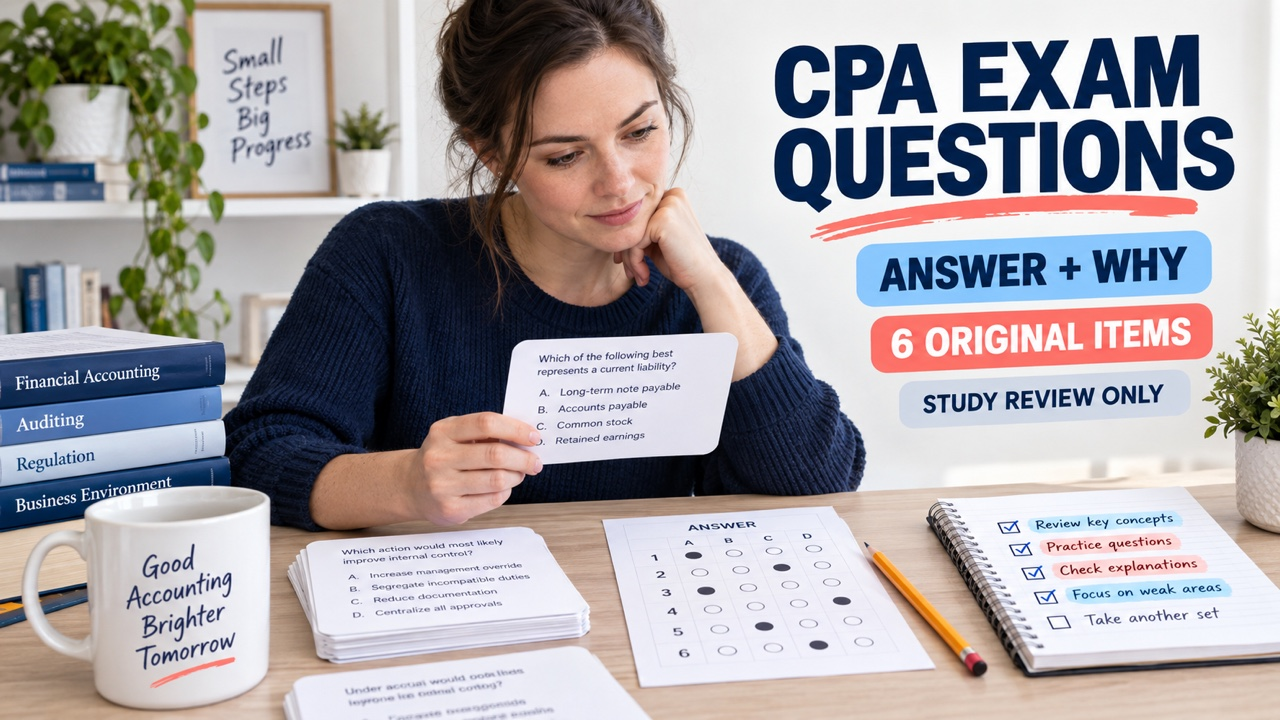

Quick answer: useful cpa exam questions and answers should give you a real attempt, a clear answer reveal, the reason the answer works, the important wrong path, and a next review action. Additionally, this page gives you six original practice items across AUD, FAR, REG, BAR, ISC, and TCP. Moreover, it is independent study material, not official AICPA content, an official score, or a readiness prediction.
First, the current AICPA Blueprints organize sections by Area, Group, and Topic, list AUD, FAR, REG, BAR, ISC, and TCP, and describe five testlets: the first two contain MCQs and the next three contain TBSs. Therefore, those facts establish scope; the questions below are independently authored practice. Finally, this draft was checked September 16, 2026; reopen the live AICPA pages before relying on a current label or date.
CPA Exam Questions and Answers: What This Set Does
In short, this is a six-question answer-rationale guide. Next, each item starts with a tested skill, assumptions, difficulty, and a response task. You get a chance to write your answer before opening the reveal. Then the explanation identifies the supporting fact or calculation, explains why a tempting distractor fails, and gives you one concrete next action.
However, an answer key can tell you that an option is wrong without showing where your reasoning changed direction. Therefore, the goal here is to notice whether the first miss came from reading the ask, recalling a rule, selecting evidence, calculating, or following the requested format.
- Original items: six short fact patterns with no claim that they came from AICPA or a vendor.
- Answer after attempt: keep each reveal closed until you have written a response.
- Distractor review: compare your path with the most plausible wrong path, not only the final answer.
- Next action: turn the first weak step into a targeted review and a changed-fact retry.
How to Use CPA Exam Questions and Answers
First, set aside about 35 minutes for the first pass, or roughly five minutes per item plus review. Next, note the question number, requested output, fact or formula, answer, and confidence. Finally, keep each reveal closed during the attempt so you can separate a knowledge gap from a process mistake.
- Read the ask: circle the requested verb, unit, assertion, direction, or control response.
- Label the facts: mark the amount, date, account, role, or condition that can change the answer.
- Choose the answer: write the option or conclusion and a one-line reason before checking.
- Explain the distractor: identify the fact that makes the most tempting wrong path fail.
- Plan the retry: choose one source, rule, worked example, or changed fact pattern for review.
Together, the sequence mixes calculation, evidence, interpretation, and control judgment. Therefore, it is a small diagnostic set, not official weighting; use the current AICPA Blueprint for task statements.
For clarity, write the answer on one line and the reason on the next. Moreover, compare both lines with the reveal. Therefore, your review log preserves the reasoning step, not only the final choice.

CPA Exam Questions and Answers: 6 Original Items
First, every question below is original practice written for this page. Also, the stated assumptions are part of the item, so do not add a fact that is not supplied. Next, write your answer in the requested form. Then open the reveal and compare the reasoning path.
1. AUD: Match Subsequent Cash to the Assertion
Tested skill: match later cash evidence to an assertion. Assumptions: for this item, the audit team tests a $42,000 Northstar receivable at December 31. Northstar paid $30,000 on January 18, and remittance advice identifies invoice 4817. Ignore collectibility and other customers. Difficulty: foundational application.
Original practice item: which evidence step best supports the paid portion, and why? Write one sentence first.
Reveal answer and reasoning
Answer: therefore, inspect the January 18 receipt and trace it to invoice 4817 and the recorded receivable. Thus, the cash and remittance connect the payment to the invoice, supporting that at least the paid portion existed at year-end. By contrast, a customer inquiry is the distractor: it is not as directly corroborated by the receipt and invoice trail. Next action: write the assertion first, then name its strongest supporting document.
2. FAR: Reconcile the Bank Balance
Tested skill: separate bank-side items from book-side adjustments. Assumptions: for this item, the bank balance is $18,400; the deposit in transit is $3,000; outstanding checks are $2,100; a note collected is $900; the service fee is $40; and the book balance before adjustments is $18,440. Ignore all other items. Difficulty: foundational calculation.
Original practice item: give adjusted cash and the two book-side adjustments. Show the signs.
Reveal answer and reasoning
Answer: adjusted cash is $19,300. On the bank side, $18,400 + $3,000 − $2,100 = $19,300. On the book side, $18,440 + $900 − $40 = $19,300. Next, add the note collection and subtract the fee. However, the distractor is adding the deposit in transit to the books; the company already recorded it, so it belongs on the bank side. Next action: label every new fact bank-side, book-side, or already recorded.
3. REG: Calculate Adjusted Basis After Stated Recovery
Tested skill: distinguish original basis, recovery, and adjusted basis. Assumptions: for this item, equipment has an initial basis of $48,000 and the only recovery adjustment is $9,600 depreciation. Ignore disposition, recapture, improvements, and other tax facts. Difficulty: foundational calculation.
Original practice item: calculate adjusted basis after the stated recovery and label the inputs.
Reveal answer and reasoning
Answer: therefore, $38,400: $48,000 original basis − $9,600 recovery. The distractor is reporting $9,600 or adding it to $48,000; that confuses the adjustment with the remaining basis. Finally, write “original basis − recovery = adjusted basis” before solving a new case.
4. BAR: Interpret the Direction of a Revenue Variance
Tested skill: interpret variance direction. Assumptions: for this item, static-budget revenue is $80,000 and actual revenue is $76,000. Ignore costs, volume effects, and other variances. Difficulty: foundational application.
Original practice item: state the revenue variance and whether it is favorable or unfavorable. Do not calculate net result.
Reveal answer and reasoning
Answer: $4,000 unfavorable: $76,000 − $80,000 = −$4,000, so actual revenue is below budget. By contrast, the distractor calls it favorable because the absolute difference is positive; direction depends on the line item. Next action: write “actual minus budget” before interpreting a new variance.
5. ISC: Respond to an Active Former-Contractor Account
Tested skill: respond when access should have ended. Assumptions: in this case, a contractor’s engagement ended yesterday, but the account remains active with ordinary application access. Recent activity has not been reviewed. Ignore unsupported incident conclusions. Difficulty: foundational control judgment.
Original practice item: what should the control owner do first, and what follow-up belongs in the review?
Reveal answer and reasoning
Answer: first, disable the account, preserve the access record, and review activity after termination. As a result, this removes the current path while checking use. By contrast, changing only the password is the distractor: it may leave sessions, tokens, or entitlements and does not review activity. Next action: practice a new termination case by separating containment from evidence review.
6. TCP: Calculate Outside Basis After a Cash Contribution
Tested skill: update outside basis for a stated cash contribution. Assumptions: before this item, outside basis is $28,000 and the cash contribution is $5,000. No liabilities, distributions, income, losses, or other adjustments apply. Difficulty: foundational calculation.
Original practice item: what is the stated outside basis immediately afterward?
Reveal answer and reasoning
Answer: therefore, $33,000: $28,000 + $5,000. The distractor is $23,000, which subtracts the contribution instead of treating it as a stated basis increase. Next action: put the pre-transaction basis and each adjustment on separate lines.
Record Your Practice Result Without a Fake Pass Line
After the six attempts, count items where you selected the right answer and could explain the key fact or calculation. Consequently, use the band to choose what to do. Importantly, this is a study rule for this page only, not an AICPA score, passing standard, readiness determination, or predictor.
- 0–2 supported answers: review the ask and the governing idea, then retry two items untimed with the answer reveals closed.
- 3–4 supported answers: isolate the first error category and retry two changed fact patterns rather than rereading the entire section.
- 5–6 supported answers: test transfer with new amounts, dates, or control facts; do not convert this small set into an official readiness claim.
Review the Cause of Your First Miss
Before another mixed set, name the first weak step. A reading miss answers a different verb or output. A knowledge miss lacks the governing idea. An evidence miss uses a true fact that does not support the conclusion. A calculation miss has the wrong sign, unit, or order. A format miss does not follow the requested response shape.
For example, the AUD item can expose evidence selection; FAR, REG, BAR, and TCP can expose setup or sign errors; ISC can expose control judgment or reading. In addition, the label matters only if it changes the next action.
- Write the requested verb and output in your own words.
- Choose one source, rule, or worked example to review.
- Write one repair sentence, such as “Label the side of the reconciliation before adding an item.”
- Schedule a new item with a changed amount, date, role, or distractor.

CPA Exam Questions and Answers: What These Questions Cover
Specifically, these six labels are current-scope cues from the AICPA Blueprint page checked for this draft. However, one editorial item cannot represent a section or reproduce official weighting. Finally, use each cue to choose a follow-up review, then confirm scope in the live Blueprint.
- AUD: connect a later receipt to the assertion and the supporting invoice trail.
- FAR: separate bank-side reconciling items from book-side adjustments.
- REG: keep original basis, recovery, and adjusted basis distinct.
- BAR: interpret the direction of a single revenue variance.
- ISC: respond to a terminated user account and review access evidence.
- TCP: update outside basis from a stated cash contribution.
Therefore, coverage is a review starting point, not a claim about exact official facts or proportions.
CPA Exam Questions and Answers vs. the AICPA Sample Test
In contrast, the resources answer different needs. Meanwhile, the AICPA sample test is an official tool for learning CPA Exam software format and functionality. Also, AICPA describes it as shorter, says learners can see correct answers, and states that it is not scored or a readiness determination. It covers AUD, FAR, REG, ISC, BAR, and TCP.
By comparison, this page is a small content-and-reasoning set. Its six cases, reveals, distractors, study bands, and error queue are editorial choices; they do not reproduce official questions, simulate official scoring, or replace current guidance.
If you need interface familiarity, use the AICPA sample-test guide on this site and verify the live AICPA instructions. Meanwhile, keep eligibility, application, score reporting, and jurisdiction rules with NASBA, the applicable state board, and the relevant official AICPA resource.
CPA Exam Questions and Answers: What to Do After This Practice Set
Finally, start with the first miss. For reading, rewrite the requested output; for knowledge, review one rule; for evidence, make a fact-to-conclusion map; for calculation, write formula, sign, and unit; for format, copy the requested response shape.
Then, schedule one changed-fact retry in the next block. Change an amount, date, assertion, account, role, or distractor while keeping the skill constant. Record the source, repair sentence, and retry date.
FAQ: CPA Exam Questions and Answers
Did AICPA write these questions?
No. These six items are independently authored practice. AICPA pages provide scope and boundaries only; this page does not reproduce or imply access to restricted questions.
Does the result tell me whether I will pass?
No. The record is a study aid. It does not create an official score, passing standard, readiness prediction, or exam result.
How long should I spend on the questions?
Use about 35 minutes for the first pass, or roughly five minutes per item plus review. That is an editorial study method, not an official timing rule.
Where can I verify the current CPA Exam scope?
Finally, use the current AICPA CPA Exam Blueprints for areas, task statements, skills, item types, and weighting. Also, use AICPA’s official sample-test resource for software familiarity, and use NASBA or the applicable jurisdiction for process questions.
CPA Exam Questions and Answers: Sources and Originality Note
Checked September 16, 2026. For reference, the official pages below establish scope and process boundaries. By contrast, the six questions, assumptions, answer logic, distractors, study bands, error categories, and retry workflow are independently authored practice.
- AICPA: Learn what to study for the CPA Exam and current Blueprints
- AICPA: Practice for the CPA Exam with Sample Tests
- AICPA: CPA Exam FAQ
- NASBA: CPA Exam process and candidate resources
Semrush US volume, difficulty, and intent were not individually refreshed. Keep this article in draft until the row-level refresh and the remaining workflow gates are complete.